

Unit 6 – Investigative project
Learning aim - Undertake a literature search and review to produce an investigative project proposal.
A review of the chemistry experiment flame test.
The flame test is a procedure that scientists will use to determine what an unknown substance of a metal or metalloid ion is based on the
colour that the salt turns when it is placed under the blue flame of a Bunsen burner. The heat from the flame causes the electrons to emit a
visible light which changes the colour of the flame because once the substance is heated it excites the electrons from a metal ion resulting in a
different colour being shown. Every element emits a different colour on the emission spectrum which allows you to see the difference
between each element.
Equipment list:
• Bunsen Burner
• Dilute HCl
• Selection of compounds (powdered or solutions of)
• Flame test loop
• Safety mat
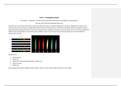
Each compound will create a different coloured flame. Some are more vibrant whereas others are more subtle.
, Li red
Na orange
K lilac (pink)
Rb red /violet
Cs blue /violet
Ca orangey red
Sr red
Ba pale green
Cu Blue / green
Pb greyish white
Hypothesis:
If the metal element is placed in the fire, then the colour of the fire will change based on the element that it is exposed to.
By finding out the colour of the metal salt I can then also complete a chemical test to find out the cations and anions. I will then use this
information to find out the unknown substances.
Information source 1.
The first source of information that I have chosen to help with this experiment is from the royal society of chemistry and is the worksheet
‘testing salts for cations and anions.’ The author of this is the Royal Society of Chemistry health and safety which was created in January 2018
and last updated in March 2018. A brief description of the information that this website gives me is that unknown substances will frequently
have to be identified by chemists so they will use a flame test as a straightforward way to do so. The flame test is used to find out cations and
anions from multiple salt solutions. A cation is a positively charged ion, (one that would be attracted to the cathode in electrolysis). And an
anion is an ion that is negatively charged. From what I have read so far, I believe that this is a reliable information source and will help me
conduct my experiment well.
To start of this information sheet explains to the learner everything that you will need to conduct this experiment in the correct way and
safely. Firstly, the learner is shown a table of results that they can use to record their results effectively. This is:
, Test Result of
Sample
performed test
(Royal Society of Chemistry health and safety, January 2018)
This table of results is an effective way to record all the information you will need to be able to make an accurate and well put together
evaluation of the experiment carried out. Next you are given a small but effective method as to how you would carry out the experiment. This
method is:
1. Use deionised water (5-10cm3) to dissolve the unknown substance.
2. Test small portions using the analysis table.
3. Repeat for all the other substances.
The student is then advised that safety precautions will need to be put in place, so you must PPE (Personal Protective Equipment). This
includes eye protection goggles as some of the unknown substances could be toxic, and/or corrosive therefore would cause either a minor or
serious harm. You must also wear a lab coat and gloves to keep yourself safe. The source then goes onto explain that there are three tests that
you must carry out for anions, and for cations there are two tests to be carried out. The tests for both are put into tables, so firstly the table of
tests for anions is:
Test Anion Test and observation
A Silver
Add a few drops of dilute nitric acid (Irritant) followed by a few drops
nitrate
Chloride of silver nitrate solution. A white precipitate of silver chloride is
followed by
(Cl–) formed. The precipitate is soluble in ammonia solution (causes eye
ammonia
damage).
solution
Add a few drops of dilute nitric acid (Irritant) followed by a few drops
Bromide of silver nitrate solution. A pale-yellow precipitate of silver bromide
(Br–) is formed. The precipitate is slightly soluble in ammonia solution.
(Causes eye damage)
Learning aim - Undertake a literature search and review to produce an investigative project proposal.
A review of the chemistry experiment flame test.
The flame test is a procedure that scientists will use to determine what an unknown substance of a metal or metalloid ion is based on the
colour that the salt turns when it is placed under the blue flame of a Bunsen burner. The heat from the flame causes the electrons to emit a
visible light which changes the colour of the flame because once the substance is heated it excites the electrons from a metal ion resulting in a
different colour being shown. Every element emits a different colour on the emission spectrum which allows you to see the difference
between each element.
Equipment list:
• Bunsen Burner
• Dilute HCl
• Selection of compounds (powdered or solutions of)
• Flame test loop
• Safety mat
Each compound will create a different coloured flame. Some are more vibrant whereas others are more subtle.
, Li red
Na orange
K lilac (pink)
Rb red /violet
Cs blue /violet
Ca orangey red
Sr red
Ba pale green
Cu Blue / green
Pb greyish white
Hypothesis:
If the metal element is placed in the fire, then the colour of the fire will change based on the element that it is exposed to.
By finding out the colour of the metal salt I can then also complete a chemical test to find out the cations and anions. I will then use this
information to find out the unknown substances.
Information source 1.
The first source of information that I have chosen to help with this experiment is from the royal society of chemistry and is the worksheet
‘testing salts for cations and anions.’ The author of this is the Royal Society of Chemistry health and safety which was created in January 2018
and last updated in March 2018. A brief description of the information that this website gives me is that unknown substances will frequently
have to be identified by chemists so they will use a flame test as a straightforward way to do so. The flame test is used to find out cations and
anions from multiple salt solutions. A cation is a positively charged ion, (one that would be attracted to the cathode in electrolysis). And an
anion is an ion that is negatively charged. From what I have read so far, I believe that this is a reliable information source and will help me
conduct my experiment well.
To start of this information sheet explains to the learner everything that you will need to conduct this experiment in the correct way and
safely. Firstly, the learner is shown a table of results that they can use to record their results effectively. This is:
, Test Result of
Sample
performed test
(Royal Society of Chemistry health and safety, January 2018)
This table of results is an effective way to record all the information you will need to be able to make an accurate and well put together
evaluation of the experiment carried out. Next you are given a small but effective method as to how you would carry out the experiment. This
method is:
1. Use deionised water (5-10cm3) to dissolve the unknown substance.
2. Test small portions using the analysis table.
3. Repeat for all the other substances.
The student is then advised that safety precautions will need to be put in place, so you must PPE (Personal Protective Equipment). This
includes eye protection goggles as some of the unknown substances could be toxic, and/or corrosive therefore would cause either a minor or
serious harm. You must also wear a lab coat and gloves to keep yourself safe. The source then goes onto explain that there are three tests that
you must carry out for anions, and for cations there are two tests to be carried out. The tests for both are put into tables, so firstly the table of
tests for anions is:
Test Anion Test and observation
A Silver
Add a few drops of dilute nitric acid (Irritant) followed by a few drops
nitrate
Chloride of silver nitrate solution. A white precipitate of silver chloride is
followed by
(Cl–) formed. The precipitate is soluble in ammonia solution (causes eye
ammonia
damage).
solution
Add a few drops of dilute nitric acid (Irritant) followed by a few drops
Bromide of silver nitrate solution. A pale-yellow precipitate of silver bromide
(Br–) is formed. The precipitate is slightly soluble in ammonia solution.
(Causes eye damage)


