Passer chapter 10: Experimentation and validity
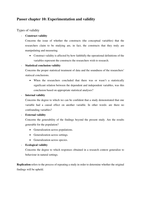
Types of validity
- Construct validity
Concerns the issue of whether the constructs (the conceptual variables) that the
researchers claim to be studying are, in fact, the constructs that they truly are
manipulating and measuring.
Construct validity is affected by how faithfully the operational definitions of the
variables represent the constructs the researchers wish to research.
- Statistical conclusion validity
Concerns the proper statistical treatment of data and the soundness of the researchers’
statiscal conclusions.
When the researchers concluded that there was or wasn’t a statistically
significant relation between the dependent and independent variables, was this
conclusion based on appropriate statistical analyses?
- Internal validity
Concerns the degree to which we can be confident that a study demonstrated that one
variable had a causal effect on another variable. In other words: are there no
confounding variables?
- External validity
Concerns the generability of the findings beyond the present study. Are the results
generable for the population?
Generalization across populations.
Generalization across settings.
Generalization across species.
- Ecological validity
Concerns the degree to which responses obtained in a research context generalize to
behaviour in natural settings.
Replication refers to the process of repeating a study in order to determine whether the original
findings will be upheld.
Types of validity
- Construct validity
Concerns the issue of whether the constructs (the conceptual variables) that the
researchers claim to be studying are, in fact, the constructs that they truly are
manipulating and measuring.
Construct validity is affected by how faithfully the operational definitions of the
variables represent the constructs the researchers wish to research.
- Statistical conclusion validity
Concerns the proper statistical treatment of data and the soundness of the researchers’
statiscal conclusions.
When the researchers concluded that there was or wasn’t a statistically
significant relation between the dependent and independent variables, was this
conclusion based on appropriate statistical analyses?
- Internal validity
Concerns the degree to which we can be confident that a study demonstrated that one
variable had a causal effect on another variable. In other words: are there no
confounding variables?
- External validity
Concerns the generability of the findings beyond the present study. Are the results
generable for the population?
Generalization across populations.
Generalization across settings.
Generalization across species.
- Ecological validity
Concerns the degree to which responses obtained in a research context generalize to
behaviour in natural settings.
Replication refers to the process of repeating a study in order to determine whether the original
findings will be upheld.