Passer chapter 9: Factorial designs
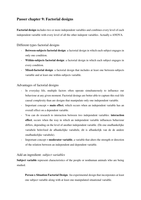
Factorial design includes two or more independent variables and combines every level of each
independent variable with every level of all the other indepent variables. Actually a ANOVA.
Different types factorial designs
- Between-subjects factorial design: a factorial design in which each subject engages in
only one condition.
- Within-subjects factorial design: a factorial design in which each subject engages in
every condition.
- Mixed-factorial design: a factorial design that includes at least one between-subjects
variable and at least one within-subjects variable.
Advantages of factorial designs
- In everyday life, multiple factors often operate simultaneously to influence our
behaviour at any given moment. Factorial desings are better able to capture this real-life
causal complexity than are designs that manipulate only one independent variable.
- Important concept = main effect, which occurs when an independent variable has an
overall effect on a dependent variable.
- You can do research to interaction between two independent variables: interaction
effect, occurs when the way in which an independent variable influences behaviour
differs, depending on the level of another independent variable. (De ene onafhankelijke
variabele beïnvloed de afhankelijke variabele, dit is afhankelijk van de de andere
onafhankelijke variabele).
- Important concept = moderator variable, a variable that alters the strength or direction
of the relation between an independent and dependent variable.
Add an ingredient: subject variables
Subject variable represent characteristics of the people or nonhuman animals who are being
studied.
Person x Situation Factorial Design. An experimental design that incorporates at least
one subject variable along with at least one manipulated situational variable.
Factorial design includes two or more independent variables and combines every level of each
independent variable with every level of all the other indepent variables. Actually a ANOVA.
Different types factorial designs
- Between-subjects factorial design: a factorial design in which each subject engages in
only one condition.
- Within-subjects factorial design: a factorial design in which each subject engages in
every condition.
- Mixed-factorial design: a factorial design that includes at least one between-subjects
variable and at least one within-subjects variable.
Advantages of factorial designs
- In everyday life, multiple factors often operate simultaneously to influence our
behaviour at any given moment. Factorial desings are better able to capture this real-life
causal complexity than are designs that manipulate only one independent variable.
- Important concept = main effect, which occurs when an independent variable has an
overall effect on a dependent variable.
- You can do research to interaction between two independent variables: interaction
effect, occurs when the way in which an independent variable influences behaviour
differs, depending on the level of another independent variable. (De ene onafhankelijke
variabele beïnvloed de afhankelijke variabele, dit is afhankelijk van de de andere
onafhankelijke variabele).
- Important concept = moderator variable, a variable that alters the strength or direction
of the relation between an independent and dependent variable.
Add an ingredient: subject variables
Subject variable represent characteristics of the people or nonhuman animals who are being
studied.
Person x Situation Factorial Design. An experimental design that incorporates at least
one subject variable along with at least one manipulated situational variable.