Passer chapter 8: Single-factor experimental designs
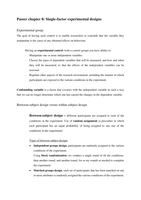
Experimental group
The goal of having such control is to enable researchers to conclude that the variable they
manipulate is the cause of any obtained effects on behaviour.
Having an experimental control (with a control group) you have ability to:
- Manipulate one or more independent variables.
- Choose the types of dependent variables that will be measured, and how and when
they will be measured, so that the effects of the independent variables can be
assessed.
- Regulate other aspects of the research environment, including the manner in which
participants are exposed to the various conditions in the experiment.
Confounding variable is a factor that covaries with the independent variable in such a way
that we can no longer determine which one has caused the changes in the dependent variable.
Between-subject design versus within-subject design
- Between-subject design = different participants are assigned to each of the
conditions in the experiment. Use of random assignment (a procedure in which
each participant has an equal probability of being assigned to any one of the
conditions in the experiment).
Types of between-subject designs
Independent-groups design, participants are randomly assigned to the various
conditions of the experiment.
Using block randomization, we conduct a single round of all the conditions,
then another round, and another round, for as my rounds as needed to complete
the experiment.
Matched-groups design, each set of participants that has been matched on one
or more attributes is randomly assigned the various conditions of the experiment.
Experimental group
The goal of having such control is to enable researchers to conclude that the variable they
manipulate is the cause of any obtained effects on behaviour.
Having an experimental control (with a control group) you have ability to:
- Manipulate one or more independent variables.
- Choose the types of dependent variables that will be measured, and how and when
they will be measured, so that the effects of the independent variables can be
assessed.
- Regulate other aspects of the research environment, including the manner in which
participants are exposed to the various conditions in the experiment.
Confounding variable is a factor that covaries with the independent variable in such a way
that we can no longer determine which one has caused the changes in the dependent variable.
Between-subject design versus within-subject design
- Between-subject design = different participants are assigned to each of the
conditions in the experiment. Use of random assignment (a procedure in which
each participant has an equal probability of being assigned to any one of the
conditions in the experiment).
Types of between-subject designs
Independent-groups design, participants are randomly assigned to the various
conditions of the experiment.
Using block randomization, we conduct a single round of all the conditions,
then another round, and another round, for as my rounds as needed to complete
the experiment.
Matched-groups design, each set of participants that has been matched on one
or more attributes is randomly assigned the various conditions of the experiment.