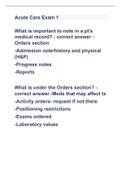
Acute Care Exam 1|2023 LATEST UPDATE|GUARANTEED SUCCESS|GRADED A
What is important to note in a pt's medical record? -Orders section -Admission note/history and physical (H&P) -Progress notes -Reports What is under the Orders section? -Meds that may affect tx -Activity orders- request if not there -Positioning restrictions -Exams ordered -Laboratory values 00:51 01:13 What is under the subjective portion of a pt's history? -History of present illness -Medical/surgical history, risk factors, allergies -Occupation, lifestyle, functional mobility status, need for home or outpatient services, architectural barriers at home (RARE) -Current meds, compliance with meds What is under the physical examination portion of the medical record? -General: vital signs, lab findings, mental status, appearance -HEENT: head, eyes, ears, nose, and throat, and neck -Chest, heart -Abdomen -Extremities -Neurologic system What are some questions to ask in the subjective exam? -Steps into home, railings -Bed/bath upstairs -Assistance at home -Prior level of function -Use of equipment -Is there a plan in place for d/c -Consistent with medical record What is something to NEVER forget in an objective exam? VITALS: take in several positions What are some D/C options from acute care? -SNF -LTAC (long term acute care) -Subacute rehab/facility -Acute rehab facility -Assisted living facility -Home health PT How do you ensure safety in an acute care setting? -Know alarms- ask if you don't -Confirm you're with the right patient -Raise or lower the bed as needed -Lock bed and chairs, have in lowest position -Always leave call bell in reach What is important to know regarding restraints in an acute care setting? -Order must be renewed every 24 hours -All 4 bed rails up is a restraint -Sitter vs restraints -Use a slipknot- can be untied rapidly -Do not tie to bed rail or moveable object -Chemical restraints- drowsy For every day on bed rest, how many days does it take to regain function? 2 days Polyneuropathy -Widespread symmetric weakness -Common with sepsis or multiorgan failure -Failure to wean from ventilator Myopathy -Diffuse quadriparesis -Respiratory muscle weakness -Decreased deep tendon reflexes -High dose corticosteroids + neuromuscular blockade 00:01 01:13 What is the purpose of an arterial line (A-line)? To directly and continuously record systolic, diastolic, and mean arterial blood pressure What is important to know about a central line? Do not take blood pressure on an extremity with a central line Swan Ganz catheter/pulmonary artery catheter -Direct measurement of pressures in the right atrium, right ventricle, pulmonary artery, and the filling pressure of the left atrium -Valves: tricuspid and pulmonic -Activities to avoid: ipsilateral shoulder flexion and abduction >90 deg, avoid excess head and neck movements What is the purpose of a chest tube? -Removes and prevents the reentry of air or fluid from the pleural space or mediastinal space and provides negative intrapleural pressure -Used to treat pneumothorax, hemothorax, pleural effusion, and empyema What angle should the HOB be at when running a nasogastric tube (NG)? 30 degrees What are the two types of wounds? 1. Traumatic 2. Surgical Arterial insufficiency wounds -Often in pretibial and dorsum of toes and feet -Intermittent claudication -Extreme pain, decreased with rest, and increased with exercise and elevation -Decreased temperature of distal limb -Decreased or absent pedal pulses -Distinct wound edges -Deep wound bed with pale granulation (if any) and minimal drainage -Cyanosis, anhydrous skin Venous insufficiency wound -Often near medial malleolus -Localized limb pain, decreased with elevation, increased with dependency -Pain with deep pressure or palpation -Pedal pulses present -Increased temp around wound -Indistinct, irregular edges -Lower extremity edema -Shallow, fibrous covered wound bed, substantial drainage Neuropathic ulcers -Painless: often lower limb pain present -Pedal pulses may be absent if vascular disease present -May have decreased temp or possibly hyperfused -Deep wound bed, often at pressure points and surrounded by callous -Shiny skin with trophic changes of skin, hair, and nails Measuring peripheral neuropathy with SW monofilaments -4.17 = intact ->5.07 = loss of "protective sensation" (10 g, threshold of sensory loss to place a person at risk) ->6.10 = essentially absent -Predictive of ulcer/amputation: 1.80-2.03 risk ratio What are normal values for measuring peripheral neuropathy with a biothesiometer? -Normal: <25 mv -PN: >25 mv What is adequate footwear? -Cushioned shock-absorbing outsole -Flexible uppers -Squared-off toe box deep enough to protect toes without rubbing -Laces or velcro -No signs of rubbing Unacceptable footwear -Excess wear of surfaces -Inappropriate size (short, long, narrow, or wide) -Pointed toes -Open toe or heel -Heel height >1 inch -Slip ons -Hard soles -High heels Pressure wound/injury -Suspected deep tissue injury (DTI) -Localized area of discoloration (purple or maroon) -Intact skin -Caused by damage of underlying tissues from pressure or shear Stage 1 pressure injury -Usually over bony prominence -Intact reddened skin, no blaching Pressure injury stage 2 -Shallow open ulcer -Red pink wound bed -Partial thickness loss of dermis -No slough Stage 3 pressure injury -Subcutaneous fat may be visible (full thickness loss) -Muscle, tendon, bone NOT exposed -May have tunneling or undermining -Slough may be present Stage 4 pressure injury -Muscle, tendon, or bone is exposed -Often tunneling and undermining -Slough or eschar on some part of wound bed Unstageable pressure injury -Slough and/or eschar is covering wound bed -Cannot be stage until eschar debrided Scar management -Friction massage: mechanically loosens adhesions and softens the scar -Stretches and breaks down fibrous tissue -Silicone scar treatment -Compression garments Edema management -Retrograde massage -Compression garments/ACE wraps -Cold pumps -Intermittent compression pumps Edema classification -0+ non pitting edema -1+ Mild pitting edema, 2mm depression that disappears rapidly -2+ Moderate pitting edema, 4mm depression that disappears in 10-15 seconds -3+ Moderately severe pitting edema, 6mm depression that may last more than 1 min -4+ Severe pitting edema, 8mm depression that can last more than 2 minutes Factors that impact wound healing -Age -Lifestyle- smoking, occupation -Nutrition- lab values -Cognition and self care -Vascular status: surgery, ABI values -Medical status: CHF, HTN, DM, renal -Meds
Written for
- Institution
- ACUTE CARE
- Course
- ACUTE CARE
Document information
- Uploaded on
- May 2, 2023
- Number of pages
- 67
- Written in
- 2022/2023
- Type
- Exam (elaborations)
- Contains
- Questions & answers
Subjects
-
acute care exam 1|2023 latest update|guaranteed success|graded a

Also available in package deal