a. nervous response
1. Receptor – detect internal/external stimuli & convert energy to electrical impulse
2. Coordinator: CNS
3. Effector: muscle/gland – response
Human nervous system
Central Nervous System = brain & spinal cord
Peripheral Nervous System: connect CNS to receptors & effectors
o Somatic: nerve pairs originating from CNS – contain sensory & motor neurones
o Autonomic: unconscious control of internal organ function
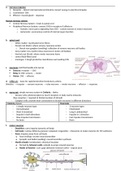
b. spinal cord
- White matter: myelinated nerve fibres
- Dorsal root (back): where sensory neurones enters
o Dorsal root ganglion (swelling): collection of sensory neurone cell bodies
- Grey matter: less myelin (relay neurones & motor cell bodies)
- Ventral root (front): where motor neurones leave
- central fluid-filled canal
- meninges: 3 tough protective membranes surrounding CNS
c. neurones (cell that bundle into nerve)
Sensory: receptor → CNS
Relay in CNS: sensory → motor
Motor: CNS → effector
d. reflex arc – basis for rapid/protective/involuntary actions
Stimulus → receptor → sensory neurone → relay neurone → motor neurone → effector → response
e. nerve net: simple nervous system in Cnidaria – Hydra
- Sensory cells: photoreceptors & touch receptors in body wall & tentacles
(few receptors = respond to limited number of stimuli)
- Ganglion cells: provide short connections to branch neurones in different directions
Cnidaria phylum Mammals
- 1 simple neurone type - 3 neurone types
- Unmyelinated - Myelinated
- Short & branched - Long & unbranched
- Impulse in both directions - Impulse in 1 direction
- Slow impulse transmission - Fast impulse transmission
- No brain - Brain
f. motor neurone
- Dendrites: carry impulse towards cell body
- Cell body: nucleus (DNA) & granular cytoplasm (organelles – ribosomes to make enzymes for NT synthesis)
- Axon: impulse away from cell body
o Axon endings: secrete neurotransmitter
o Synaptic end bulbs (swelling): neurotransmitter synthesis
- Myelin sheath (vertebrates): electrical insulator
o formed by Schwann cells: extends & wraps around neurone
o Nodes of Ranvier: 1um: gaps (between Schwann cells) – expose axon
1. Receptor – detect internal/external stimuli & convert energy to electrical impulse
2. Coordinator: CNS
3. Effector: muscle/gland – response
Human nervous system
Central Nervous System = brain & spinal cord
Peripheral Nervous System: connect CNS to receptors & effectors
o Somatic: nerve pairs originating from CNS – contain sensory & motor neurones
o Autonomic: unconscious control of internal organ function
b. spinal cord
- White matter: myelinated nerve fibres
- Dorsal root (back): where sensory neurones enters
o Dorsal root ganglion (swelling): collection of sensory neurone cell bodies
- Grey matter: less myelin (relay neurones & motor cell bodies)
- Ventral root (front): where motor neurones leave
- central fluid-filled canal
- meninges: 3 tough protective membranes surrounding CNS
c. neurones (cell that bundle into nerve)
Sensory: receptor → CNS
Relay in CNS: sensory → motor
Motor: CNS → effector
d. reflex arc – basis for rapid/protective/involuntary actions
Stimulus → receptor → sensory neurone → relay neurone → motor neurone → effector → response
e. nerve net: simple nervous system in Cnidaria – Hydra
- Sensory cells: photoreceptors & touch receptors in body wall & tentacles
(few receptors = respond to limited number of stimuli)
- Ganglion cells: provide short connections to branch neurones in different directions
Cnidaria phylum Mammals
- 1 simple neurone type - 3 neurone types
- Unmyelinated - Myelinated
- Short & branched - Long & unbranched
- Impulse in both directions - Impulse in 1 direction
- Slow impulse transmission - Fast impulse transmission
- No brain - Brain
f. motor neurone
- Dendrites: carry impulse towards cell body
- Cell body: nucleus (DNA) & granular cytoplasm (organelles – ribosomes to make enzymes for NT synthesis)
- Axon: impulse away from cell body
o Axon endings: secrete neurotransmitter
o Synaptic end bulbs (swelling): neurotransmitter synthesis
- Myelin sheath (vertebrates): electrical insulator
o formed by Schwann cells: extends & wraps around neurone
o Nodes of Ranvier: 1um: gaps (between Schwann cells) – expose axon