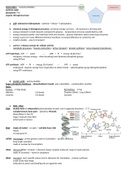
Nucleotides – mononucleotides
pentose sugar
phosphate: PO4
organic nitrogenous base
a. ATP: adenosine triphosphate = adenine + ribose + 3 phosphates
b. chemical energy in biological processes: universal energy currency – all reactions in all living cells
+ energy released in small amounts compared to glucose – temperature increase would destroy cells
+ energy released quickly: one hydrolysis with one enzyme – glucose hydrolysis takes many steps/enzymes
+ energy source for many different chemical reactions: increased efficiency & control by cell
+ small & soluble – easy to transport
c. carries + releases energy for cellular activity
metabolic processes / muscle contraction / active transport / protein synthesis / nerve impulse transmission
ATP hydrolysis: ATP + water → ADP + Pi + energy 30.6kJ/mol-1
- exergonic: releases energy – when breaking bond between phosphate groups
- using ATPase
ATP synthesis: ADP + Pi + energy 30.6 kJmol-1 → ATP + water
- endergonic: requires energy from respiration to reform bond – add phosphate group (phosphorylation)
- using ATP synthetase
d. nucleic acids – polynucleotide
Sugar-phosphate backbone – phosphodiester bonds: join nucleotides – condensation reaction
Bases
Purines – 2 rings puag Pyrimidines – 1 ring
Adenine 2 H-bonds Thymine (DNA) / Uracil (RNA)
Guanine 3 H-bonds Cytosine
e. DNA / RNA
DNA: double helix of antiparallel polynucleotide strands: run in opposite directions – 5’-3’
complementary base pairs – joined by H-bonds
deoxyribose (1 less O)
larger molecule than RNA
only found in nucleus
RNA: single-stranded – no pairs = variable base ratio
ribose
U (instead of T)
mRNA messenger: carries genetic code for translation – protein synthesis
long single-stranded
made in nucleus by transcription
rRNA ribosomalRNA + protein = ribosome (large complex molecule: large & small subunit)
made in nucleolus – found in cytoplasm
tRNA: transport: carry specific amino acid to ribosome for translation – protein synthesis
small clover-leaf shape
anticodon & amino acid binding site on opposite ends
pentose sugar
phosphate: PO4
organic nitrogenous base
a. ATP: adenosine triphosphate = adenine + ribose + 3 phosphates
b. chemical energy in biological processes: universal energy currency – all reactions in all living cells
+ energy released in small amounts compared to glucose – temperature increase would destroy cells
+ energy released quickly: one hydrolysis with one enzyme – glucose hydrolysis takes many steps/enzymes
+ energy source for many different chemical reactions: increased efficiency & control by cell
+ small & soluble – easy to transport
c. carries + releases energy for cellular activity
metabolic processes / muscle contraction / active transport / protein synthesis / nerve impulse transmission
ATP hydrolysis: ATP + water → ADP + Pi + energy 30.6kJ/mol-1
- exergonic: releases energy – when breaking bond between phosphate groups
- using ATPase
ATP synthesis: ADP + Pi + energy 30.6 kJmol-1 → ATP + water
- endergonic: requires energy from respiration to reform bond – add phosphate group (phosphorylation)
- using ATP synthetase
d. nucleic acids – polynucleotide
Sugar-phosphate backbone – phosphodiester bonds: join nucleotides – condensation reaction
Bases
Purines – 2 rings puag Pyrimidines – 1 ring
Adenine 2 H-bonds Thymine (DNA) / Uracil (RNA)
Guanine 3 H-bonds Cytosine
e. DNA / RNA
DNA: double helix of antiparallel polynucleotide strands: run in opposite directions – 5’-3’
complementary base pairs – joined by H-bonds
deoxyribose (1 less O)
larger molecule than RNA
only found in nucleus
RNA: single-stranded – no pairs = variable base ratio
ribose
U (instead of T)
mRNA messenger: carries genetic code for translation – protein synthesis
long single-stranded
made in nucleus by transcription
rRNA ribosomalRNA + protein = ribosome (large complex molecule: large & small subunit)
made in nucleolus – found in cytoplasm
tRNA: transport: carry specific amino acid to ribosome for translation – protein synthesis
small clover-leaf shape
anticodon & amino acid binding site on opposite ends