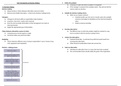
M6:1 Introduction to Decision Making 1. Define the problem
● A decision is made only when a problem is recognized
1.1 Decision Making ● If the manager is unaware that a problem exists - they will not feel the
Decision making need to make any decision
● Always involves a choice between alternative courses of action
● Relevant and reliable information - critical to the decision-making process 2. Identify the decision-making criteria
● What are we trying to achieve?
Managers ○ Maximize profits over the next 12 months, given the available
● Managers at all levels within an organization make decisions resources and subject to limitations on the risks that should be
● Long term, short term, routine and occasional taken
● Have the role to provide information so that management can reach an ○ Reduce excessive spending
informed decision
● Supply the appropriate type of information
3. Develop alternatives
Choice between alternative courses of action ● The different ways in which the problem might be resolved in a way
● Comparing actual results against a target that is consistent with the decision-making criteria
● Corrective action may need to be taken
4. Analyze the alternatives
Budgeting ● Evaluated financially - to estimate the profit that would result from
● Choices between different ways of using an organization’s scarce resources (eg, choosing that alternative
cash, equipment and manpower) ● Other financial considerations taken into account too
Decision - making process 5. Select an alternative
● Selecting one alternative from 2 or more that have been analyzed
● The recommended choice should satisfy the goals of the organzation
, M6:2 Relevant Cost
Relevant costs Future cash flows arising as a direct consequence of a decision
Based on future, incremental cash flows
The value of the benefit sacrificed when one course of action is
chosen in preference to an alternative.
Differential cost
● The difference in total cost between alternatives
Opportunity cost
● The value of the benefit sacrificed when one course of
action is chosen in preference to an alternative.
Variable costs
Non - relevant Sunk cost
cost ● A past cost
● Not relevant in decision-making
Fixed costs
M 6:3 - Choice of product (product mix) decisions
,3.1 The Limiting Factor
Limiting factor
● Any factor which limits the organisation’s activities
● Contribution is maximised by earning the biggest contribution per unit of
limiting factor
Possible limiting factors:
● Sales - level of sales demand for a product
● Resources - scarce resources which limit production to below the level of
demand
● Labour - total quantity of labour available
● Labour - shortage of skilled of labour
● Materials - Insufficient available materials to produce enough units to satisfy
sales demand
● Manufacturing capacity - Insufficient machine capacity for production required
to meet sales demand
Contribution
Profit (marginal costing) Profit (marginal costing)
= Contribution - Fixed costs
Contribution Contribution
= Sales revenue - Variable costs
Contribution per unit of Maximised by earning the biggest contribution from
limiting factor each unit of limiting factor
Example:
If skilled labour is the limiting factor, contribution will
be maximised by earning the biggest contribution from
each hour of skilled labour worked
FORMULA:
Contribution per unit of limiting factor
= Contribution per unit/Limiting factor
M 6:4 - Make or buy decisions
Limiting factor decision ● Involves the determination of the contribution
earned by each different product from each
4.1 Introduction
unit of limiting factor
Make or buy problem
, ● Whether to make a product with its own internal resources or pay another
organization to make the product
Relevant costs to be decided
Differential costs
● Between the two options (sourcing internally and externally)
● The difference in total costs between alternatives
Variable costs vs. fixed costs
Example : whether or not a company should manufacture or buy its components
● Make option - more direct control over the work
● Buy option - external organization has a specialist skill and expertise in the work
Make or buy considerations
● How can spare capacity be freed up by the ‘buy’ option be used most profitably?
● Could the decision to use an outside supplier cause an industrial dispute?
● Would the subcontractor be reliable with the delivery times and product
quality?
● Does the company wish to be flexible and maintain better control over
operations by making everything itself?
M 6:5 - Outsourcing
5.1 Introduction
● A decision is made only when a problem is recognized
1.1 Decision Making ● If the manager is unaware that a problem exists - they will not feel the
Decision making need to make any decision
● Always involves a choice between alternative courses of action
● Relevant and reliable information - critical to the decision-making process 2. Identify the decision-making criteria
● What are we trying to achieve?
Managers ○ Maximize profits over the next 12 months, given the available
● Managers at all levels within an organization make decisions resources and subject to limitations on the risks that should be
● Long term, short term, routine and occasional taken
● Have the role to provide information so that management can reach an ○ Reduce excessive spending
informed decision
● Supply the appropriate type of information
3. Develop alternatives
Choice between alternative courses of action ● The different ways in which the problem might be resolved in a way
● Comparing actual results against a target that is consistent with the decision-making criteria
● Corrective action may need to be taken
4. Analyze the alternatives
Budgeting ● Evaluated financially - to estimate the profit that would result from
● Choices between different ways of using an organization’s scarce resources (eg, choosing that alternative
cash, equipment and manpower) ● Other financial considerations taken into account too
Decision - making process 5. Select an alternative
● Selecting one alternative from 2 or more that have been analyzed
● The recommended choice should satisfy the goals of the organzation
, M6:2 Relevant Cost
Relevant costs Future cash flows arising as a direct consequence of a decision
Based on future, incremental cash flows
The value of the benefit sacrificed when one course of action is
chosen in preference to an alternative.
Differential cost
● The difference in total cost between alternatives
Opportunity cost
● The value of the benefit sacrificed when one course of
action is chosen in preference to an alternative.
Variable costs
Non - relevant Sunk cost
cost ● A past cost
● Not relevant in decision-making
Fixed costs
M 6:3 - Choice of product (product mix) decisions
,3.1 The Limiting Factor
Limiting factor
● Any factor which limits the organisation’s activities
● Contribution is maximised by earning the biggest contribution per unit of
limiting factor
Possible limiting factors:
● Sales - level of sales demand for a product
● Resources - scarce resources which limit production to below the level of
demand
● Labour - total quantity of labour available
● Labour - shortage of skilled of labour
● Materials - Insufficient available materials to produce enough units to satisfy
sales demand
● Manufacturing capacity - Insufficient machine capacity for production required
to meet sales demand
Contribution
Profit (marginal costing) Profit (marginal costing)
= Contribution - Fixed costs
Contribution Contribution
= Sales revenue - Variable costs
Contribution per unit of Maximised by earning the biggest contribution from
limiting factor each unit of limiting factor
Example:
If skilled labour is the limiting factor, contribution will
be maximised by earning the biggest contribution from
each hour of skilled labour worked
FORMULA:
Contribution per unit of limiting factor
= Contribution per unit/Limiting factor
M 6:4 - Make or buy decisions
Limiting factor decision ● Involves the determination of the contribution
earned by each different product from each
4.1 Introduction
unit of limiting factor
Make or buy problem
, ● Whether to make a product with its own internal resources or pay another
organization to make the product
Relevant costs to be decided
Differential costs
● Between the two options (sourcing internally and externally)
● The difference in total costs between alternatives
Variable costs vs. fixed costs
Example : whether or not a company should manufacture or buy its components
● Make option - more direct control over the work
● Buy option - external organization has a specialist skill and expertise in the work
Make or buy considerations
● How can spare capacity be freed up by the ‘buy’ option be used most profitably?
● Could the decision to use an outside supplier cause an industrial dispute?
● Would the subcontractor be reliable with the delivery times and product
quality?
● Does the company wish to be flexible and maintain better control over
operations by making everything itself?
M 6:5 - Outsourcing
5.1 Introduction