Focus 1
What is classification? Why classify Keys
things? is a process in which
Classification Dichotomous keys
objects or living things are sorted into A dichotomous key is a tool that allows the user to
groups based upon similarities in their determine the identity of items in the natural world, such
as trees, wildflowers, mammals, reptiles, rocks, and
features (characteristics). Scientists fish. Keys consist of a series of choices that lead the user
classify organisms to try to make their to the correct name of a given item. "Dichotomous"
study easier and to improve their ability means "divided into two parts". Features such as size,
to communicate with each other. By colour, behaviour, and habitat are not good for
putting similar species into groups those classification because they can change throughout the life
millions of species do not seem so of the organism. Using the structure of an organism is
much better.
overwhelming. People then rely on their
knowledge of classification to
understand what different species are Circular Keys
These keys are in the shape of circles, with the broadest
like. groupings in the centre, which is where you should start.
You then work your way to the outside where you will find
the name of the object you are trying to classify. To
Focus 2
identify features of an object or organism given its name,
work from the outside in.
Light
The type of microscope most
microscopes
commonly used in schools is the
compound light microscope. These
microscopes use light and a number
of lenses to form an image. The
diagram at right shows a typical
school microscope. The specimen (the
object being observed) is placed on a
rectangular piece of glass called a
microscope slide. The specimen
needs to be very thin so that light can
pass through it. A small, thin piece of
glass called a coverslip is placed on
top of the specimen. Light is made to
pass through the object and the glass
lenses, which bend the rays of light. A
magnified image of the part of the
specimen directly under the objective
lens is formed. The microscope at
right has only one eyepiece; it is a
monocular microscope. Some school
microscopes have two eyepieces;
they are called binocular microscopes.
Some of the microscopes at your
school may have built-in lights. These
Focus 2
microscopes do not have a mirror at
the bottom; they have a light instead.
Living things and MRS
GREN
All living things are made up of tiny units called cells. Cells are so small we can only Kingdom
see them with a microscopic They are microscopic. A typical animal is made up of
billions of cells. All animals (including humans), plants and fungi are classed as Phylum
multicellular organisms. This means that they are made up many cells. Uni-cellular Class
organisms (like bacteria) are made up of only 1 cell. All living things have seven
features and to be classified as living, they must have all features. Order
Family
Move (All living things move in some way)
Respire (All living things break down food, many using oxygen to carry out respiration Genus
which produces energy) Species
Stimulus (All living things respond to what happens in their environment)
, Plantae: Magnification
Organisms in this kingdom gain The process of making an
nutrition from the sun, using the image larger
process of photosynthesis. For a compound
Archaebacteria’s
They have eukaryotic cells
microscope, it is
It contains unicellular organisms
that look like bacteria but live calculated by multiplying
in extreme the eyepiece
conditions without oxygen. While magnification by the
normal bacteria live almost objective lens
anywhere, Archaebacteria are magnification
found in harsh environments that
Types of microscopes
are too salty, hot, or acidic for
anything else to grow. Some of Electron microscope
Protista: Highest magnification
them actually breathe acid.
Protists come in many shapes compound microscope
Their cells do not have a
and get their energy in various
membrane bound nucleus
Fungi: Med magnification
ways. Some can swallow other
makingorganisms
These them prokaryotes
look similar to Lowest magnification
cells (like Amoeba), while others
use photosynthesis (like Euglen plants, but they don't have Stereo microscope
a). They all store their DNA in a leaves, stems, or flowers.
membrane-bound nucleus, So They reproduce using spores and Resolution
Focus 2
they have eukaryotic cells just gain nutrition by breaking down How clear an image is
like the cells of animals, plants, (decomposing) dead organisms.
and fungi. They have eukaryotic cells Field of view
What can be seen down
the eyepiece
As magnification
increases, FOV decreases
What is classification? Why classify Keys
things? is a process in which
Classification Dichotomous keys
objects or living things are sorted into A dichotomous key is a tool that allows the user to
groups based upon similarities in their determine the identity of items in the natural world, such
as trees, wildflowers, mammals, reptiles, rocks, and
features (characteristics). Scientists fish. Keys consist of a series of choices that lead the user
classify organisms to try to make their to the correct name of a given item. "Dichotomous"
study easier and to improve their ability means "divided into two parts". Features such as size,
to communicate with each other. By colour, behaviour, and habitat are not good for
putting similar species into groups those classification because they can change throughout the life
millions of species do not seem so of the organism. Using the structure of an organism is
much better.
overwhelming. People then rely on their
knowledge of classification to
understand what different species are Circular Keys
These keys are in the shape of circles, with the broadest
like. groupings in the centre, which is where you should start.
You then work your way to the outside where you will find
the name of the object you are trying to classify. To
Focus 2
identify features of an object or organism given its name,
work from the outside in.
Light
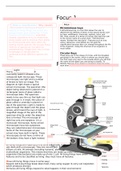
The type of microscope most
microscopes
commonly used in schools is the
compound light microscope. These
microscopes use light and a number
of lenses to form an image. The
diagram at right shows a typical
school microscope. The specimen (the
object being observed) is placed on a
rectangular piece of glass called a
microscope slide. The specimen
needs to be very thin so that light can
pass through it. A small, thin piece of
glass called a coverslip is placed on
top of the specimen. Light is made to
pass through the object and the glass
lenses, which bend the rays of light. A
magnified image of the part of the
specimen directly under the objective
lens is formed. The microscope at
right has only one eyepiece; it is a
monocular microscope. Some school
microscopes have two eyepieces;
they are called binocular microscopes.
Some of the microscopes at your
school may have built-in lights. These
Focus 2
microscopes do not have a mirror at
the bottom; they have a light instead.
Living things and MRS
GREN
All living things are made up of tiny units called cells. Cells are so small we can only Kingdom
see them with a microscopic They are microscopic. A typical animal is made up of
billions of cells. All animals (including humans), plants and fungi are classed as Phylum
multicellular organisms. This means that they are made up many cells. Uni-cellular Class
organisms (like bacteria) are made up of only 1 cell. All living things have seven
features and to be classified as living, they must have all features. Order
Family
Move (All living things move in some way)
Respire (All living things break down food, many using oxygen to carry out respiration Genus
which produces energy) Species
Stimulus (All living things respond to what happens in their environment)
, Plantae: Magnification
Organisms in this kingdom gain The process of making an
nutrition from the sun, using the image larger
process of photosynthesis. For a compound
Archaebacteria’s
They have eukaryotic cells
microscope, it is
It contains unicellular organisms
that look like bacteria but live calculated by multiplying
in extreme the eyepiece
conditions without oxygen. While magnification by the
normal bacteria live almost objective lens
anywhere, Archaebacteria are magnification
found in harsh environments that
Types of microscopes
are too salty, hot, or acidic for
anything else to grow. Some of Electron microscope
Protista: Highest magnification
them actually breathe acid.
Protists come in many shapes compound microscope
Their cells do not have a
and get their energy in various
membrane bound nucleus
Fungi: Med magnification
ways. Some can swallow other
makingorganisms
These them prokaryotes
look similar to Lowest magnification
cells (like Amoeba), while others
use photosynthesis (like Euglen plants, but they don't have Stereo microscope
a). They all store their DNA in a leaves, stems, or flowers.
membrane-bound nucleus, So They reproduce using spores and Resolution
Focus 2
they have eukaryotic cells just gain nutrition by breaking down How clear an image is
like the cells of animals, plants, (decomposing) dead organisms.
and fungi. They have eukaryotic cells Field of view
What can be seen down
the eyepiece
As magnification
increases, FOV decreases