Nurs 6501 Final Exam (Advanced Pathophysiology Finals) with accurate verified answers available
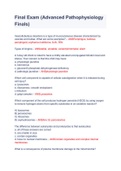
Vesicollobullous disorders is a type of mucocutaneous disease characterized by vesicles and bullae. What are some examples? - ANSPemphigus, bulbous pemphigoid, erythema multiforme, SJS, TEN Types of Angina - ANSstable, unstable, variant/printzmetal, silent A 3-day old infant is noted to have a mildly elevated unconjugated bilirubin level and icterus. Your concern is that this child may have: a. physiologic jaundice b. kernicterus c. glucose-6-phosphate dehydrogenase deficiency d. pathologic jaundice - ANSphysiologic jaundice Which cell component is capable of cellular autodigestion when it is released during cell injury? a. lysosomes b. ribosomesc. smooth endoplasmi c reticulum d. golgi complex - ANSLysosomes Which component of the cell produces hydrogen peroxide (H2O2) by using oxygen to remove hydrogen atoms from specific substrates in an oxidative reaction? A) lysosomes B) peroxisomes C) ribosomes D) oxyhydrosomes - ANSAns: B- peroxisomes The difference between eukaryotes and prokaryotes is that eukaryotes: a. all of these answers are correct b. are smaller in size c. contain organelles d. have no nuclear membrane - ANSContain organelles and complex internal membranes
Written for
- Institution
- Nurs 6501
- Course
- Nurs 6501
Document information
- Uploaded on
- April 24, 2023
- Number of pages
- 23
- Written in
- 2022/2023
- Type
- Exam (elaborations)
- Contains
- Questions & answers
Subjects
- nurs 6501
-
nurs 6501 final exam advanced pathophysiology finals with accurate verified answers available
-
vesicollobullous disorders is a type of mucocutaneous disease characterized by vesicles and bu

Also available in package deal