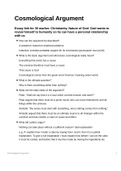
Cosmological Argument
Essay link for 30 marker: Christianity, Nature of God- God wants to
reveal himself to humanity so he can have a personal relationship
with us
How can the argument be described?
A posteriori- based on empirical evidence
Inductive- provides probable support for its conclusions (persuasion over proof)
What is the basic argument and what does cosmological really mean?
Everything that exists has a cause
The universe therefore must have a cause
That cause is God
Cosmological comes from the greek word ‘Kosmos’ meaning order/ world
What is the ultimate question?
Why is there something rather than nothing?
What are the early ideas of the argument?
Plato: “Shall we say that it is a soul which controls heaven and earth?”
Plato argued that there must be a prime mover who can move themselves and all
things within the universe.
Aristotle: “the series must start with something, since nothing comes from nothing.”
Aristotle argued that there must be an ultimate source to all changes within the
universe and that creates a chain of cause and effect.
What did Leibniz argue?
Nothing can take place without a sufficient reason= total explanation
e.g. if I explain how I made a cake by saying how I iced it, then it is a partial
explanation. To give a full explanation I must explain how before I can ice the cake,
it must be cooled, and before that it must be made by mixing the ingredients etc.
Cosmological Argument 1
, To get to a sufficient reason, we have to reach something that is not contingent i.e. it
is self-explanatory.
Since everything in the world is contingent, the sufficient reason that is non-
contingent must lie outside the universe (God)
Explain Aquinas’ First Way
Motion
P1: There are some things in motion or state of change
P2: Nothing can change by itself- everything is a secondary mover (Plato)
P3: If everything is a secondary mover then there would be an infinite regress of
movers
P4: (reductio ad absurdum) If P3 were true then there would be no secondary
movers, but this is false
C: Therefore, there must be an unmoved prime mover- God
Explain Aquinas’ Second Way
Causation
P1: Every event has a cause
P2: Nothing can be the cause of itself
P3: If we imagine that this order of causes goes back infinitely then there would be
no first cause
P4: (reductio ad absurdum) If P3 were true then there would be no causes at all, but
this is false.
C: Therefore, there must be a first uncaused cause- God.
Explain Aquinas’ Third Way
Contingency
P1: In nature, everything can either exist or not exist
P2: Given infinite time, eventually everything will not exist
P3: If there was once nothing, nothing could have come from it
P4: Therefore, some thing or some things must exist necessarily
Cosmological Argument 2
Essay link for 30 marker: Christianity, Nature of God- God wants to
reveal himself to humanity so he can have a personal relationship
with us
How can the argument be described?
A posteriori- based on empirical evidence
Inductive- provides probable support for its conclusions (persuasion over proof)
What is the basic argument and what does cosmological really mean?
Everything that exists has a cause
The universe therefore must have a cause
That cause is God
Cosmological comes from the greek word ‘Kosmos’ meaning order/ world
What is the ultimate question?
Why is there something rather than nothing?
What are the early ideas of the argument?
Plato: “Shall we say that it is a soul which controls heaven and earth?”
Plato argued that there must be a prime mover who can move themselves and all
things within the universe.
Aristotle: “the series must start with something, since nothing comes from nothing.”
Aristotle argued that there must be an ultimate source to all changes within the
universe and that creates a chain of cause and effect.
What did Leibniz argue?
Nothing can take place without a sufficient reason= total explanation
e.g. if I explain how I made a cake by saying how I iced it, then it is a partial
explanation. To give a full explanation I must explain how before I can ice the cake,
it must be cooled, and before that it must be made by mixing the ingredients etc.
Cosmological Argument 1
, To get to a sufficient reason, we have to reach something that is not contingent i.e. it
is self-explanatory.
Since everything in the world is contingent, the sufficient reason that is non-
contingent must lie outside the universe (God)
Explain Aquinas’ First Way
Motion
P1: There are some things in motion or state of change
P2: Nothing can change by itself- everything is a secondary mover (Plato)
P3: If everything is a secondary mover then there would be an infinite regress of
movers
P4: (reductio ad absurdum) If P3 were true then there would be no secondary
movers, but this is false
C: Therefore, there must be an unmoved prime mover- God
Explain Aquinas’ Second Way
Causation
P1: Every event has a cause
P2: Nothing can be the cause of itself
P3: If we imagine that this order of causes goes back infinitely then there would be
no first cause
P4: (reductio ad absurdum) If P3 were true then there would be no causes at all, but
this is false.
C: Therefore, there must be a first uncaused cause- God.
Explain Aquinas’ Third Way
Contingency
P1: In nature, everything can either exist or not exist
P2: Given infinite time, eventually everything will not exist
P3: If there was once nothing, nothing could have come from it
P4: Therefore, some thing or some things must exist necessarily
Cosmological Argument 2