Samenvatting
hs 2,3,6,8-20, 22-27, 30-31
Flick, Uwe (2009), An Introduction to Qualitative Research. London: Sage
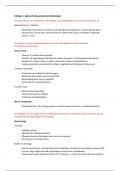
Chapter 2: Qualitative research: why and how to do it
Concept Definition/explanation Page nr.
Pluralization of life Variations in social structures. 12
worlds. Key expressions to this are:
The ‘new obscurity’ (Habermans 1996).
The growing individualisation of ways of living and
biological patterns (Beck 1992)
The dissolution of ‘old’ social inequalities into the new
diversity milieus, subcultures, lifestyles and ways of living.
Postmodernism “Refers to the incipient or actual dissolution of those social 12
forms associated with modernity" (Sarup 1993).
Advocates of postmodernism say that locally, temporarily
and situationally limited narratives are now required,
instead of big narratives and theories
Sensitizing concepts Ways of seeing and understanding data, when it is not known 12
how the research will go. Instead of starting with theories,
sensitizing concepts are required.
The generalization of To be able to say that the outcome of research on a few people 13
findings is the same as for a population.
When concrete cases are studied, general statements can be
made.
When classifying observed phenomena, frequency and
distribution are important
Validity of causal The extent to which causal relationships measured match the 13
relationships truth. To make the validity as high as possible, the influence of
the ones participating should be minimal, thus guaranteeing
objectivity.
Disenchantment of the A term, made by Max Weber, that describes the rationalization 13
world of the world and the devaluation of mysticism. According to
Weber this is science’s task
Utilization research Refers to the actual implementation of research outcome. 13
Essential features of 1. Appropriateness of methods and theories 14
qualitative research 2. Perspectives of the participants and their diversity
3. Reflexivity of the researcher and the research
4. Variety approaches and methods in qualitative research
1. Appropriates of Whether other variables are controlled or excluded. When a 14
methods and theories clear identification and isolation of variables is not possible:
Don’t make models of clear cause-effect relations
Take contextual conditions into account in complex
qualitative research
Design methods open to the complexity of a study’s subject
3. Reflexivity of the Reflexivity is that the subjectivity of the researcher and of 16
researcher and the those being studied becomes part of the research process.
research Research diaries are diaries in which researchers’
reflections on their actions, impressions, feelings, etc. are
documented
, Folk Psychology A psychology that embraces everyday concepts, also known as 17
common sense psychology.
Wundt(1928) used ‘verstehen’ in his Folk Psychology,
wanting to understand human behaviour.
Monographic A conception of science that is oriented towards induction and 17
conception of science case studies.
Naturalistic sociology The idea that the physical world and the sociological world are 18
governed by the same principles
Narrative overview One of the two original methods that were crucial to the 18
development of qualitative research in Germany.
Objective The other original method that was crucial to the development 18
hermeneutics of qualitative research in Germany.
Modernist phase A phase in the US that last until the 1970s, marked by attempts 19
to formalize qualitative research
Blurred genres Various theoretical models and understandings standing side 19
by side, that could be chosen from by researchers. This was
until the 1980s.
Phenomenology One of the models that could be chosen. It is the study of the 19
structure of experience
The crisis of Occurring in the US in the 1980s, making the process of 19
representation displaying knowledge a substantial part of the research
progress
hs 2,3,6,8-20, 22-27, 30-31
Flick, Uwe (2009), An Introduction to Qualitative Research. London: Sage
Chapter 2: Qualitative research: why and how to do it
Concept Definition/explanation Page nr.
Pluralization of life Variations in social structures. 12
worlds. Key expressions to this are:
The ‘new obscurity’ (Habermans 1996).
The growing individualisation of ways of living and
biological patterns (Beck 1992)
The dissolution of ‘old’ social inequalities into the new
diversity milieus, subcultures, lifestyles and ways of living.
Postmodernism “Refers to the incipient or actual dissolution of those social 12
forms associated with modernity" (Sarup 1993).
Advocates of postmodernism say that locally, temporarily
and situationally limited narratives are now required,
instead of big narratives and theories
Sensitizing concepts Ways of seeing and understanding data, when it is not known 12
how the research will go. Instead of starting with theories,
sensitizing concepts are required.
The generalization of To be able to say that the outcome of research on a few people 13
findings is the same as for a population.
When concrete cases are studied, general statements can be
made.
When classifying observed phenomena, frequency and
distribution are important
Validity of causal The extent to which causal relationships measured match the 13
relationships truth. To make the validity as high as possible, the influence of
the ones participating should be minimal, thus guaranteeing
objectivity.
Disenchantment of the A term, made by Max Weber, that describes the rationalization 13
world of the world and the devaluation of mysticism. According to
Weber this is science’s task
Utilization research Refers to the actual implementation of research outcome. 13
Essential features of 1. Appropriateness of methods and theories 14
qualitative research 2. Perspectives of the participants and their diversity
3. Reflexivity of the researcher and the research
4. Variety approaches and methods in qualitative research
1. Appropriates of Whether other variables are controlled or excluded. When a 14
methods and theories clear identification and isolation of variables is not possible:
Don’t make models of clear cause-effect relations
Take contextual conditions into account in complex
qualitative research
Design methods open to the complexity of a study’s subject
3. Reflexivity of the Reflexivity is that the subjectivity of the researcher and of 16
researcher and the those being studied becomes part of the research process.
research Research diaries are diaries in which researchers’
reflections on their actions, impressions, feelings, etc. are
documented
, Folk Psychology A psychology that embraces everyday concepts, also known as 17
common sense psychology.
Wundt(1928) used ‘verstehen’ in his Folk Psychology,
wanting to understand human behaviour.
Monographic A conception of science that is oriented towards induction and 17
conception of science case studies.
Naturalistic sociology The idea that the physical world and the sociological world are 18
governed by the same principles
Narrative overview One of the two original methods that were crucial to the 18
development of qualitative research in Germany.
Objective The other original method that was crucial to the development 18
hermeneutics of qualitative research in Germany.
Modernist phase A phase in the US that last until the 1970s, marked by attempts 19
to formalize qualitative research
Blurred genres Various theoretical models and understandings standing side 19
by side, that could be chosen from by researchers. This was
until the 1980s.
Phenomenology One of the models that could be chosen. It is the study of the 19
structure of experience
The crisis of Occurring in the US in the 1980s, making the process of 19
representation displaying knowledge a substantial part of the research
progress