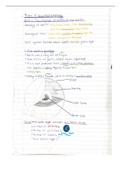
The hydrological cycle refers to the cycle of water between atmosphere, litho
1. Hydrology and fluvial geomorphology The drainage basin is an open system as it allows the movement of energy an
boundaries.
Monday, 22 February 2021 3:05 PM The global hydrological cycle is a closed system as there is no transfer of mat
or leaves the system. However, there may be transfers of energy crossing the
system, such as solar energy and gravitational potential energy.
condensation The hydrological cycle: Also called the water cycle is the Middle course landforms Meanders are bends in
movement of water between the ocean, atmosphere, earth Erosional and depositional landforms speed of waterflow bet
surface (vegetation and underground - ground water stores). water, the thalweg, occ
deeper and there is less
transpiration Drainage basin: Also called the river basin or the catchment action and abrasion, th
precipitation area, it is the area of land surrounding a river where the river river cliff on the outer b
water comes from. channel being shallowe
Watershed: The boundary of the drainage basin which divides energy, material is depo
one river basin from another. within a meander] on th
evaporation
throughflow overland flow
Upstream Do
○ Cross section = (of the river) the width of the river multiplied by the
groundwater flow average depth across the river. It is measured in m².
Increases downstream as the river is wider and deeper.
○ River velocity = the speed of the river water. It is measured in m/sec. Occupied chan
Infiltration = downwards movement in soil Increases downstream as there are less friction. Chan
Percolation = downwards movement in rocks Determined by: Averag
Throughflow = sideways movement of water through soil - Gradient of river profile [steeper gradient]
Groundwater flow = sideways movement of water through rocks - Volume of water [larger volume] Load
- Amount of friction between the bed, banks and bedload [less
The three types of clouds friction]
Load particle size
Cirrus: high altitude, thin clouds like horse tails ○ River discharge = the amount of water flowing in a river. It is measured Channel bed roughness
Cumulus: white, fluffy clouds which look like cauliflower in cumecs or m³ per second. It is calculated by cross section (m²) Slope angle (gradient)
Stratus: clouds which form in lays, when they are grey they cause rain multiplied by the velocity (m/sec).
A useless
The long profile of the river is the line drawn from the source to the mouth showing
how the gradient of the river changes. A normal river will have a steeper gradient at Upper course landforms Waterfalls are formed when there is a layer of hard rocks (granite
the upper course and a gentle gradient at the lower course. Erosional landforms situated over soft rocks (sandstone).
→ When water run over them, the soft rock is eroded quicker
Erosion: the break up of the Hydraulic action: the force of water flowing in the river
Pressure of water/air hard rock and this creates a step.
banks and bed of the river removes particles of rock from the river bed and banks.
pressurized in cracks. Water is forced into cracks in the bank. Overtime it breaks → As erosion continues, the hard rock is undercut forming an
channel and removal of the up the bank. → Abrasion and hydraulic action erodes to create a plunge p
material so the river channel
→ Overtime, the plunge pool gets bigger, increasing the size o
becomes wider and deeper. Solution [corrosion]: the slightly acidic water overhang until the hard rock is no longer supported.
Requires a lot of energy. Abrasion [corrasion]: the will dissolves the bed and banks made up of
some rock types. For example, limestone and
→ It collapses into the plunge pool to be broken up by attritio
river's bed load is bounced by
1. Hydrology and fluvial geomorphology The drainage basin is an open system as it allows the movement of energy an
boundaries.
Monday, 22 February 2021 3:05 PM The global hydrological cycle is a closed system as there is no transfer of mat
or leaves the system. However, there may be transfers of energy crossing the
system, such as solar energy and gravitational potential energy.
condensation The hydrological cycle: Also called the water cycle is the Middle course landforms Meanders are bends in
movement of water between the ocean, atmosphere, earth Erosional and depositional landforms speed of waterflow bet
surface (vegetation and underground - ground water stores). water, the thalweg, occ
deeper and there is less
transpiration Drainage basin: Also called the river basin or the catchment action and abrasion, th
precipitation area, it is the area of land surrounding a river where the river river cliff on the outer b
water comes from. channel being shallowe
Watershed: The boundary of the drainage basin which divides energy, material is depo
one river basin from another. within a meander] on th
evaporation
throughflow overland flow
Upstream Do
○ Cross section = (of the river) the width of the river multiplied by the
groundwater flow average depth across the river. It is measured in m².
Increases downstream as the river is wider and deeper.
○ River velocity = the speed of the river water. It is measured in m/sec. Occupied chan
Infiltration = downwards movement in soil Increases downstream as there are less friction. Chan
Percolation = downwards movement in rocks Determined by: Averag
Throughflow = sideways movement of water through soil - Gradient of river profile [steeper gradient]
Groundwater flow = sideways movement of water through rocks - Volume of water [larger volume] Load
- Amount of friction between the bed, banks and bedload [less
The three types of clouds friction]
Load particle size
Cirrus: high altitude, thin clouds like horse tails ○ River discharge = the amount of water flowing in a river. It is measured Channel bed roughness
Cumulus: white, fluffy clouds which look like cauliflower in cumecs or m³ per second. It is calculated by cross section (m²) Slope angle (gradient)
Stratus: clouds which form in lays, when they are grey they cause rain multiplied by the velocity (m/sec).
A useless
The long profile of the river is the line drawn from the source to the mouth showing
how the gradient of the river changes. A normal river will have a steeper gradient at Upper course landforms Waterfalls are formed when there is a layer of hard rocks (granite
the upper course and a gentle gradient at the lower course. Erosional landforms situated over soft rocks (sandstone).
→ When water run over them, the soft rock is eroded quicker
Erosion: the break up of the Hydraulic action: the force of water flowing in the river
Pressure of water/air hard rock and this creates a step.
banks and bed of the river removes particles of rock from the river bed and banks.
pressurized in cracks. Water is forced into cracks in the bank. Overtime it breaks → As erosion continues, the hard rock is undercut forming an
channel and removal of the up the bank. → Abrasion and hydraulic action erodes to create a plunge p
material so the river channel
→ Overtime, the plunge pool gets bigger, increasing the size o
becomes wider and deeper. Solution [corrosion]: the slightly acidic water overhang until the hard rock is no longer supported.
Requires a lot of energy. Abrasion [corrasion]: the will dissolves the bed and banks made up of
some rock types. For example, limestone and
→ It collapses into the plunge pool to be broken up by attritio
river's bed load is bounced by