Public International Law Lecture 5
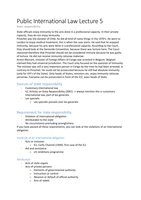
State responsibility
State officials enjoy immunity to the acts done in a professional capacity. In their private
capacity, they do not enjoy immunity.
Pinochet was the dictator of Chile, he did all kind of nasty things in the 1970’s. He went to
London to enjoy medical treatment; this is when the case starts. He said that he enjoyed
immunity, because his acts were done in a professional capacity. According to the Court,
they should look at the Genocide Convention, because there was torture here. The Court
reasoned therefore that Pinochet should not be considered immune because he was guilty
of torture. He did not receive immunity rationae materiae.
Arrest Warrant, minister of Foreign Affairs of Congo was arrested in Belgium. Belgium
claimed they had universal jurisdiction. The Court only focused on the question of immunity.
The minister was still a very important person in Congo by the time he had been arrested, in
contrary to Pinochet. He could not be prosecuted because he still had absolute immunity
(only for VIP’s of the State). Only heads of States, ministers etc. enjoy immunity rationae
personae. Everyone can be prosecuted in front of the ICC, even heads of State.
Sources of state responsibility
- Customary international law
- ILC Articles on State Responsibility (2001) -> always mention this is customary
international law, part of lex generalis
- Lex specialis
o Lex specialis prevails over lex generalis
Requirement for state responsibility
- Violation of international obligation
- Attributable to the state
- No circumstance precluding wrongfulness
If you have passed all these requirements, you can look at the violations of an international
obligation.
Violation of an international obligation
- Acts or omission
o ICJ, Corfu Channel (1949): first case of the ICJ.
- Aid and assistance
o US renditions programme
Attribution
- Acts of state organs
- Acts of private persons
o Elements of governmental authority
o Instruction or control
o Absence or default of official authority
o Acts of rebels
State responsibility
State officials enjoy immunity to the acts done in a professional capacity. In their private
capacity, they do not enjoy immunity.
Pinochet was the dictator of Chile, he did all kind of nasty things in the 1970’s. He went to
London to enjoy medical treatment; this is when the case starts. He said that he enjoyed
immunity, because his acts were done in a professional capacity. According to the Court,
they should look at the Genocide Convention, because there was torture here. The Court
reasoned therefore that Pinochet should not be considered immune because he was guilty
of torture. He did not receive immunity rationae materiae.
Arrest Warrant, minister of Foreign Affairs of Congo was arrested in Belgium. Belgium
claimed they had universal jurisdiction. The Court only focused on the question of immunity.
The minister was still a very important person in Congo by the time he had been arrested, in
contrary to Pinochet. He could not be prosecuted because he still had absolute immunity
(only for VIP’s of the State). Only heads of States, ministers etc. enjoy immunity rationae
personae. Everyone can be prosecuted in front of the ICC, even heads of State.
Sources of state responsibility
- Customary international law
- ILC Articles on State Responsibility (2001) -> always mention this is customary
international law, part of lex generalis
- Lex specialis
o Lex specialis prevails over lex generalis
Requirement for state responsibility
- Violation of international obligation
- Attributable to the state
- No circumstance precluding wrongfulness
If you have passed all these requirements, you can look at the violations of an international
obligation.
Violation of an international obligation
- Acts or omission
o ICJ, Corfu Channel (1949): first case of the ICJ.
- Aid and assistance
o US renditions programme
Attribution
- Acts of state organs
- Acts of private persons
o Elements of governmental authority
o Instruction or control
o Absence or default of official authority
o Acts of rebels