The Foreign Exchange Market
The Foreign Exchange Market is a global marketplace made up of banks and dealers/brokers where
differing national currencies are bought and sold in spot markets and derivative markets such as
forwards, futures, options and swaps. Huge sums of money are exchanged on a daily basis over $4
trillion per day. The main centre for foreign exchange is London followed by New York.
The exchange rate is simply the price of one currency in terms of another. It can be expressed in two
ways:
1. The foreign currency per units of the domestic currency: $1.6212/£1. This means that
$1.6212 are needed to buy £1. If there is a rise in the dollars per pound exchange rate from
$1.6212/£1 to $1.80/£1 then more dollars are obtained per pound so the pound has
appreciated as it is worth more now (or equivalently the dollar has depreciated).
2. The domestic currency per units of the foreign currency: £0.6168/$1. This means that only
£0.6168 is needed to buy $1. If there is a rise in the pounds per dollar exchange rate from
£0.6168/$1 to £0.8/$1 it means that more pounds have to be given to obtain a dollar, which
means that the pound has depreciated in value as it doesn’t obtain you as much any more
(or the dollar has appreciated as it is worth more pounds now).
Exchange rates are expressed as bid and offer rates. For example the midpoint for the exchange rate
is $1.6212/£1. The bid rate is the rate at which the bank will buy pounds (sell dollars) which is
$1.6210/£1. The offer rate is the rate at which the bank will sell pounds (buy dollars) which is
$1.6214/£1. In this example, the bank would buy £1 and so would need to give up $1.6210. They will
then sell this £1 for $1.6214 and so will gain $0.0004 per pound.
The main participants of the foreign exchange market are retail clients, commercial banks, foreign
exchange brokers, central banks and other authorised agents. The most important foreign exchange
centres are London, Tokyo, New York, Singapore and Frankfurt. They keep in contact with one
another with developments in the market via telephone, computer terminals and fax. The most
active centres are London, with a daily turnover averaging $1359 billion, followed by New York with
$662 billion. The most traded currency is the US dollar.
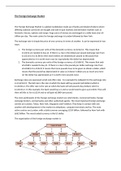
The organisation of the foreign exchange market is:
, Arbitrage in the Foreign Exchange Market
The FCA (Financial Centre Arbitrage) is a type of arbitrage (the exploitation of price differentials for
riskless guaranteed profits) ensures that the dollar-pound exchange rate quoted in New York will be
the same as that quoted in London and other financial centres. If the exchange rate is $1.61/£1 in
New York but it is $1.59/£1 in London, it would be profitable for banks to buy pounds in London as
they only have to give up $1.59 and simultaneously sell pounds in New York because they’ll get
$1.61 in London and so will guarantee 2 cents for every pound bought and sold. If the banks keep
buying £1 in London, the dollar will start to depreciate because the supply of dollars will have
increased when they bought pounds; whilst selling pounds in New York will lead to an appreciation
of the dollar in New York. This process continues until the rate quoted in the two centres coincides
at $1.60/£1 for example.
Cross-Currency Arbitrage exploits the differences between the exchange rate of different currencies.
For example, if the exchange rate of the dollar against the pound is $1.65/£1 and the exchange rate
of the dollar against the euro is $1.50/€1, currency arbitrage implies that the exchange rate of the
euro against the pound will be €1.10/£1. This is because for £1 you need $1.65, but £1 is only worth
$1.50 so you need more euros to have the right amount in dollars so it is:
1.65
=1.1 so the euro against the pound rate is €1.1/£1. If the Euro-Dollar rate is not equal to
1.5
$1.10/ €1, there will be an arbitrage opportunity.
Spot and Forward Exchange Rate
The spot exchange rate is the quote or the exchange rate between two currencies for immediate
delivery. The forward exchange rate is the exchange rate between two currencies quoted for a given
date in the future. A variety of forward rates may be quoted: (1 month, 3 months, 6 months and a
year).
The demand for foreign exchange:
As the pound appreciates against the dollar, the rate moves from $1.40/£1 to $2/£1 so it is more
expensive for US citizens to obtain goods as the price of UK exports to US importers increases. This
leads to lower quantity of exports with a reduced demand for pounds so as the exchange rate
increases, the demand is less so when the rate is $1/£1 only 6000 pounds are demanded but when it
drops to $1.40/£1, 1400 pounds are demanded so it is a negative slope because as the exchange rate
The Foreign Exchange Market is a global marketplace made up of banks and dealers/brokers where
differing national currencies are bought and sold in spot markets and derivative markets such as
forwards, futures, options and swaps. Huge sums of money are exchanged on a daily basis over $4
trillion per day. The main centre for foreign exchange is London followed by New York.
The exchange rate is simply the price of one currency in terms of another. It can be expressed in two
ways:
1. The foreign currency per units of the domestic currency: $1.6212/£1. This means that
$1.6212 are needed to buy £1. If there is a rise in the dollars per pound exchange rate from
$1.6212/£1 to $1.80/£1 then more dollars are obtained per pound so the pound has
appreciated as it is worth more now (or equivalently the dollar has depreciated).
2. The domestic currency per units of the foreign currency: £0.6168/$1. This means that only
£0.6168 is needed to buy $1. If there is a rise in the pounds per dollar exchange rate from
£0.6168/$1 to £0.8/$1 it means that more pounds have to be given to obtain a dollar, which
means that the pound has depreciated in value as it doesn’t obtain you as much any more
(or the dollar has appreciated as it is worth more pounds now).
Exchange rates are expressed as bid and offer rates. For example the midpoint for the exchange rate
is $1.6212/£1. The bid rate is the rate at which the bank will buy pounds (sell dollars) which is
$1.6210/£1. The offer rate is the rate at which the bank will sell pounds (buy dollars) which is
$1.6214/£1. In this example, the bank would buy £1 and so would need to give up $1.6210. They will
then sell this £1 for $1.6214 and so will gain $0.0004 per pound.
The main participants of the foreign exchange market are retail clients, commercial banks, foreign
exchange brokers, central banks and other authorised agents. The most important foreign exchange
centres are London, Tokyo, New York, Singapore and Frankfurt. They keep in contact with one
another with developments in the market via telephone, computer terminals and fax. The most
active centres are London, with a daily turnover averaging $1359 billion, followed by New York with
$662 billion. The most traded currency is the US dollar.
The organisation of the foreign exchange market is:
, Arbitrage in the Foreign Exchange Market
The FCA (Financial Centre Arbitrage) is a type of arbitrage (the exploitation of price differentials for
riskless guaranteed profits) ensures that the dollar-pound exchange rate quoted in New York will be
the same as that quoted in London and other financial centres. If the exchange rate is $1.61/£1 in
New York but it is $1.59/£1 in London, it would be profitable for banks to buy pounds in London as
they only have to give up $1.59 and simultaneously sell pounds in New York because they’ll get
$1.61 in London and so will guarantee 2 cents for every pound bought and sold. If the banks keep
buying £1 in London, the dollar will start to depreciate because the supply of dollars will have
increased when they bought pounds; whilst selling pounds in New York will lead to an appreciation
of the dollar in New York. This process continues until the rate quoted in the two centres coincides
at $1.60/£1 for example.
Cross-Currency Arbitrage exploits the differences between the exchange rate of different currencies.
For example, if the exchange rate of the dollar against the pound is $1.65/£1 and the exchange rate
of the dollar against the euro is $1.50/€1, currency arbitrage implies that the exchange rate of the
euro against the pound will be €1.10/£1. This is because for £1 you need $1.65, but £1 is only worth
$1.50 so you need more euros to have the right amount in dollars so it is:
1.65
=1.1 so the euro against the pound rate is €1.1/£1. If the Euro-Dollar rate is not equal to
1.5
$1.10/ €1, there will be an arbitrage opportunity.
Spot and Forward Exchange Rate
The spot exchange rate is the quote or the exchange rate between two currencies for immediate
delivery. The forward exchange rate is the exchange rate between two currencies quoted for a given
date in the future. A variety of forward rates may be quoted: (1 month, 3 months, 6 months and a
year).
The demand for foreign exchange:
As the pound appreciates against the dollar, the rate moves from $1.40/£1 to $2/£1 so it is more
expensive for US citizens to obtain goods as the price of UK exports to US importers increases. This
leads to lower quantity of exports with a reduced demand for pounds so as the exchange rate
increases, the demand is less so when the rate is $1/£1 only 6000 pounds are demanded but when it
drops to $1.40/£1, 1400 pounds are demanded so it is a negative slope because as the exchange rate