Main Topics – Distribution Management
Chapter 1 – 21st-Century Supply Chains
Six-Sigma: The growing managerial commitment to zero defect.
Perfect Orders: Delivering the desired assortment and quantity of products to the right location on
time, damage-free, and correctly invoiced.
Economic Value: Economic value builds on economy of scale in operations as the source of efficiency.
Procurement / Manufacturing Strategy
Market Value: Market value is about presenting an attractive assortment of products at the right time
and place to realize effectiveness. Market value focusses on economies of scope in product/service
presentation. Market / Distribution Strategy
Relevancy Value: Relevancy value involves customization of value-adding services, over and above
basic product characteristics and physical location, that make a real difference to customers. Relevancy
value means the right products and services, as reflected by market value, at the right price, as
reflected by economic value, modified, sequence, synchronized, and positioned in a manner that
creates customer-specific value. Supply Chain Strategy
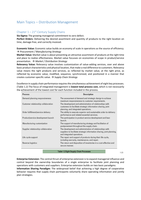
Excellence in supply chain performance requires the simultaneous achievement of eight key processes.
(Table 1.2) The focus of integrated management is lowest total process cost, which is not necessarily
the achievement of the lowest cost for each function included in the process.
Enterprise Extension: The central thrust of enterprise extension is to expand managerial influence and
control beyond the ownership boundaries of a single enterprise to facilitate joint planning and
operations with customers and suppliers. Enterprise extension builds on two basic paradigms:
Information Sharing Paradigm: The widespread belief that achieving a high degree of cooperative
behavior requires that supply chain participants voluntarily share operating information and jointly
plan strategies.
Chapter 1 – 21st-Century Supply Chains
Six-Sigma: The growing managerial commitment to zero defect.
Perfect Orders: Delivering the desired assortment and quantity of products to the right location on
time, damage-free, and correctly invoiced.
Economic Value: Economic value builds on economy of scale in operations as the source of efficiency.
Procurement / Manufacturing Strategy
Market Value: Market value is about presenting an attractive assortment of products at the right time
and place to realize effectiveness. Market value focusses on economies of scope in product/service
presentation. Market / Distribution Strategy
Relevancy Value: Relevancy value involves customization of value-adding services, over and above
basic product characteristics and physical location, that make a real difference to customers. Relevancy
value means the right products and services, as reflected by market value, at the right price, as
reflected by economic value, modified, sequence, synchronized, and positioned in a manner that
creates customer-specific value. Supply Chain Strategy
Excellence in supply chain performance requires the simultaneous achievement of eight key processes.
(Table 1.2) The focus of integrated management is lowest total process cost, which is not necessarily
the achievement of the lowest cost for each function included in the process.
Enterprise Extension: The central thrust of enterprise extension is to expand managerial influence and
control beyond the ownership boundaries of a single enterprise to facilitate joint planning and
operations with customers and suppliers. Enterprise extension builds on two basic paradigms:
Information Sharing Paradigm: The widespread belief that achieving a high degree of cooperative
behavior requires that supply chain participants voluntarily share operating information and jointly
plan strategies.