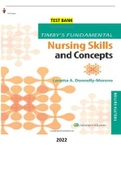
Title: Test Bank for Timbys Fundamental Nursing skills and Concepts 12th Edition by Loretta Donnelly-Moreno
Timbys Fundamental Nursing skills and Concepts 12Ed. by Loretta A Donnelly-Moreno . COMPLETE, Elaborated and Latest Test Bank . ALL Chapters Included 1-38. 516 Pages of Content-A+ Graded for 2023COMPLETE - Elaborated Test Bank for Timbys Fundamental Nursing skills and Concepts 12Ed. by Loretta A Donnelly-Moreno . ALL Chapters Included 1-38. 516 Pages of Content-A+ Graded for 2023
Introducing Public Administration 10Ed by Jay M. Shafritz, E. W. Russell , Christopher P. Borick & Albert C. Hyde
TABLE OF CONTENTS
UNIT 1 Exploring Contemporary Nursing
Chapter 1 Nursing Foundations
Chapter 2 Nursing Process
UNIT 2 Integrating Basic Concepts
Chapter 3 Laws and Ethics
Chapter 4 Health and Illness
Chapter 5 Homeostasis, Adaptation, and Stress
Chapter 6 Culture and Ethnicity
UNIT 3 Fostering Communication
Chapter 7 The Nurse–Client Relationship
Chapter 8 Client Teaching
Chapter 9 Recording and Reporting
UNIT 4 Performing Basic Client Care
Chapter 10 Asepsis
Chapter 11 Admission, Discharge, Transfer, and Referrals
Chapter 12 Vital Signs
Chapter 13 Physical Assessment
Chapter 14 Special Examinations and Tests
UNIT 5 Assisting With Basic Needs
Chapter 15 Nutrition
Chapter 16 Fluid and Chemical Balance
Chapter 17 Hygiene
Chapter 18 Comfort, Rest, and Sleep
Chapter 19 Safety
Chapter 20 Pain Management
Chapter 21 Oxygenation
Chapter 22 Infection Control
UNIT 6 Assisting the Inactive Client
Chapter 23 Body Mechanics, Positioning, and Moving
Chapter 24 Fitness and Therapeutic Exercise
Chapter 25 Mechanical Immobilization
Chapter 26 Ambulatory Aids
UNIT 7 The Surgical Client
Chapter 27 Perioperative Care
Chapter 28 Wound Care
Chapter 29 Gastrointestinal Intubation
UNIT 8 Promoting Elimination
Chapter 30 Urinary Elimination
Chapter 31 Bowel Elimination
UNIT 9 Medication Administration
Chapter 32 Oral Medications
Chapter 33 Topical and Inhalant Medications
Chapter 34 Parenteral Medications
Chapter 35 Intravenous Medications
UNIT 10 Intervening in Emergency Situations
Chapter 36 Airway Management
Chapter 37 Resuscitation
UNIT 11 Caring for the Terminally Ill
Chapter 38 End-of-Life Care
Chapter 1
1. A client reports to the emergency department with ankle pain due to a minor road accident.
By asking the client to describe the accident, which type of nursing skill is the nurse using?
A. assessment skills
B. comforting skills
C. counseling skills
D. caring skills
Answer: A
Rationale: By asking the client to describe the accident, the nurse is using assessment skills to
collect more information about the client's condition. The nurse is interviewing the client to
collect related data. The nurse is not using comforting skills, as the nurse is not providing any
emotional support. The counseling skills of the nurse are also not used, as no health education
is provided. Caring skills include assistance provided with the activities of daily living, which
is not applicable in this scenario.
Question format: Multiple Choice
Chapter 1: Nursing Foundations
Cognitive Level: Understand
Client Needs: Safe, Effective Care Environment: Management of Care
Integrated Process: Nursing Process
Reference: p. 15
2. One of the nursing achievements in the Crimean War was that the death rate of soldiers dropped from 60% to 1%. What is the most appropriate reason for the fall in the death rate?
A. increased motivation among the soldiers
B. decreased rate of infection and gangrene
C. increased funds courtesy of donations from families
D. college-based education and training of nurses
Answer: B
Rationale: During the Crimean War, the death rate of British soldiers was 60%, which
dropped to 1% due to the nursing care provided. The nurses improved the ventilation,
nutritional, and sanitary conditions of the soldiers, leading to decreased rates of infection and
gangrene. As a result, the death rate dropped. The families and the soldiers donated funds after the war, not during the war, through which an organized education and training facility
for nurses was started.
Question format: Multiple Choice
Chapter 1: Nursing Foundations
Cognitive Level: Remember
Client Needs: Safe, Effective Care Environment: Safety and Infection Control
Integrated Process: Nursing Process
Reference: p. 3
3. A nurse at a health care facility provides information, assistance, and encouragement to
clients during the various phases of nursing care. In which activity does the nurse use counseling skills?
A. educating a group of young girls about AIDS
B. telling a client to localize the pain in his abdomen
C. encouraging a client to walk without support
D. assisting a lactating mother in feeding her child
Answer: A
Rationale: The activity of educating a group of young girls about AIDS is based on the nurse using counseling skills. Telling a client to localize his pain is an assessment skill.
Encouraging a client to walk without support can be both a comforting skill and a caring
skill. Assisting a lactating mother in feeding her baby is an example of a caring skill.
Question format: Multiple Choice
Chapter 1: Nursing Foundations
Cognitive Level: Understand
Client Needs Pn: Safe, Effective Care Environment: Coordinated Care
Client Needs: Safe, Effective Care Environment: Management of Care
Client Needs: Health Promotion and Maintenance
Client Needs Pn: Health Promotion and Maintenance
Integrated Process: Teaching/Learning
Reference: p. 15
4. A nurse is conducting an interview of a 40-year-old client who is admitted with chest pain.
Which action by the nurse indicates active listening?
A. listening to the client silently
B. interrupting after each sentence
C. asking for clarifications and repetitions
D. talking about the nurse's own experience
Answer: C
Rationale: Active listening is an important component of counseling skills. It encourages the client to open up and express their concerns. The nurse may ask the client to repeat and
clarify statements. Interrupting after every sentence may annoy the client. When the nurse listens to the client silently, the client may feel that the nurse is not interested. On the other
hand, if the nurse talks about the nurse's own experience, the focus of the session shifts to the nurse rather than to the client.
Question format: Multiple Choice
Chapter 1: Nursing Foundations
Cognitive Level: Apply
Client Needs: Psychosocial Integrity
Integrated Process: Caring
Reference: p. 15
5. A student wants to attend a nursing program that prepares its graduates for both staff and
managerial positions. Which type of nursing program should the nurse suggest for this student?
A. hospital-based diploma
B. baccalaureate nursing program
C. associate degree program
D. continuing nursing program
Answer: B
Rationale: Baccalaureate-prepared nurses have the greatest potential for qualifying for
nursing positions at both staff and managerial levels. Hospital-based diploma programs are 3-
year courses and provide maximum exposure to clinical nursing. Students becoming nurses
through the associate degree program would not be expected to work in a management position. Continuing nursing programs are on-the-job educational programs.
Question format: Multiple Choice
Chapter 1: Nursing Foundations
Cognitive Level: Remember
Client Needs Pn: Safe, Effective Care Environment: Coordinated Care
Client Needs: Safe, Effective Care Environment: Management of Care
Integrated Process: Teaching/Learning
Reference: p. 11
6. A client is brought to the emergency department with a head injury following an all-terrain
vehicle (ATV) accident. The nurse asks the family members to describe how the accident occurred. The nurse is implementing which type of skill?
A. assessment skills
B. caring skills
C. counseling skills
D. comforting skills
Answer: A
Rationale: The immediate requirement when a client is brought to the emergency department with a head injury is to assess the injury and the system affected, as well as a description of
how the accident occurred. This requires implementation of assessment skills. Subsequently,
the nurse can implement caring skills, counseling skills, and comforting skills; however,
assessment should be the priority.
Question format: Multiple Choice
Chapter 1: Nursing Foundations
Cognitive Level: Understand
Client Needs: Safe, Effective Care Environment: Management of Care
Integrated Process: Nursing Process
Reference: p. 15
7. Training schools for nurses were established in the United States after the Civil War. The standards of U.S. schools deviated from those of the Nightingale paradigm. Which statement is true about U.S. training schools?
A. Training schools were affiliated with a few select hospitals.
B. Training of nurses provided no financial advantages to the hospital.
C. Training was formal, based on nursing care.
D. Training schools eliminated the need to pay employees.
Answer: D
Rationale: Training schools in the United States profited by eliminating the need to pay
employees because students worked without pay in return for training, which usually
consisted of chores. U.S. training schools were established by any hospital; there was no
formal training. Training was an outcome of work, which eliminated the need to pay
employees. Nightingale training schools were affiliated with a few select hospitals, training
of nurses provided no financial advantages to the hospital, and the training was formal, based
on nursing care.
Question format: Multiple Choice
Chapter 1: Nursing Foundations
Cognitive Level: Remember
Client Needs Pn: Safe, Effective Care Environment: Coordinated Care
Client Needs: Safe, Effective Care Environment: Management of Care
Integrated Process: Teaching/Learning
Reference: p. 5
8. In a nursing unit, the RN delegates nursing tasks to the LPN. Keeping in mind the delegation guidelines, which statement denotes the right task for the LPN?
A. Make beds with the help of unlicensed assistive personnel.
B. Assist clients with nasogastric tube feeds.
C. Take orders from an in-house physician.
D. Assess the client's needs and start an intravenous line.
Answer: B
Rationale: Assisting clients with nasogastric tube feeding is an appropriate task for an LPN,
as it does not require independent decisions and sophisticated techniques. According to the delegation guidelines, "right task" means that the task should be assigned according to the competency of the caregiver. LPNs may not be authorized to make independent decisions,
like starting an IV line, for the client. Bed making is a very basic task and may not be appropriate for an LPN if the UAP is already present. When the RN and LPN are present, the RN takes the physician's orders.
Question format: Multiple Choice
Chapter 1: Nursing Foundations
Cognitive Level: Apply
Client Needs: Physiological Integrity: Basic Care and Comfort
Integrated Process: Nursing Process
Reference: p. 8
9. A 50-year-old client reports to a primary care unit with an open wound due to a fall in the bathroom. Which nursing actions represent caring skills?
A. The nurse cleans the wound and applies a dressing to it.
B. The nurse inspects and examines the wound for swelling.
C. The nurse tells the client to take care while on slippery surfaces.
D. The nurse informs the client that the wound is small and will heal easily.
Answer: A
Rationale: The nursing action of cleaning the wound and applying a dressing indicates caring
skills. Caring skills involve nursing interventions that restore or maintain a person's health.
The nurse implements assessment skills while inspecting and examining the wound. The nurse counsels the client to take care when walking on slippery surfaces. By informing the client about the wound's condition, the nurse uses comforting skills.
Question format: Multiple Choice
Chapter 1: Nursing Foundations
Cognitive Level: Understand
Client Needs: Physiological Integrity: Basic Care and Comfort
Integrated Process: Caring
Reference: p. 15
10. The scope and character of nursing practice underwent significant changes in the years following the Civil War. Which activity exemplifies nursing practice in the early years of the 20th century?
A. providing basic health care to recent immigrants to the United States
B. contributing to the scientific knowledge base of nursing by conducting research
C. participating in collaborative practice with physicians
D. establishing school nursing as a recognized specialty in urban settings
Answer: A
Rationale: In the early 20th century, some nurses moved into communities and established
"settlement houses" where they lived and worked among poor immigrants. This period of
history was not characterized by collaboration between physicians and nurses due to the subservient view of nursing that prevailed. Research and school nursing were not major
focuses at this time.
Question format: Multiple Choice
Chapter 1: Nursing Foundations
Cognitive Level: Understand
Client Needs: Safe, Effective Care Environment: Management of Care
Integrated Process: Teaching/Learning
Reference: p. 4
11. A nursing student has begun a clinical placement at a large hospital that serves a diverse
population. The student has consequently acquired a new appreciation for the fact that nursing combines art with science. What is the clearest manifestation of the scientific basis for nursing?
A. mentoring students and junior nurses
B. providing evidence-based nursing care
C. maintaining an attitude of curiosity
D. participating in continuing educational activities
Answer: B
Rationale: By developing an accumulating body of unique scientific knowledge, it is now possible to predict which nursing interventions are most likely to produce desired outcomes, a process referred to as evidence-based practice (EBP). EBP is possible because of the scientific basis that underlies nursing. Mentoring, maintaining curiosity, and participating in
continuing education are beneficial, but these are not direct manifestations of the scientific basis for nursing.
Question format: Multiple Choice
Chapter 1: Nursing Foundations
Cognitive Level: Understand
Client Needs: Safe, Effective Care Environment: Management of Care
Integrated Process: Teaching/Learning
Reference: p. 6
12. Beginning with Florence Nightingale, many definitions of nursing have been put forth by
individual nurses and by nursing organizations. Which statement best describes an aspect of
the changes in these definitions over time?
A. drawing a clear distinction between the art of nursing and science of nursing
B. definitions of nursing that have become narrower in scope over time
C. characterization of nursing as a discipline that is a distinct alternative to medical treatment
D. definition of an independent health care practice that is not solely dependent on physicians
Answer: D
Rationale: The most recent definitions of nursing specify that nursing has an independent area of practice in addition to traditional dependent and interdependent functions involving
physicians. This does not mean, however, that nursing is an alternative to medical treatment.
Definitions have become broader over time and address the fact that nursing combines art with science.
Question format: Multiple Choice
Chapter 1: Nursing Foundations
Cognitive Level: Remember
Client Needs: Safe, Effective Care Environment: Management of Care
Integrated Process: Teaching/Learning
Reference: p. 6
13. A team of nurses who provide care in a community hospital have been encouraged to
participate in continuing educational activities. Why is continuing education needed in
nursing?
A. Continuing education helps to delineate the distinctions between nurses and physicians.
B. Continuing education increases the public visibility of individual nurses and the nursing
profession.
C. Continuing education has the potential to partially alleviate the nursing shortage.
D. Continuing education allows for safer division of labor on hospital units and more effective delegation of tasks.
Answer: C
Rationale: Health care officials hope that enrollment in all nursing programs and continuing
education will reduce the current and projected critical shortage of nurses. Continuing
education is not driven by a desire to increase the visibility of nursing, to draw distinctions between nursing and medicine, or to facilitate the division of labor.
Question format: Multiple Choice
Chapter 1: Nursing Foundations
Cognitive Level: Remember
Client Needs: Safe, Effective Care Environment: Management of Care
Integrated Process: Teaching/Learning
Reference:
Content preview
Prof.Exams
TEST BANK
2022
,Prof.Exams
COMPLETE
Elaborated Test Bank
for
Timby’s Fundamental
Nursing skills and Concepts
12Ed.
by
Loretta A Donnelly-Moreno .
2022
,Prof.Exams
TABLE OF CONTENTS
UNIT 1 Exploring Contemporary Nursing
Chapter 1 Nursing Foundations
Chapter 2 Nursing Process
UNIT 2 Integrating Basic Concepts
Chapter 3 Laws and Ethics
Chapter 4 Health and Illness
Chapter 5 Homeostasis, Adaptation, and Stress
Chapter 6 Culture and Ethnicity
UNIT 3 Fostering Communication
Chapter 7 The Nurse–Client Relationship
Chapter 8 Client Teaching
Chapter 9 Recording and Reporting
UNIT 4 Performing Basic Client Care
Chapter 10 Asepsis
Chapter 11 Admission, Discharge, Transfer, and Referrals
Chapter 12 Vital Signs
Chapter 13 Physical Assessment
Chapter 14 Special Examinations and Tests
UNIT 5 Assisting With Basic Needs
Chapter 15 Nutrition
Chapter 16 Fluid and Chemical Balance
Chapter 17 Hygiene
Chapter 18 Comfort, Rest, and Sleep
Chapter 19 Safety
Chapter 20 Pain Management
Chapter 21 Oxygenation
Chapter 22 Infection Control
, Prof.Exams
UNIT 6 Assisting the Inactive Client
Chapter 23 Body Mechanics, Positioning, and Moving
Chapter 24 Fitness and Therapeutic Exercise
Chapter 25 Mechanical Immobilization
Chapter 26 Ambulatory Aids
UNIT 7 The Surgical Client
Chapter 27 Perioperative Care
Chapter 28 Wound Care
Chapter 29 Gastrointestinal Intubation
UNIT 8 Promoting Elimination
Chapter 30 Urinary Elimination
Chapter 31 Bowel Elimination
UNIT 9 Medication Administration
Chapter 32 Oral Medications
Chapter 33 Topical and Inhalant Medications
Chapter 34 Parenteral Medications
Chapter 35 Intravenous Medications
UNIT 10 Intervening in Emergency Situations
Chapter 36 Airway Management
Chapter 37 Resuscitation
UNIT 11 Caring for the Terminally Ill
Chapter 38 End-of-Life Care