3.1 – What is Business?
Why businesses exist
Business – An organisation or individual that provides a good or service to customers
Tangible – A real thing
Goods / products are tangible
Services are intangible
Four factors of production – The 4 things a business needs to be able to produce their
goods / services.
1. Capital (Finance)
2. Enterprise (Skills of employees to combine the other 3)
3. Land (Natural resources and location)
4. Labour (Workers)
Value added
Needs – In order to survive
Wants – In order to enjoy
Why businesses exist:
Create wealth
Create jobs
Benefit society
Support other businesses (supply chain)
Provide a source of tax revenue for the government
1
, 3.1 – What is Business?
Aims and Objectives
Aim – Generic, broad, long-term goals for the future.
Objective – More specific, SMART, short-term goals to achieve aims.
Specific
Measurable
Agreed
Realistic
Time-related
Types of aims:
Survival – At least break even
Growth – Reinvest profits to increase market share
Profit maximisation – Increase revenue or cut costs
p
r
o
f
i
t
¿
r
e
v
e
n
u
e
− ¿ c
o
s
t
Growth – Increase market share
m
a
r
k
e
t
s
h
a
r
e
¿
b u s i n e s s s a l e s
t o t a l m a r k e t s a l e s
¿
1 0 0
Objectives hierarchy:
1. Aims – One of the 3 types
2. Mission statement
3. Corporate objectives – Relate to the business as a whole e.g., increase market share
by 5% in 3 years.
4. Functional objectives – Help achieve corporate objectives
Influences on business objectives:
Size of business
Private/public sector
Market
Ownership
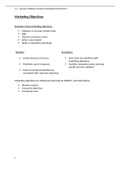
Mission Statements
2
Why businesses exist
Business – An organisation or individual that provides a good or service to customers
Tangible – A real thing
Goods / products are tangible
Services are intangible
Four factors of production – The 4 things a business needs to be able to produce their
goods / services.
1. Capital (Finance)
2. Enterprise (Skills of employees to combine the other 3)
3. Land (Natural resources and location)
4. Labour (Workers)
Value added
Needs – In order to survive
Wants – In order to enjoy
Why businesses exist:
Create wealth
Create jobs
Benefit society
Support other businesses (supply chain)
Provide a source of tax revenue for the government
1
, 3.1 – What is Business?
Aims and Objectives
Aim – Generic, broad, long-term goals for the future.
Objective – More specific, SMART, short-term goals to achieve aims.
Specific
Measurable
Agreed
Realistic
Time-related
Types of aims:
Survival – At least break even
Growth – Reinvest profits to increase market share
Profit maximisation – Increase revenue or cut costs
p
r
o
f
i
t
¿
r
e
v
e
n
u
e
− ¿ c
o
s
t
Growth – Increase market share
m
a
r
k
e
t
s
h
a
r
e
¿
b u s i n e s s s a l e s
t o t a l m a r k e t s a l e s
¿
1 0 0
Objectives hierarchy:
1. Aims – One of the 3 types
2. Mission statement
3. Corporate objectives – Relate to the business as a whole e.g., increase market share
by 5% in 3 years.
4. Functional objectives – Help achieve corporate objectives
Influences on business objectives:
Size of business
Private/public sector
Market
Ownership
Mission Statements
2