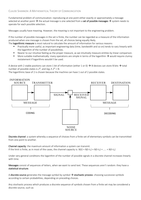
CLAUDE SHANNON: A MATHEMATICAL THEORY OF COMMUNICATION
Fundamental problem of communication: reproducing at one point either exactly or approximately a message
selected at another point the actual message is one selected from a set of possible messages system needs to
operate for each possible selection.
Messages usually have meaning. However, the meaning is not important to the engineering problem.
If the number of possible messages in the set is finite, the number can be regarded as a measure of the information
produced when one message is chosen from the set, all choices being equally likely.
The logarithmic measure is most natural to calculate the amount of information for various reasons:
Practically more useful, as important engineering data (time, bandwidth and so on) tends to vary linearly with
the logarithm of the number of possibilities.
Nearer to our intuitive feeling as the proper measure, as we intuitively measure entities by linear comparison.
More suitable mathematically: many operations are simple in terms of the logarithm would require clumsy
restatement if logarithms wouldn’t be used.
A device with 2 stable positions can store 1 bit of information (either 1 or 0) N devices can store N bits total
number of possible states is 2N, and log2 • 2N = N.
The logarithmic base of 2 is chosen because the machine can have 1 out of 2 possible states.
CODING DECODING
Discrete channel: a system whereby a sequence of choices from a finite set of elementary symbols can be transmitted
from one point to another.
Channel capacity: the maximum amount of information a system can transmit.
If the limit is finite, as in most of the cases, the channel capacity is: N(t) = N(t-t1) + N(t-t2) + ….. + N(t-tn).
Under very general conditions the logarithm of the number of possible signals in a discrete channel increases linearly
with time.
Messages consist of sequences of letters, when we want to send text. These sequences aren’t random: they have a
statistical structure.
A discrete source generates the message symbol by symbol stochastic process: choosing successive symbols
according to certain probabilities, depending on preceding choices.
Any stochastic process which produces a discrete sequence of symbols chosen from a finite set may be considered a
discrete source, such as:
Fundamental problem of communication: reproducing at one point either exactly or approximately a message
selected at another point the actual message is one selected from a set of possible messages system needs to
operate for each possible selection.
Messages usually have meaning. However, the meaning is not important to the engineering problem.
If the number of possible messages in the set is finite, the number can be regarded as a measure of the information
produced when one message is chosen from the set, all choices being equally likely.
The logarithmic measure is most natural to calculate the amount of information for various reasons:
Practically more useful, as important engineering data (time, bandwidth and so on) tends to vary linearly with
the logarithm of the number of possibilities.
Nearer to our intuitive feeling as the proper measure, as we intuitively measure entities by linear comparison.
More suitable mathematically: many operations are simple in terms of the logarithm would require clumsy
restatement if logarithms wouldn’t be used.
A device with 2 stable positions can store 1 bit of information (either 1 or 0) N devices can store N bits total
number of possible states is 2N, and log2 • 2N = N.
The logarithmic base of 2 is chosen because the machine can have 1 out of 2 possible states.
CODING DECODING
Discrete channel: a system whereby a sequence of choices from a finite set of elementary symbols can be transmitted
from one point to another.
Channel capacity: the maximum amount of information a system can transmit.
If the limit is finite, as in most of the cases, the channel capacity is: N(t) = N(t-t1) + N(t-t2) + ….. + N(t-tn).
Under very general conditions the logarithm of the number of possible signals in a discrete channel increases linearly
with time.
Messages consist of sequences of letters, when we want to send text. These sequences aren’t random: they have a
statistical structure.
A discrete source generates the message symbol by symbol stochastic process: choosing successive symbols
according to certain probabilities, depending on preceding choices.
Any stochastic process which produces a discrete sequence of symbols chosen from a finite set may be considered a
discrete source, such as: