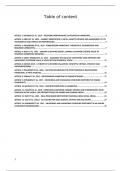
Content
Chapter 7: Communication 1
Chapter 19: Change 7
Chapter 5: Learning 13
Chapter 6: Personality 18
Chapter 9: Motivation 24
Chapter 8: Perception 28
Chapter 12 - Individuals in groups 30
Chapter 13 - Teamworking 36
Chapter 10: Group Formation 41
Chapter 11: Group structure 44
Chapter 21 - Conflict 48
Chapter 7: Communication
Organisational communication
- it’s essential for selection, training, performance review, purchasing supplies,
dealing with customers, problem-solving and determining strategy
- organisational communication is not neutral but an attempt for management to
gauge or change attitude and behaviour
- Communications are improved if you are able to ‘feel’ what others are feeling
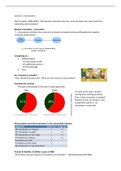
- Quirke’s Communication escalator 2008:
- Interpersonal communication: it is the transfer or exchange of information and
meaning between at least two people, often corresponds to social imperative (social
rules/norms/prerequisites) (e.g. Koole et al., 2010 (112 caller and crying turn talking))
Communication process:
- conversation: a competitive sport in which the first person to draw breath is
declared the listener.
- Communication process: the transmission of information, and the exchange of
meaning, between at least two people
,⇒ We do not receive communication passively. We have to interpret or decode the
message.
- Coding: the stage in the interpersonal communication process in which the
transmitter chooses how to express a message for transmission to someone else.
- Decoding: the stage in the interpersonal communication process in which the
recipient interprets a message transmitted to them by someone else
- Noise: factors outside the communication process which interfere with or distract
attention from the transmission and reception of the intended meaning ⇒ anything
that interferes with the communication signal
- e.g lack of direct feedback, motives, emotions
- feedback: processes through which the transmitter of a message has been received
and decoded ⇒ when we communicate face-to-face we get instant feedback,
whether its verbal or non-verbal
- perceptual filters: personal preferences, values, attitudes, origins, and life
experiences that create the “filters” (biases) and interfere with effective
transmission and receipt of messages
Shannon & Weaver model
(1949): Why communication is
so hard
Media richness (Daft & lengel, 1990)
- characteristics of information/ communication task
- complexity
- ambiguity
- characteristics of medium
- multiple cues
- speed of feedback
- personal focus
- natural language
Fit: higher levels of complexity and ambiguity required richer media
Main barriers to effective organizational communication:
- power differences (top-down/bottom-up)
, - gender differences (men = talk more and give information; women = listen and
reflect more)
- physical surroundings (room size and layout)
- language (accents and dialects)
- cultural differences (different norms and expectations concerning formal &
informal communication)
Verbal communication
- Verbal communication is the written or spoken conveying of a message
- Language, words, grammar, spelling
- Focus on what we can see
- Messages
- channels
- How do you achieve what you want? (questioning techniques)
- Which signals do you convey? (conversation controls)
- does not only direct communication in the desired direction but also behaviour
Questioning techniques (how do you achieve what you want?)
⇒ Loftus & Palmer (1974) = car crash and glass example
Conversation controls (Which signals do you convey?)
⇒ We control our conversations through a range of conscious and unconscious verbal and
non-verbal signals which tell the parties to a conversation when one has finished an
utterance or when it’s somebody else's turn to speak
, Non-verbal communication
- non-verbal behaviour: the process of coding meaning through behaviours such as
facial expressions, limb gestures and body postures
- power tells: non-verbal signals that indicate to others how important someone is,
or how powerful they would like us to think they are
Models of non-verbal behaviour (Bonaccio et al., 2017)
Five functions:
1. To reveal your personal attributes: Our non-verbal behaviour (NVB) sends signals
about our personality, intentions, and attitudes. Even the absence of NVB can be
decoded as signalling an attitude.
2. To exercise social control and establish hierarchy: We often respond to nonverbal
cues of power with cues that signify submission. Other ‘power tells’ include talking
and interrupting more, eye contact, the pitch of your voice, and facial expression
Chapter 7: Communication 1
Chapter 19: Change 7
Chapter 5: Learning 13
Chapter 6: Personality 18
Chapter 9: Motivation 24
Chapter 8: Perception 28
Chapter 12 - Individuals in groups 30
Chapter 13 - Teamworking 36
Chapter 10: Group Formation 41
Chapter 11: Group structure 44
Chapter 21 - Conflict 48
Chapter 7: Communication
Organisational communication
- it’s essential for selection, training, performance review, purchasing supplies,
dealing with customers, problem-solving and determining strategy
- organisational communication is not neutral but an attempt for management to
gauge or change attitude and behaviour
- Communications are improved if you are able to ‘feel’ what others are feeling
- Quirke’s Communication escalator 2008:
- Interpersonal communication: it is the transfer or exchange of information and
meaning between at least two people, often corresponds to social imperative (social
rules/norms/prerequisites) (e.g. Koole et al., 2010 (112 caller and crying turn talking))
Communication process:
- conversation: a competitive sport in which the first person to draw breath is
declared the listener.
- Communication process: the transmission of information, and the exchange of
meaning, between at least two people
,⇒ We do not receive communication passively. We have to interpret or decode the
message.
- Coding: the stage in the interpersonal communication process in which the
transmitter chooses how to express a message for transmission to someone else.
- Decoding: the stage in the interpersonal communication process in which the
recipient interprets a message transmitted to them by someone else
- Noise: factors outside the communication process which interfere with or distract
attention from the transmission and reception of the intended meaning ⇒ anything
that interferes with the communication signal
- e.g lack of direct feedback, motives, emotions
- feedback: processes through which the transmitter of a message has been received
and decoded ⇒ when we communicate face-to-face we get instant feedback,
whether its verbal or non-verbal
- perceptual filters: personal preferences, values, attitudes, origins, and life
experiences that create the “filters” (biases) and interfere with effective
transmission and receipt of messages
Shannon & Weaver model
(1949): Why communication is
so hard
Media richness (Daft & lengel, 1990)
- characteristics of information/ communication task
- complexity
- ambiguity
- characteristics of medium
- multiple cues
- speed of feedback
- personal focus
- natural language
Fit: higher levels of complexity and ambiguity required richer media
Main barriers to effective organizational communication:
- power differences (top-down/bottom-up)
, - gender differences (men = talk more and give information; women = listen and
reflect more)
- physical surroundings (room size and layout)
- language (accents and dialects)
- cultural differences (different norms and expectations concerning formal &
informal communication)
Verbal communication
- Verbal communication is the written or spoken conveying of a message
- Language, words, grammar, spelling
- Focus on what we can see
- Messages
- channels
- How do you achieve what you want? (questioning techniques)
- Which signals do you convey? (conversation controls)
- does not only direct communication in the desired direction but also behaviour
Questioning techniques (how do you achieve what you want?)
⇒ Loftus & Palmer (1974) = car crash and glass example
Conversation controls (Which signals do you convey?)
⇒ We control our conversations through a range of conscious and unconscious verbal and
non-verbal signals which tell the parties to a conversation when one has finished an
utterance or when it’s somebody else's turn to speak
, Non-verbal communication
- non-verbal behaviour: the process of coding meaning through behaviours such as
facial expressions, limb gestures and body postures
- power tells: non-verbal signals that indicate to others how important someone is,
or how powerful they would like us to think they are
Models of non-verbal behaviour (Bonaccio et al., 2017)
Five functions:
1. To reveal your personal attributes: Our non-verbal behaviour (NVB) sends signals
about our personality, intentions, and attitudes. Even the absence of NVB can be
decoded as signalling an attitude.
2. To exercise social control and establish hierarchy: We often respond to nonverbal
cues of power with cues that signify submission. Other ‘power tells’ include talking
and interrupting more, eye contact, the pitch of your voice, and facial expression