Infancy Task 2 Pre-natal development
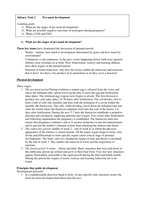
Learning goals:
1) What are the stages of pre-natal development?
2) What are possible negative outcomes of teratogens during pregnancy?
3) What is FAS and FSS?
1) What are the stages of pre-natal development?
Three key issues have dominated the discussion of prenatal period:
- Nature – nurture: how much is development determined by genes and how much by
environment?
- Continuous vs discontinuous: in the past: events happening before birth were ignored,
abilities were switched on at birth. Now: behavioural, sensory and learning abilities
have their origins in the prenatal period.
- Function of foetal behaviour: why does the foetus exhibit the behaviour and reactions
that it does? Are these a by-product of its maturation or do they serve a function?
Physical development
Three stages:
1. The germinal period During ovulation a mature egg is released from the ovary and
enters the fallopian tube, sperm travel up the tube to meet the egg and fertilization
takes place. The fertilized egg (zygote) now begins to divide. The first division to
produce two cells takes place 24-36 hours after fertilization. The cell divides, first to
form a ball of cells (the morulla) and then with the formation of a cavity within the
morulla, the blastocysts. The cells, while dividing, travel down the fallopian tube and
enter the womb where the blastocyst implants itself into the wall of the uterus, 5-6
days after fertilization. During the next 5-7 days the blastocyst establishes a primitive
placenta and circulation, supplying nutrients and oxygen. Two weeks after fertilization
and following implantation the pregnancy is established. The blastocyst must also
ensure that pregnancy continues, and so it secretes hormones to prevent menstruation
and to prevent the mother’s immune system from attacking the embryo and foetus.
2. The embryonic period: middle of week 2 – end of week 8, at which the physical
appearance of the embryo is clearly human. All the major organs begin to form, cells
divide and differentiate to form specific organs (most critical stage of prenatal
development). The heart, only two chambered, begins to beat and blood is circulated
by the end of week 3. This enables the removal of waste and the acquisition of
nutrients.
3. The foetal period: 9 weeks – labour and birth. Basic structures that were laid down in
the embryonic period are refined and grow to their final form. Very few new structures
appear. Particularly noticeable is the rapid growth during the third and fourth month
During this period the origins of motor, sensory and learning behaviour are to be
found.
Principles that guide development
Development proceeds:
1. in a cephalocaudal direction (head to foot). At any specific time structures nearer the
head are more developed than those near the toes.
Learning goals:
1) What are the stages of pre-natal development?
2) What are possible negative outcomes of teratogens during pregnancy?
3) What is FAS and FSS?
1) What are the stages of pre-natal development?
Three key issues have dominated the discussion of prenatal period:
- Nature – nurture: how much is development determined by genes and how much by
environment?
- Continuous vs discontinuous: in the past: events happening before birth were ignored,
abilities were switched on at birth. Now: behavioural, sensory and learning abilities
have their origins in the prenatal period.
- Function of foetal behaviour: why does the foetus exhibit the behaviour and reactions
that it does? Are these a by-product of its maturation or do they serve a function?
Physical development
Three stages:
1. The germinal period During ovulation a mature egg is released from the ovary and
enters the fallopian tube, sperm travel up the tube to meet the egg and fertilization
takes place. The fertilized egg (zygote) now begins to divide. The first division to
produce two cells takes place 24-36 hours after fertilization. The cell divides, first to
form a ball of cells (the morulla) and then with the formation of a cavity within the
morulla, the blastocysts. The cells, while dividing, travel down the fallopian tube and
enter the womb where the blastocyst implants itself into the wall of the uterus, 5-6
days after fertilization. During the next 5-7 days the blastocyst establishes a primitive
placenta and circulation, supplying nutrients and oxygen. Two weeks after fertilization
and following implantation the pregnancy is established. The blastocyst must also
ensure that pregnancy continues, and so it secretes hormones to prevent menstruation
and to prevent the mother’s immune system from attacking the embryo and foetus.
2. The embryonic period: middle of week 2 – end of week 8, at which the physical
appearance of the embryo is clearly human. All the major organs begin to form, cells
divide and differentiate to form specific organs (most critical stage of prenatal
development). The heart, only two chambered, begins to beat and blood is circulated
by the end of week 3. This enables the removal of waste and the acquisition of
nutrients.
3. The foetal period: 9 weeks – labour and birth. Basic structures that were laid down in
the embryonic period are refined and grow to their final form. Very few new structures
appear. Particularly noticeable is the rapid growth during the third and fourth month
During this period the origins of motor, sensory and learning behaviour are to be
found.
Principles that guide development
Development proceeds:
1. in a cephalocaudal direction (head to foot). At any specific time structures nearer the
head are more developed than those near the toes.