DCL Task 7. Development of numerical magnitude
Learning goals
1. Influence of numerical distance on numerical quantity discrimination. Explain
experiment Girelli
2. Automatization of numerical representations. Explain study
3. Neurological basis of representations of numerical quantities over development
4. Explain the figure
1. Mathematical development
Butterworth
Brain areas in mathematical functioning and their cognitive functions
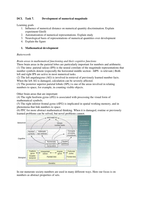
Three brain areas in the parietal lobes are particularly important for numbers and arithmetic.
(1) The intra- parietal sulcus (IPS) is the neural correlate of the magnitude representations that
number symbols denote (especially the horizontal middle section - hIPS –is relevant.) Both
left and right IPS are active in most numerical tasks.
(2) The left angulargyrus (AG) is involved ín retrieval of previously learned number facts.
When the left AG is damaged, calculation can be severely affected.
(3) The posterior superior parietal lobule (SPL) is one of the areas involved in relating
numbers to space, for example, in counting visible objects.
Other brain areas that are important:
(4) The right fusiform gyrus (rFG) is associated with processing the visual form of
mathematical symbols.
(5) The right inferior frontal gyrus (rIFG) is implicated in spatial working memory, and in
phenomena that link numbers to space.
(6) PFC for more abstract mathematical thinking. When it is damaged, routine or previously
learned problems can be solved, but novel problems cannot.
In our numerate society numbers are used in many different ways. Here our focus is on
numbers as abstract properties of sets.
Learning goals
1. Influence of numerical distance on numerical quantity discrimination. Explain
experiment Girelli
2. Automatization of numerical representations. Explain study
3. Neurological basis of representations of numerical quantities over development
4. Explain the figure
1. Mathematical development
Butterworth
Brain areas in mathematical functioning and their cognitive functions
Three brain areas in the parietal lobes are particularly important for numbers and arithmetic.
(1) The intra- parietal sulcus (IPS) is the neural correlate of the magnitude representations that
number symbols denote (especially the horizontal middle section - hIPS –is relevant.) Both
left and right IPS are active in most numerical tasks.
(2) The left angulargyrus (AG) is involved ín retrieval of previously learned number facts.
When the left AG is damaged, calculation can be severely affected.
(3) The posterior superior parietal lobule (SPL) is one of the areas involved in relating
numbers to space, for example, in counting visible objects.
Other brain areas that are important:
(4) The right fusiform gyrus (rFG) is associated with processing the visual form of
mathematical symbols.
(5) The right inferior frontal gyrus (rIFG) is implicated in spatial working memory, and in
phenomena that link numbers to space.
(6) PFC for more abstract mathematical thinking. When it is damaged, routine or previously
learned problems can be solved, but novel problems cannot.
In our numerate society numbers are used in many different ways. Here our focus is on
numbers as abstract properties of sets.