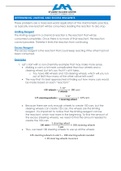
DETERMINING LIMITING AND EXCESS REAGENTS
These problems are a more real-world application of the stoichiometry practice,
as typically one reactant will be consumed, leading the reaction to also stop.
Limiting Reagent
The limiting reagent in a chemical reaction is the reactant that will be
consumed completely. Once there is no more of that reactant, the reaction
cannot proceed. Therefor it limits the reaction from continuing.
Excess Reagent
The excess reagent is the reactant that could keep reacting if the other had not
been consumed.
Examples
1. Let’s start with a non-chemistry example that may make more sense.
• Making a car is a lot more complicated than four wheels and a
steering wheel, but let's say that it’s all it takes.
o You have 400 wheels and 125 steering wheels, which will you run
out of first? How many of the other will be left over?
• The way that it is best approached is finding out how many cars would
be made based on each “reactant.”
1 𝑐𝑎𝑟
400 𝑤ℎ𝑒𝑒𝑙𝑠 ∗ = 100 𝑐𝑎𝑟𝑠
4 𝑤ℎ𝑒𝑒𝑙𝑠
1 𝑐𝑎𝑟
125 𝑠𝑡𝑒𝑒𝑟𝑖𝑛𝑔 𝑤ℎ𝑒𝑒𝑙𝑠 ∗ = 125 𝑐𝑎𝑟𝑠
1 𝑠𝑡𝑒𝑒𝑟𝑖𝑛𝑔 𝑤ℎ𝑒𝑒𝑙
• Because there are only enough wheels to create 100 cars, but the
steering wheels can create 125 cars, the wheels are the limiting
reagent. It is important to notice that the limiting reagent can be
the reactant, which had more in the beginning. To find the amount of
the excess (steering wheels), we need to find the amount needed to
create the 100 cars.
1 𝑠𝑡𝑒𝑒𝑟𝑖𝑛𝑔 𝑤ℎ𝑒𝑒𝑙
100 𝑐𝑎𝑟𝑠 ∗ = 100 𝑠𝑡𝑒𝑒𝑟𝑖𝑛𝑔 𝑤ℎ𝑒𝑒𝑙𝑠
1 𝑐𝑎𝑟
• Thus, we need 100 steering wheels to use up all the wheels.
125 𝑠𝑡𝑒𝑒𝑟𝑖𝑛𝑔 𝑤ℎ𝑒𝑒𝑙𝑠 𝑡𝑜 𝑠𝑡𝑎𝑟𝑡 − 100 𝑠𝑡𝑒𝑒𝑟𝑖𝑛𝑔 𝑤ℎ𝑒𝑒𝑙𝑠 𝑛𝑒𝑒𝑑𝑒𝑑
= 25 𝑠𝑡𝑒𝑒𝑟𝑖𝑛𝑔 𝑤ℎ𝑒𝑒𝑙𝑠 𝑖𝑛 𝑒𝑥𝑐𝑒𝑠𝑠
These problems are a more real-world application of the stoichiometry practice,
as typically one reactant will be consumed, leading the reaction to also stop.
Limiting Reagent
The limiting reagent in a chemical reaction is the reactant that will be
consumed completely. Once there is no more of that reactant, the reaction
cannot proceed. Therefor it limits the reaction from continuing.
Excess Reagent
The excess reagent is the reactant that could keep reacting if the other had not
been consumed.
Examples
1. Let’s start with a non-chemistry example that may make more sense.
• Making a car is a lot more complicated than four wheels and a
steering wheel, but let's say that it’s all it takes.
o You have 400 wheels and 125 steering wheels, which will you run
out of first? How many of the other will be left over?
• The way that it is best approached is finding out how many cars would
be made based on each “reactant.”
1 𝑐𝑎𝑟
400 𝑤ℎ𝑒𝑒𝑙𝑠 ∗ = 100 𝑐𝑎𝑟𝑠
4 𝑤ℎ𝑒𝑒𝑙𝑠
1 𝑐𝑎𝑟
125 𝑠𝑡𝑒𝑒𝑟𝑖𝑛𝑔 𝑤ℎ𝑒𝑒𝑙𝑠 ∗ = 125 𝑐𝑎𝑟𝑠
1 𝑠𝑡𝑒𝑒𝑟𝑖𝑛𝑔 𝑤ℎ𝑒𝑒𝑙
• Because there are only enough wheels to create 100 cars, but the
steering wheels can create 125 cars, the wheels are the limiting
reagent. It is important to notice that the limiting reagent can be
the reactant, which had more in the beginning. To find the amount of
the excess (steering wheels), we need to find the amount needed to
create the 100 cars.
1 𝑠𝑡𝑒𝑒𝑟𝑖𝑛𝑔 𝑤ℎ𝑒𝑒𝑙
100 𝑐𝑎𝑟𝑠 ∗ = 100 𝑠𝑡𝑒𝑒𝑟𝑖𝑛𝑔 𝑤ℎ𝑒𝑒𝑙𝑠
1 𝑐𝑎𝑟
• Thus, we need 100 steering wheels to use up all the wheels.
125 𝑠𝑡𝑒𝑒𝑟𝑖𝑛𝑔 𝑤ℎ𝑒𝑒𝑙𝑠 𝑡𝑜 𝑠𝑡𝑎𝑟𝑡 − 100 𝑠𝑡𝑒𝑒𝑟𝑖𝑛𝑔 𝑤ℎ𝑒𝑒𝑙𝑠 𝑛𝑒𝑒𝑑𝑒𝑑
= 25 𝑠𝑡𝑒𝑒𝑟𝑖𝑛𝑔 𝑤ℎ𝑒𝑒𝑙𝑠 𝑖𝑛 𝑒𝑥𝑐𝑒𝑠𝑠