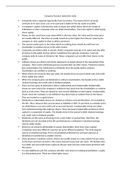
Company financial statement notes
Companies have a separate legal entity from its owners. This means that it can enter
contracts in its own name, sue or be sued and is liable for the tax made on profits.
A company’s capital is divided into units of equal size called shares which are issued to
individuals or other companies who are called shareholders. The total capital is called equity
share capital.
Shares, by law, must have a par value which is the face value. Par value and the issue price
are usually different. The share is usually issued at a price higher than the par value by the
company to raise capital in what is called a premium.
The current market price is the value which an existing share would be sold from one
shareholder to another person in the stick market.
Companies are either public or private. Public companies have plc in its name and may offer
its shares to the public but has stricter regulations than private companies. A private
company ends its name in limited or ltd. These companies can not offer their shares to the
public.
Ordinary shares are where each share represents an equal interest in the ownership of the
company. They receive dividends paid out of profit after all other claims. Preference shares
gives shareholders the entitlement to dividends from the profits before ordinary
shareholders are entitled to anything.
When shares are issued at their par value, the double entry account is debit cash and credit
share capital (par value).
When the company gives out dividends to ordinary shareholders, the double entry is debit
retained earnings and credit cash or dividend payable.
There are two types of preference shares: redeemable and irredeemable. Redeemable
shares are ones which the company is entitled to buy back from the shareholders or redeem
back at a later time. They are treated as non-current liabilities or debt capital. Irredeemable
shares mean the company is not entitled to buy them back or redeem them in the future.
They are treated as a capital share.
Dividends to redeemable shares are classed as a finance cost and therefore, it is included in
the SPL. This is because they are put down as liabilities in SFP. To put them as a double entry
we debit finance cost and credit cash or accrued interest. Irredeemable shares are taken
from retained earnings like ordinary shares. This is because irredeemable preference share
capital is a component of equity. The double entry in the journal is debit retained earnings
and credit cash or dividend payable.
Dividends are the same as drawings from a sole trader or partnership. Therefore, the
dividends are not recorded in the SPL and instead are a reduction in retained earnings
reserve under equity.
Reserves are amounts attributable to equity shareholders other than share capital.
Companies may have different reserves set up for different purposes. The most popular
reserve is retained earnings. This is accumulated profit that has not been paid out as
dividends or transferred to another reserve.
Share premium is another reserve. Shares are usually issued at a value above the par value,
so the share premium account is the excess amount issued over par value. The double entry
is to debit cash and credit share capital at the par value and also credit share premium with
the excess.
To raise additional cash, the company will offer new shares to existing shareholders, usually
at a discounted price. These are called rights issues.
Companies have a separate legal entity from its owners. This means that it can enter
contracts in its own name, sue or be sued and is liable for the tax made on profits.
A company’s capital is divided into units of equal size called shares which are issued to
individuals or other companies who are called shareholders. The total capital is called equity
share capital.
Shares, by law, must have a par value which is the face value. Par value and the issue price
are usually different. The share is usually issued at a price higher than the par value by the
company to raise capital in what is called a premium.
The current market price is the value which an existing share would be sold from one
shareholder to another person in the stick market.
Companies are either public or private. Public companies have plc in its name and may offer
its shares to the public but has stricter regulations than private companies. A private
company ends its name in limited or ltd. These companies can not offer their shares to the
public.
Ordinary shares are where each share represents an equal interest in the ownership of the
company. They receive dividends paid out of profit after all other claims. Preference shares
gives shareholders the entitlement to dividends from the profits before ordinary
shareholders are entitled to anything.
When shares are issued at their par value, the double entry account is debit cash and credit
share capital (par value).
When the company gives out dividends to ordinary shareholders, the double entry is debit
retained earnings and credit cash or dividend payable.
There are two types of preference shares: redeemable and irredeemable. Redeemable
shares are ones which the company is entitled to buy back from the shareholders or redeem
back at a later time. They are treated as non-current liabilities or debt capital. Irredeemable
shares mean the company is not entitled to buy them back or redeem them in the future.
They are treated as a capital share.
Dividends to redeemable shares are classed as a finance cost and therefore, it is included in
the SPL. This is because they are put down as liabilities in SFP. To put them as a double entry
we debit finance cost and credit cash or accrued interest. Irredeemable shares are taken
from retained earnings like ordinary shares. This is because irredeemable preference share
capital is a component of equity. The double entry in the journal is debit retained earnings
and credit cash or dividend payable.
Dividends are the same as drawings from a sole trader or partnership. Therefore, the
dividends are not recorded in the SPL and instead are a reduction in retained earnings
reserve under equity.
Reserves are amounts attributable to equity shareholders other than share capital.
Companies may have different reserves set up for different purposes. The most popular
reserve is retained earnings. This is accumulated profit that has not been paid out as
dividends or transferred to another reserve.
Share premium is another reserve. Shares are usually issued at a value above the par value,
so the share premium account is the excess amount issued over par value. The double entry
is to debit cash and credit share capital at the par value and also credit share premium with
the excess.
To raise additional cash, the company will offer new shares to existing shareholders, usually
at a discounted price. These are called rights issues.