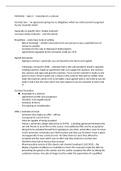
MN10442 – topic 2 – essentials of a contract
Contract law – ‘an agreement giving rise to obligations which are enforced and recognised
by law’ (Guenter treite)
Generally no specific form ‘simple contracts’
Can have verbal contracts – over the phone
Exceptions – some have to be in writing
- Bills of exchange – written instruction from one person to pay a specified sum of
money to another
- Contracts for the sale or disposal of land/property
- Agreements regulated by the consumer credit act 1974
Signed documents
- Signing a contract = generally, you are bound by the terms once signed
- L’Estrange v Graucob (1934) – claimant had a café and wanted to install a cigarette
vending machine. Made an agreement with G to supply the machine. She receives
the contract and signs and gets the machine. Turns out the machine is faulty so she
goes to return it but G points out a clause in the contract that said no matter what
state the machine comes in he is not liable. Court agreed with G. she tried to say she
hadn’t read it but the court said if you have signed it you are assumed to have read
it.
Contract formation
Essentials of a contract
- Agreement of offer and acceptance
- Intention to be legally bound
- Certainty of terms
- The passing of consideration
Offer v invitation to treat
- Someone who makes an offer = offeror
- A proposal of a set of terms
- Must be capable of being accepted
- Moran v university college Salford (no.2) (1993) – a binding agreement between the
uni and Moran to enrol him on the course. Unconditional offer and he accepted by
doing this he excluded himself from applying to any other universities. Goes to move
to the university. University can’t find his place and they say he doesn’t have a place
and apparently It was a clerical error. He takes them to court they offered he
accepted and the court said it was an offer and they entered a contract and
therefore they had to honour that contract
- Pharmaceutical society of GB v Boots cash chemist (southern) Ltd (1953) – the
display of goods constitutes an invitation to treat. The customer made the offer by
presenting the goods to the cashier and the cashier accepted the offer by taking the
customers money. Any sale of drugs must be under the supervision of a qualified
Contract law – ‘an agreement giving rise to obligations which are enforced and recognised
by law’ (Guenter treite)
Generally no specific form ‘simple contracts’
Can have verbal contracts – over the phone
Exceptions – some have to be in writing
- Bills of exchange – written instruction from one person to pay a specified sum of
money to another
- Contracts for the sale or disposal of land/property
- Agreements regulated by the consumer credit act 1974
Signed documents
- Signing a contract = generally, you are bound by the terms once signed
- L’Estrange v Graucob (1934) – claimant had a café and wanted to install a cigarette
vending machine. Made an agreement with G to supply the machine. She receives
the contract and signs and gets the machine. Turns out the machine is faulty so she
goes to return it but G points out a clause in the contract that said no matter what
state the machine comes in he is not liable. Court agreed with G. she tried to say she
hadn’t read it but the court said if you have signed it you are assumed to have read
it.
Contract formation
Essentials of a contract
- Agreement of offer and acceptance
- Intention to be legally bound
- Certainty of terms
- The passing of consideration
Offer v invitation to treat
- Someone who makes an offer = offeror
- A proposal of a set of terms
- Must be capable of being accepted
- Moran v university college Salford (no.2) (1993) – a binding agreement between the
uni and Moran to enrol him on the course. Unconditional offer and he accepted by
doing this he excluded himself from applying to any other universities. Goes to move
to the university. University can’t find his place and they say he doesn’t have a place
and apparently It was a clerical error. He takes them to court they offered he
accepted and the court said it was an offer and they entered a contract and
therefore they had to honour that contract
- Pharmaceutical society of GB v Boots cash chemist (southern) Ltd (1953) – the
display of goods constitutes an invitation to treat. The customer made the offer by
presenting the goods to the cashier and the cashier accepted the offer by taking the
customers money. Any sale of drugs must be under the supervision of a qualified