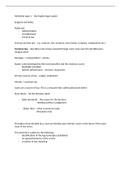
MN10442 topic 1 – the English legal system
England and Wales:
Public law
- Administrative
- Constitutional
- Criminal law
Civil law (private law – e.g. contract, tort, business, land, family, company, employment etc.)
Common law – describes rules of law evolved through court cases over the last 800 years.
(magna carta)
Damages = compensation = money
Equity: rules developed by the lord chancellor and the chancery courts
- Equitable remedies:
- Specific performance, recission, injunctions
Primary sources of law – judges, parliament
Murder = common law
Cases are a source of law. This is a characteristic called judicial precedent
Stare decsis – let the decision stand
- Ratio decidendi – the reason for the decision
Binding section in judgement
- Obiter dicta – other comments made
Persuasive only
Principles of law decided by a court are binding upon inferior courts in the future if the same
issue of law arises.
This doctrine is subject to the following:
- Identification of the legal principle established
- An agreed hierarchy of the courts
- A system of law reporting
, The separation of power
- Legislative = parliament (house of parliament/lords)
- The executive = pm and cabinet
- The judiciary = appointed judges (supreme court)
Statute law
Acts of parliament – statutes (legislation)
Superior law
E.g., the employment act 2008 divided into sections and subsections
Cannot be challenged by the courts (save the European courts where an act conflicts
with European legislation)
An act must go through the full process of debate, be approved by both houses of
parliament, and receive the royal assent before becoming law.
‘bill’ whilst in transit through the houses and sections are called clauses.
Common law
Case law and equity/judge-made law
Judges must interpret and apply legislation and previous decisions
Superior courts make binding decisions where parliament has not legislated
Statutory interpretation:
The literal rule – words taken at face value, meaning is clear, even if it produces an absurd
result (fisher vs bell 1960)
Fisher vs bell – flick knife in the window of the shop with a price ticket. Ruled an invitation to
treat rather than offered for sale
The golden rule – an extension of the literal rule, if the literal rule produces a ridiculous
absurd result (alder vs George 1960)
Alder vs George - Under the Official Secrets Act 1920 it was an offence to obstruct a
member of the armed forces 'in the vicinity’ of a prohibited palace. The defendant was
actually in the prohibited place, rather than 'in the vicinity' of it, at the time of obstruction.
The court applied the golden rule. It would be absurd for a person to be liable if they were
near to a prohibited place and not if they were actually in it. His conviction was therefore
upheld.
The mischief rule – reambigous wording, in Heydon's case [1584] provide a remedy for
mischief the statute was enacted to prevent (smith vs Hughes 1960)
Smith vs hughes - The defendants were prostitutes who had been charged under the Street
Offences Act 1959 which made it an offence to solicit in a public place. The prostitutes were
soliciting from private premises in windows or on balconies so could be seen by the public.
he court applied the mischief rule holding that the activities of the defendants were within
England and Wales:
Public law
- Administrative
- Constitutional
- Criminal law
Civil law (private law – e.g. contract, tort, business, land, family, company, employment etc.)
Common law – describes rules of law evolved through court cases over the last 800 years.
(magna carta)
Damages = compensation = money
Equity: rules developed by the lord chancellor and the chancery courts
- Equitable remedies:
- Specific performance, recission, injunctions
Primary sources of law – judges, parliament
Murder = common law
Cases are a source of law. This is a characteristic called judicial precedent
Stare decsis – let the decision stand
- Ratio decidendi – the reason for the decision
Binding section in judgement
- Obiter dicta – other comments made
Persuasive only
Principles of law decided by a court are binding upon inferior courts in the future if the same
issue of law arises.
This doctrine is subject to the following:
- Identification of the legal principle established
- An agreed hierarchy of the courts
- A system of law reporting
, The separation of power
- Legislative = parliament (house of parliament/lords)
- The executive = pm and cabinet
- The judiciary = appointed judges (supreme court)
Statute law
Acts of parliament – statutes (legislation)
Superior law
E.g., the employment act 2008 divided into sections and subsections
Cannot be challenged by the courts (save the European courts where an act conflicts
with European legislation)
An act must go through the full process of debate, be approved by both houses of
parliament, and receive the royal assent before becoming law.
‘bill’ whilst in transit through the houses and sections are called clauses.
Common law
Case law and equity/judge-made law
Judges must interpret and apply legislation and previous decisions
Superior courts make binding decisions where parliament has not legislated
Statutory interpretation:
The literal rule – words taken at face value, meaning is clear, even if it produces an absurd
result (fisher vs bell 1960)
Fisher vs bell – flick knife in the window of the shop with a price ticket. Ruled an invitation to
treat rather than offered for sale
The golden rule – an extension of the literal rule, if the literal rule produces a ridiculous
absurd result (alder vs George 1960)
Alder vs George - Under the Official Secrets Act 1920 it was an offence to obstruct a
member of the armed forces 'in the vicinity’ of a prohibited palace. The defendant was
actually in the prohibited place, rather than 'in the vicinity' of it, at the time of obstruction.
The court applied the golden rule. It would be absurd for a person to be liable if they were
near to a prohibited place and not if they were actually in it. His conviction was therefore
upheld.
The mischief rule – reambigous wording, in Heydon's case [1584] provide a remedy for
mischief the statute was enacted to prevent (smith vs Hughes 1960)
Smith vs hughes - The defendants were prostitutes who had been charged under the Street
Offences Act 1959 which made it an offence to solicit in a public place. The prostitutes were
soliciting from private premises in windows or on balconies so could be seen by the public.
he court applied the mischief rule holding that the activities of the defendants were within