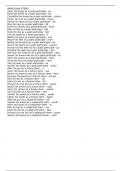
HESI PHARMACOLOGY ACTUAL EXAM 2022
MARSHIKS [COMPANY NAME] [Company address] HESI PHARMACOLOGY ACTUAL EXAM 2022 This study source was downloaded by from CourseH on :09:20 GMT -05:00 HESI PHARMACOLOGY ACTUAL EXAM 2022 1. A male client who has been taking a high dose of a nonsteroidal anti-inflammatory drug (NSAID) comes to the clinic complaining of gastric pain and blood in his stool. The healthcare provider discontinues the NSAIDs and prescribes esomeprazole. Which information should the client include in the nurse’s teaching plan? A. Once pain subsides, NSAID therapy can be continued B. Resume a diet that consists of milk, cream, and bland foods C. Notify the healthcare provider of the passage of black stool D. Call the clinic if diarrhea or headache occur when taking esomeprazole Answer: C. Notify the healthcare provider of the passage of black stool 2.When administering zolpidem to an older client, which computer documentation indicates that the desired outcome has been achieved? A. Sleeps soundly through the night B. Decreased episodes of incontinence C. Exhibits fewer emotional outburst D. Improved ability to concentrate Answer: A. Sleeps soundly through the night 3.A male client with a fungal infection of the toenail reports to the nurse that he has been applying an over-the-counter triple antibiotic ointment to the infection daily for two weeks without any improvement. Which action should the nurse take? A. Instruct the client to obtain a prescription for oral terbinafine B. Suggest that the client use the ointment twice a day to be more effective C. Reassure that the treatment of fungus-infected toenails often takes several months D. Advise the client to obtain a prescription-strength formulation of the ointment Answer: A. Instruct the client to obtain a prescription for oral terbinafine 4. A client with a nasogastric tube (NGT) has a prescription for sucralfate. The liquid form of the medication is not currently available in the pharmacy and tablets have been delivered to the medication dispensing system. Which action should the nurse include when administering the medication? A. Crush the tablet and mix it with water separately from other medications B. Crush the tablet and mix it with other crushed tablets diluted in water C. Withhold the medication until a liquid form is available on the nursing unit D. Crush the tablet and mix it with other liquid medications for administration Answer: A. Crush the tablet and mix it with water separately from other medications 5. A client with chronic asthma receives a prescription for montelukast, a leukotriene modifier. Which statement by the client indicates to the nurse that medication teaching was effective? A. I should take this medication only when I am having an asthma attack B. I will take the tablet every evening to control my asthma C. This medication will stop an asthma attack immediately D. I will not need to use my inhalers twice a day when I start this medication Answer: B. I will take the tablet every evening to control my asthma 6. The nurse is planning to administer the antiulcer GI agent sucralfate to a client with peptic ulcer disease. Which action should the nurse include in this client’s plan of care? This study source was downloaded by from CourseH on :09:20 GMT -05:00 A. Assess for secondary Candida infection B. Administersucralfate once a day, preferably at bedtime C. Give sucralfate on an empty stomach D. Monitor for electrolyte imbalance Answer: B. Give sucralfate once a day, preferably at bedtime This study source was downloaded by from CourseH on :09:20 GMT -05:00 7. Aclient with anemia secondary to chronic kidney disease (CKD) started a prescription for epoetin alfa two months ago. Which client finding best indicates that the medication is effective? A. Reports of increased energy levels and decreased fatigue B. Takes concurrent iron therapy without adverse effects C. Food diary showsincreased consumption of iron-rich foods D. Hemoglobin level increased to 12 grams/dL(120 mmol/L) Answer: D. Hemoglobin level increased to 12 grams/dL(120 mmol/L) 8. The healthcare provider prescribes propylthiouracil (PTU) and Lugol’ssolution, a strong idoine solution, for a client with hyperthyroidism. How should the nurse schedule the administration of these medications? A. Administer iodine one hour before PTU B. Offer both drugstogether with a meal C. Schedule both medications at bedtime D. Give parental dose once every 24 hours Answer: B. Offer both drugs together with a meal 9. Twenty minutes after the nurse starts a secondary IV infusion of cefepime 2 grams using an infusion pump to deliver the dose in one hour, the client reports feeling nauseated. Which action should the nurse implement? A. Continue the infusion and administer a PRN antiemetic prescription B. Stop the medication infusion and notify the healthcare provider of the adverse effect C. Reassure the client that the nausea us not related to the IV infusion D. Increase the rate of the infusion to complete the dose of the medication more rapidly Answer: A. Continue the infusion and administer a PRN antiemetic prescription 10. A client with diabetic peripheral neuropathy, who has been taking pregabalin for 2 weeks reports diminished foot pain. The nurse notes that there is no improvement in the healing of several toe ulcerations. Which action should the nurse take? A. Review the plan of care for strategies used to manage the foot ulcerations B. Reassure the client that diabetic foot ulcers take several months to heal C. Explain that the medication dosage will probably need to be increased D. Withhold the next dose of the drug until the healthcare provider is notified Answer: A. Review the plan of care for strategies used to manage the foot ulcerations 11. A client with type 2 diabetes mellitus who takes glimepiride by mouth daily calls the nurse to report a recent onset of nausea, vomiting and diarrhea. Which response should the nurse provide? A. Increases oral fluid intake until these symptoms subside. B. Use insulin sliding scale until symptoms are resolved C. Schedule a visit for evaluation by the healthcare provider D. Return to the clinic for laboratory test for an infection Answer: A. Increases oral fluid intake until these symptoms subside. 12. The healthcare provider increases a client’s prescription for glipizide 5mg to glipizide 7.5 mg by mouth every 12 hours. The medication is available in 5 mg scored tablets. How many tablets should the nurse administer with each dose? Answer: 1.5 13. The nurse is administering the muscle relaxant baclofen PO to a client diagnosed with multiple sclerosis. Which interventions should the nurse implement? A. Advise the client to move slowly and cautiously when rising and walking B. Ensure the client knows to stop baclofen before using other antispasmodics C. Monitor intake and output every 8 hours D. Evaluate muscle strength every 4 hours Answer: D. Evaluate muscle strength every 4 hours This study source was downloaded by from CourseH on :09:20 GMT -05:00 14. The nurse retrieves hydromorphone 4 mg/ml from the Pyxis Medstation, an automated dispensing system, for a client who is receiving hydromorphone 3 mg IM every 8 hours PRN severe pain. How many mL should the nurse administer tothe client? (Round to the nearest tenth) Answer: 0.8 15. When conducting a drug education about an oral prescription for cyclosporine, which juice should the nurse instruct the client to avoid because it can increase the serum cyclosporine levels? A. Apple B. Grape C. Grapefruit D. Orange Answer: C. Grapefruit 16. A patient with hepatic encephalopathy is receiving lactulose. Which assessment provides the nurse with the best information to evaluate the client’s therapeutic response to the drug? A. Serum electrolyte and ammonia B. Stool color and character C. Fingerstick glucose D. Serum Hepatic enzymes Answer: B. Stool color and character 17. A client is recieving morphine sulfate via a PCA pump postoperatively. Which assessment finding should prompt the nurse to administer a prescribed PRN dose of naloxone? A. Respiratory rate of 7 breaths/minute B. Pulse oximeter reading of 89% on room air C. Expresses that they cannot get enough air to breathe D. Intercostal retractions and bilateral wheezing on auscultation Answer: A. Respiratory rate of 7 breaths/minute 18. The nurse is providing instructions about a client’s new medications. how should the nurse explain the purpose of probenecid, a uricosuric drug? A. Promotes excretion of uric acid in the urine B. Increases the strength of the urine stream C. Prevents the formation of kidney stones D. Decreases pain and burning during urination Answer: A. Promotes excretion of uric acid in the urine 19. A female client who has trichomoniasis vaginitis receives a prescription for metronidazole. Which instruction should the nurse provide this client? A. Urine may turn an orange color B. Report any difficulty with hearing C. Male partners must also be treated D. Take the medication only when symptomatic Answer: C. Male partners must also be treated 20. After receiving five doses of filgrastim the nurse notes that the client’s white blood cell count has increased from 2500/mm (2.5* 10/LSI) to 5,000/mm(5* 10/LSI). What action should the nurse implement? A. Assess the client’s vital signs B. Implement neutropenic precautions C. Review the client’s culture and sensitivity reports D. Inform the client that the medication has been effective Answer: B. Implement neutropenic precautions This study source was downloaded by from CourseH on :09:20 GMT -05:00 21. The nurse is preparing a discharge teaching plan for a client who is taking ciprofloxacin hydrochloride (Cipro) tablets, which were prescribed because of suspected anthrax exposure. Which instructions should be included in the teaching plan? (Select all that apply) A. Increase fluid intake while taking the medication B. Crush and mix the tablets with pudding if you have trouble swallowing the tablets C. Use NSAIDs to relieve mild joint aches and pains caused by the medication D. Report any tendon pain or swelling to the HCP immediately E. Limit exposure to sunlight and avoid tanning beds Answers: A, D, and E 22. A client with chronic lower back pain has been taking the non-steroidal anti-inflammatory drug (NSAID) ibuprofen, by mouth twice a day for several months. Which assessment is most important for the nurse to complete? A. Assess back pain using numeric scale B. Palpate volume of pedal pulses C. Determine presence of abdominal pain D. Evaluate ongoing sleep patterns Answer: C. Determine presence of abdominal pain 23. A 48 year-old male client tells the nurse that he obtained sildenafil without a prescription over the internet and asks the nurse if it is safe to take. In addition to advising the client to obtain medical evaluation. It is important that the nurse immediately determine if he takes what other type of medication? A. Anticoagulants, such as warfarin B. Statins, such as atorvastatin C. Nitrates, such as nitroglycerine D. Analgesics, such as acetaminophen Answer: C. Nitrates, such as nitroglycerine 24. A client recently diagnosed with early stage Alzheimer's disease receives a prescription for donepezil, an acetylcholinesterase inhibitor. Which content should the nurse include in the client medication teaching? A. Discuss the fact that Aricept may slow the progression of the disease over the next year. B. Instruct the client to get monthly liver function studies to assess for liver failure C. Encourage the client to avoid foods high in Vitamin K, such as green leafy vegetables D. Explain that the psychiatrist has prescribed the maximum dose and will decrease it gradually Answer: A. Discuss the fact that Aricept may slow the progression of the disease over the next year 25. The nurse is planning care for a client with major depression who is receiving a new prescription for duloxetine. Which information is most important for the nurse to obtain? A. Liver function laboratory results B. Family history of mental illness C. Recent use of other antidepressants D. Weight change in the last month Answer: A. Liver function laboratory results 26. The nurse is preparing a client with COPD and a chronic productive cough for discharged home. Which prescribed medication should the nurse review with the client to manage this symptom A. Tiotropium B. Salmeterol C. Prednisone D. Guaifenesin Answer: D. Guaifenesin 27. A client who receives multiple antihypertensive medications experience syncope due to a drop in blood pressure to 70/40 mm Hg. Which is the rationale for the nurse’s decision to hold the client’s scheduled antihypertensive medications? A. The synergetic effect of the multiple medications has resulted in drug toxicity and resulting hypotension B. Increased urinary clearance of the multiple medications has produced diuresis and lowered the blood pressure C. The antagonistic interaction among the various blood pressure medications has reduced their effectiveness D. The additive effect of multiple medications has caused the blood pressure to drop too low Answer: D. The additive effect of multiple medications has caused the blood pressure to drop too low 28. A client who is taking dextroamphetamine-amphetamine extended-release tablets for attention deficit hyperactivity disorder (ADHD) complains about having difficulty sleeping at night. Which assessment is most important for the nurse to obtain? A. Ask about the client’s bedtime routine B. Determine what time the dose is taken C. Inquire about perceived anxiety D. Determine daily caffeine intake Answer: B. Determine what time the dose is taken 29. Based on the capillary glucose measurement, a client is to receive 10 units of regular insulin. The client’s medication drawer contains 1 vial of 70/30 mixture of regular insulin and isophane insulin. How should the nurse prepare the prescribed dose? A. Withdraw ten units regular insulin from the 70/30 vial B. Withhold the dose until insulin regular is available on the unit C. Put up 30 units from the 70/30 vial, but only administer one third D. Obtain a new vial of regular insulin and withdraw ten units Answer: D. Obtain a new vial of regular insulin and withdraw ten units 30. When administering medications to a group of clients, which client should the nurse closely monitor for development of acute kidney injury (AKI)? A. Sucralfate B. Lorazepam C. Digoxin D. Vancomycin Answer: D. Vancomycin 31. The nurse administers risedronate to a client with osteoporosis at 0700. The client asks for a glass of milk to drink with medication. Which action should the nurse take? A. Instruct the client that it is necessary to take nothing but water with the medication B. Assign a UAP to bring the client of a glass of low-fat milk C. Consult with a pharmacist about scheduling the dose one hour after client eats D. Withhold the medication until the client’s breakfast tray is available on the unit Answer: A. Instruct the client that it is necessary to take nothing but water with the medication 32. A client again is receiving vancomycin and the nurse is planning to draw a blood peak and trough to determine the serum level of the drug. Which collection times provide the best determination of these level? A. Two hours after completion of the IV dose and one hour before the next administration of this drug B. Midway through administration of the IV dose and 30 minutes before the next administration of the drug C. Two hours after completion of the IV dose and two hours before the next administration of the drug D. Immediately after completion of the IV dose and 30 minutes before the next administration of the drug Answer: D. Immediately after completion of the IV dose and 30 minutes before the next administration of the drug 33. The nurse is preparing an intermittent infusion famotidine 20 mg in 100 ml Lactated Ringer’s solution to infuse over 15 mThiins sututdeyssofuorcreawacsldieownntlowadietdhbya1d00u0o00d8e43n2a2l66u0l7cfreorm. TCohuersenHhono0u4l-d11-p2r0o22g0r7a:0m9:2t0hGeMiTnf-0u5s:0i0on pump to deliver how many ml/hr? Round to the nearest whole number. Answer: 400 This study source was downloaded by from CourseH on :09:20 GMT -05:00 34. A client who received a renal transplant three months ago is readmitted to the acute care unit with signs of graft rejection. While taking the client’s history, the nurse determines that the client has been self-administering St. John’s Wort, an herbal preparation, on the advice of a friend. Which information is most significant about this finding? A. The client probably used this herb to treat depression B. Wort can decrease plasma concentrations of cyclosporine C. Ingestion of Wort can reduce the client’s intake of sodium D. Adding the herb can decrease the need for corticosteroids Answer: B. Wort can decrease plasma concentrations of cyclosporine 35. Which information should the nurse include in the teaching plan for a client who is receiving verapamil, a calcium channel blocker, for hypertension? A. Schedule an appointment to monitor serum calcium level B. Eat a diet high in green leafy vegetables and whole grains C. Report any sudden weight gain or traveling of the lower extremities D. Take the medication at bedtime to prevent problems with dizziness Answer: B. Eat a diet high in green leafy vegetables and whole grains 36. The nurse is administering sodium polystyrene sulfonate to a client in acute kidney injury. Which laboratory finding indicates that the medication has been effective? A. Hemoglobin level of 13.5 grams/dL (135 g/L) B. Serum glucose level of 120 mg/dL (6.7 mmol/L) C. Serum potassium level of 3.8 mEq/L D. Serum ammonia level of 30 micrograms/dL Answer: C. Serum potassium level of 3.8 mEq/L 37. The nurse is preparing to administer a secondary infusion of the first dose of piperacillin-tazobactam to a client with pneumonia. Which action is most important for the nurse to initiate? A. Program the infusion pump B. Assess for drug allergies C. Document the client’s vital signs D. Review the culture and sensitivity results Answer: B. Assess for drug allergies 38. Which instructions should the nurse include when teaching a client about self-administration of a bulk-forming laxative? A. Remain upright for thirty minutes following drug administration B. Follow medication administration with an additional glass of water C. Avoid the intake of dairy products while using medication D. Take the medication one hour after meals and other medications Answer: B. Follow medication administration with an additional glass of water 39. When assessing a client who has been receiving prednisone for several months, the nurse observes that the client has developed an extremely rounded face. Which prescription should the nurse anticipate from the healthcare provider? A. An adjustment in the medication dosage to help resolve the problem B. A low-fat diet to help prevent further abnormal fat deposits C. The medication will need to be stopped immediately to prevent an adrenal crisis D. A diuretic may be necessary to reduce facial swelling Answer: A. An adjustment in the medication dosage to help resolve the problem This study source was downloaded by from CourseH on :09:20 GMT -05:00 40. Two days ago a client with coronary artery disease (CAD) and hypertension started a new prescription for amlodipine, a calcium channel blocker. The nurse observes that the client has developed a 2+ bilateral pitting edema in the lower extremities. Which action should the nurse take in response to this finding? A. Withhold the next scheduled dose of the medication B. Place the client on bedrest with feet elevated C. Monitor the client’s serum calcium levels D. Include daily weights in the plan of care Answer: B. Place the client on bedrest with feet elevated 41. The healthcare provider prescribes the antibiotic tetracycline HCL for an adult client that arrived at an outpatient clinic. Which instructions should the nurse include in the teaching plan for this client? A. Take with milk or antacids to prevent GI irritation B. Protect the skin from sunlight while taking the drug C. Take with orange juice to enhance GI absorption D. Return to the clinic weekly to obtain serum drug levels Answer: B. Protect the skin from sunlight while taking the drug 42. An older female client comes to the clinic for a regular check-up. The client tells the nurse that she has increased her daily doses of acetaminophen for the past month to control joint pain. Based on this client’s comment, which previous lab values should the nurse compare with today’s lab report? A. Look at last quarters hemoglobin and hematocrit, expecting an increase today due to dehydration B. Determine if there is a decrease in serum potassium due to renal compromise C. Look for an increase in today’s LDH compared to the previous one to assess for possible liver damage D. Expect to find an increase in today’s APTT as compared to last quarters due to bleeding Answer: C. Look for an increase in today’s LDH compared to the previous one to assess for possible liver damage 43. The nurse is preparing to administer alendronate to a client with osteoporosis. Which laboratory value indicates that the nurse should withhold the medication and contact the healthcare provider? A. Sodium 132 mEq/L B. Calcium 13.0 mg/dL C. Magnesium 2.4 mEq/L D. Potassium 5.2 mEq/L Answer: B. Calcium 13.0 mg/dL 44. A client who experiences migraine headaches reports having fewer headaches since using the herbal remedy feverfew. Which information is most important for the nurse to include in a teaching plan for this client? A. Increased anxiety and nervousness have been reported by those taking feverfew B. Those with allergies to chamomile, ragweed, or yarrow should not take feverfew C. Feverfew may interact with aspirin or nonsteroidal anti-inflammatory drugs D. Abdominal pain, gas, nausea, vomiting, and diarrhea can occur when taking feverfew Answer: B. Those with allergies to chamomile, ragweed, or yarrow should not take feverfew 45. A client taking atorvastatin develops an increased serum creatine phosphokinase level. The nurse should assess the client for the onset of which problem? A. Excessive bruising B. Nausea and vomiting C. Peripheral edema D. Muscle tenderness Answer: D. Muscle tenderness 46. The nurse is providing instructions to a client who has been prescribed valproic acid by mouth twice a day for seizures. Which symptoms should the nurse tell the client to report to the healthcare provider? A. Gastric Irritation B. Orthostatic Hypotension C. Dry mucosal membranes D. Rapid weight gain Answer: D. Rapid weight gain 47. A client who is receiving multiple antihypertensive medications has a serum potassium level of 6.2 mEq/L (6.2 mmol/L SI). Which of the client's prescribed medications can the nurse safely administer? A. Hydrochlorothiazide B. Lisinopril C. Aldactone D. Valsartan Answer: A. Hydrochlorothiazide 48. Which nursing action has the highest priority when administering a dose of codeine with acetaminophen to a client? A. Administer a stool softener/laxative at the same time as the analgesic B. Tell the client to notify the nurse if pain is not relieved C. Instruct the client to request assistance when ambulating to the bathroom D. Advise the client that the medication should start to work in about 30 minutes Answer: A. Administer a stool softener/laxative at the same time as the analgesic 49. The nurse is planning the home care of a client who is receiving mydriatic medication. Which environment is best for the client? A. Cool, humidified air B. A dimly lit room C. A quiet, restful environment D. A warm room temperature Answer: B. A dimly lit room 50. Which assessment finding requires nursing intervention prior to the administration of a prescribed dose of digoxin to an adult? A. Apical pulse heart beat at the pulmonic site B. Presence of a systolic heart murmur C. Apical pulse rate of 50 beats/minute D. Irregular apical pulse rhythm Answer: C. Apical pulse rate of 50 beats/minute 51. The nurse administers to a client with thick mucous and a nonproductive cough. To evaluate the effectiveness of the medication, what question should the nurse ask the client? A. How much phlegm are you coughing up? B. Are you still coughing C. Are you experiencing any pain when you cough? D. What color is the mucuous Answer: A. How much phlegm are you coughing up? 52. The nurse is instructing a client with allergic rhinitis about the correct technique for using an intranasal inhaler. What instruction is most important for the nurse to provide the client? A. Hold one nostril closed while spraying the other nostril B. Use the inhaler when first awakening in the morning C. Angle the tip of the inhaler upward while spraying D. Avoid shaking the inhaler immediately before using AnsTwhisesrtu:dAy Hrceowldasodonwenlonaodesdtbryil10c0l0o0s08e4d32w266h0i7lefrosmpCroauyrsienH oont0h4e-1r1-n20o22st0r7:i0l9:20 GMT -05:00 53. The nurse is preparing to administer a prescribed dose of amoxicillin-clavulanate to a client. The client reports an allergy to penicillins and sulfa drugs, which is not documented on the medical record. Which action should the nurse implement? A. Hold the scheduled dose of antibiotic until the healthcare provider is notified of the client’s statement B. Teach the client that there is no antibiotic cross-sensitivity between penicillins and sulfa drugs C. Advise the client that amoxicillin-clavulanate is a combination drug containing penicillin and another drug that prevents allergic responses D. Reassure the client that the dose being administered is safe for the client and a true allergic response is unlikely Answer: A. Hold the scheduled dose of antibiotic until the healthcare provider is notified of the client’s statement 54. A client who fell at home fractured the left hip. The client has a history of atrial fibrillation and is currently taking warfarin 5 mg by mouth daily. The nurse receives a call from the laboratory regarding the client’s INR value of 20. After writing down and reading back the value, which intervention should the nurse implement first? A. Give a dose of Vitamin K intramuscular (IM) now as prescribed B. Assess the client’s oral mucosa for signs of bleeding C. Hold the next dose of warfarin as instructed D. Encourage the client to eat vitamin K rich foods. Answer: A. Give a dose of Vitamin K intramuscular (IM) now as prescribed 55. A client with psychosis who is receiving an antipsychotic medicatin is continually rubbing the back of the neck. Which nursing intervention is best for the nurse to implement? A. Provide the client a heating pad to place on the neck B. Obtain a prescription for physical therapy services C. Give a PRN prescription for benztropine D. Obtain an extra pillow for the client to use at night Answer: C. Give a PRN prescription for benztropine This study source was downloaded by from CourseH on :09:20 GMT -05:00
Written for
- Institution
-
Chamberlain College Of Nursing
- Course
-
HESI PHARMACOLOGY .
Document information
- Uploaded on
- April 1, 2023
- Number of pages
- 11
- Written in
- 2022/2023
- Type
- Exam (elaborations)
- Contains
- Questions & answers
Subjects
-
hesi pharmacology actual exam 2022
-
marshiks company name company address hesi pharmacology actual exam 2022 this study source was downloaded by 100000843226607 from courseherocom on 04 11 2022