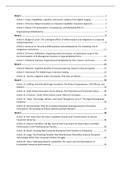
Week 1 ........................................................................................................................................ 1
Article 1. Tripas: Capabilities, cognition, and inertia: evidence from digital imaging ......................... 2
Article 2. O’Connor: Major Innovation as a Dynamic Capability: A Systems Approach ...................... 4
Article 3. Gibson: The Antecedents, Consequences, and Mediating Role of ...................................... 7
Organizational Ambidexterity ............................................................................................................. 7
Week 2 ........................................................................................................................................ 8
Article 4. Burgers & Covin: The contingent effects of differentiation and integration on corporate
entrepreneurship ................................................................................................................................ 8
Article 5. Jansen et al.: Structural differentiation and ambidexterity: the mediating role of
integration mechanisms .................................................................................................................... 11
Article 6. O’Conner, DeMartino: Organizing radical innovation: an exploratory study of the
structural aspects of RI Management Systems in large established firms ........................................ 14
Article 7. O’Reilly & Tushman: Organizational Ambidexterity: Past, Present, and Future ............... 18
Week 3 ...................................................................................................................................... 21
Article 8. Meissner: Cognitive benefits of scenario planning, impact on bias and quality ............... 21
Article 9. Hammond: The hidden traps in decision making .............................................................. 22
Article 10. Tversky: Judgment under Uncertainty, Heuristics and Biases ......................................... 23
Week 4 ...................................................................................................................................... 24
Article 11. Schilling: Serial Breakthrough Innovation: The Roles of Separateness, Self-Efficacy, and
Idealism ............................................................................................................................................. 24
Article 12. Tellis: Radical Innovation Across Nations: The Preeminence of Corporate Culture ........ 26
Article 13. O’Connor: Create Three Distinct Career Paths for Innovators ........................................ 28
Article 14. Tripas: Technology, Identity, and Inertia Through the Lens of “The Digital Photography
Company............................................................................................................................................ 29
Article 15. Kammerlander: Why do Incumbents Respond Heterogeneously to Disruptive
Innovations? The Interplay of Domain Identity and Role Identity? .................................................. 33
Week 5 ...................................................................................................................................... 38
Article 16. Keil: Gems from the Ashes: Capability Creation and Transformation in Internal
Corporate Venturing ......................................................................................................................... 38
Article 17. Khanna: Fail Often, Fail Big, and Fail Fast? Learning from Small Failures and R&D
Performance in the Pharmaceutical Industry ................................................................................... 40
Article 18. Raisch: Growing New Corporate Businesses from Initiation to Graduation.................... 41
Article 19. Lange: The Parenting Paradox: How Multibusiness Diversifiers Endorse Disruptive
Technologies While Their Corporate Children Struggle .................................................................... 43
Article 20. Teece: Explicating dynamic capabilities, the nature and microfoundations of
(sustainable enterprise performance)............................................................................................... 45
,Week 1
Article 1. Tripas: Capabilities, cognition, and inertia: evidence from digital imaging
Existing explanation for failure to adapt to radically new technology have focused on the nature of a
firm’s capabilities. This paper explore how the combination of capabilities and cognition helps to
explain organizational inertia in the face of radical technological change. It focuses on cognition at
the level of the senior management team given the critical influence of top management teams on
strategic decision making.
Established firms are less likely to adapt when the new technology is:
1. Competence destroying (it requires mastery of an entirely new scientific discipline)
2. Destroys the ‘architectural knowledge’ (knowledge about interfaces among product components
3. Destroys the value of a firm’s existing complementary assets
Methods
An in-depth, inductive case study of the Polaroid Corporation’s historical involvement in digital
imaging (radical transition). Publicly available data, company archives and interviews with Polaroid
employees were collected on the evolution of Polaroid’s activities.
Polaroid
Beliefs in 1980:
- a technology-driven, not market-driven company. Polaroid’s technology and products would create
a market.
- held over 500 patents. The firm’s patent position was so strong that when Kodak entered the
instant photography market in 1976 Polaroid successfully sued them for patent infringement and
was able to exclude Kodak from the U.S. market.
- adopt a razor/blade pricing strategy. The firm dropped prices on cameras in order to stimulate
adoption and subsequent demand for film. The belief was that Polaroid could not make money on
hardware, only software (i.e., film).
- customers value instant print.
Beliefs in 1981 – 89 / digital imaging:
- committing substantial investment dollars to digital imaging technologies, which was in line with
Polaroid’s belief in the primacy of technology.
- a new instant digital camera/printer (PIF), which was in line with the razor/blade model, instant
physical print.
Thus, the beliefs of senior management clearly influenced search activities that did take place, and
the activities that did not take place.
The most significant change in senior management’s beliefs was a shift away from being a purely
technology-driven company. Polaroid faced stagnant growth for the first time in the 1980s.
Management placed an increased emphasis on marketing, and a formal market research function
was established. Market input also became an official part of the product development process.
,Beliefs in 1990 - 98:
- Consistent with the new belief in being more market driven, an electronic imaging marketing group,
comprised entirely of new hires, was established. These new individuals, with no prior Polaroid
experience, had a different perspective from that of senior management --> cognitive dissonance/
clash between senior management and the newly hired members.
- Solution: new outsider CEO with a new top management team. He focused on marketing in both
the instant photography and digital imaging domains.
Beliefs in 1998:
- No large-scale inventions, instead Polaroid was focused on rapid incremental product development.
- Still supported the razor/blade business model and conventional film.
A crucial challenge for organizations facing radical technological discontinuities is the ability to
distinguish changes that require only the development of new technological capabilities from
changes that also require the adoption of different strategic beliefs.
For Polaroid, success in the new digital imaging worldrequired different strategic belief
, Article 2. O’Connor: Major Innovation as a Dynamic Capability: A Systems Approach
While persistent, skilled, visionary champions are critical to RI (radical innovations), organizations will
never maximize their resources and advantages if they do not move from relying on the single-
minded, impassioned champion to a dynamic capability that includes them as one element of a
system.
This article uses systems theory, recent advances in dynamic capabilities theory and management of
innovation literature to offer a framework for building an Major Innovation (MI) dynamic capability =
composed of both radical and really new innovation.
* Purpose of MI: leverage and stretch current competencies while simultaneously building new ones.
MI is composed of 7 elements that together form a management system rather than a process-based
approach to nurturing radical innovation.
1. Clearly identified organizational structure
= an identified team, group, department, or other entity in the firm that is charged with the
responsibility for making MI.
P1: An MI dynamic capability requires an identifiable organizational group responsible
for the firm’s major innovation efforts
- You need constant attention for MI.
- Breakthrough innovation requires structure and clear reporting relationships to ensure the
opportunity for both discipline and creativity.
- A separate entity is needed to develop competencies without being stamped out by rules.
2. Internal and external interface mechanisms
= interface mechanisms with the mainstream organization, some tightly coupled and others loose.
Tightly: required to ensure a clear understanding of the MI system’s role in the organization and of
how it differs from the rest of the company’s innovation system. Plus, the MI system must exhibit
tight coupling with the firm’s strategic intent to ensure that the MI management system remains
relevant to the larger organization.
P2a: An MI dynamic capability requires that the MI system’s role in the larger organization
be communicated throughout the organization.
P2b: An MI dynamic capability requires that the MI system objectives be tightly and
reciprocally coupled to the firm’s strategic intent.
Loose: coupling with respect to resources, networks, and business unit (BU) operating systems
cannot be tight due to the mainstream organization’s core rigidities.
P2c: An MI dynamic capability requires that the MI system be loosely coupled with the
mainstream organization in terms of access to resources, networks, and BU systems.
Decoupling of processes: in that the processes and evaluative criteria that work for incremental
innovation are inappropriate for MI.
P2d: An MI dynamic capability requires that the MI system’s project management processes
be decoupled from those of the mainstream system.
Article 1. Tripas: Capabilities, cognition, and inertia: evidence from digital imaging ......................... 2
Article 2. O’Connor: Major Innovation as a Dynamic Capability: A Systems Approach ...................... 4
Article 3. Gibson: The Antecedents, Consequences, and Mediating Role of ...................................... 7
Organizational Ambidexterity ............................................................................................................. 7
Week 2 ........................................................................................................................................ 8
Article 4. Burgers & Covin: The contingent effects of differentiation and integration on corporate
entrepreneurship ................................................................................................................................ 8
Article 5. Jansen et al.: Structural differentiation and ambidexterity: the mediating role of
integration mechanisms .................................................................................................................... 11
Article 6. O’Conner, DeMartino: Organizing radical innovation: an exploratory study of the
structural aspects of RI Management Systems in large established firms ........................................ 14
Article 7. O’Reilly & Tushman: Organizational Ambidexterity: Past, Present, and Future ............... 18
Week 3 ...................................................................................................................................... 21
Article 8. Meissner: Cognitive benefits of scenario planning, impact on bias and quality ............... 21
Article 9. Hammond: The hidden traps in decision making .............................................................. 22
Article 10. Tversky: Judgment under Uncertainty, Heuristics and Biases ......................................... 23
Week 4 ...................................................................................................................................... 24
Article 11. Schilling: Serial Breakthrough Innovation: The Roles of Separateness, Self-Efficacy, and
Idealism ............................................................................................................................................. 24
Article 12. Tellis: Radical Innovation Across Nations: The Preeminence of Corporate Culture ........ 26
Article 13. O’Connor: Create Three Distinct Career Paths for Innovators ........................................ 28
Article 14. Tripas: Technology, Identity, and Inertia Through the Lens of “The Digital Photography
Company............................................................................................................................................ 29
Article 15. Kammerlander: Why do Incumbents Respond Heterogeneously to Disruptive
Innovations? The Interplay of Domain Identity and Role Identity? .................................................. 33
Week 5 ...................................................................................................................................... 38
Article 16. Keil: Gems from the Ashes: Capability Creation and Transformation in Internal
Corporate Venturing ......................................................................................................................... 38
Article 17. Khanna: Fail Often, Fail Big, and Fail Fast? Learning from Small Failures and R&D
Performance in the Pharmaceutical Industry ................................................................................... 40
Article 18. Raisch: Growing New Corporate Businesses from Initiation to Graduation.................... 41
Article 19. Lange: The Parenting Paradox: How Multibusiness Diversifiers Endorse Disruptive
Technologies While Their Corporate Children Struggle .................................................................... 43
Article 20. Teece: Explicating dynamic capabilities, the nature and microfoundations of
(sustainable enterprise performance)............................................................................................... 45
,Week 1
Article 1. Tripas: Capabilities, cognition, and inertia: evidence from digital imaging
Existing explanation for failure to adapt to radically new technology have focused on the nature of a
firm’s capabilities. This paper explore how the combination of capabilities and cognition helps to
explain organizational inertia in the face of radical technological change. It focuses on cognition at
the level of the senior management team given the critical influence of top management teams on
strategic decision making.
Established firms are less likely to adapt when the new technology is:
1. Competence destroying (it requires mastery of an entirely new scientific discipline)
2. Destroys the ‘architectural knowledge’ (knowledge about interfaces among product components
3. Destroys the value of a firm’s existing complementary assets
Methods
An in-depth, inductive case study of the Polaroid Corporation’s historical involvement in digital
imaging (radical transition). Publicly available data, company archives and interviews with Polaroid
employees were collected on the evolution of Polaroid’s activities.
Polaroid
Beliefs in 1980:
- a technology-driven, not market-driven company. Polaroid’s technology and products would create
a market.
- held over 500 patents. The firm’s patent position was so strong that when Kodak entered the
instant photography market in 1976 Polaroid successfully sued them for patent infringement and
was able to exclude Kodak from the U.S. market.
- adopt a razor/blade pricing strategy. The firm dropped prices on cameras in order to stimulate
adoption and subsequent demand for film. The belief was that Polaroid could not make money on
hardware, only software (i.e., film).
- customers value instant print.
Beliefs in 1981 – 89 / digital imaging:
- committing substantial investment dollars to digital imaging technologies, which was in line with
Polaroid’s belief in the primacy of technology.
- a new instant digital camera/printer (PIF), which was in line with the razor/blade model, instant
physical print.
Thus, the beliefs of senior management clearly influenced search activities that did take place, and
the activities that did not take place.
The most significant change in senior management’s beliefs was a shift away from being a purely
technology-driven company. Polaroid faced stagnant growth for the first time in the 1980s.
Management placed an increased emphasis on marketing, and a formal market research function
was established. Market input also became an official part of the product development process.
,Beliefs in 1990 - 98:
- Consistent with the new belief in being more market driven, an electronic imaging marketing group,
comprised entirely of new hires, was established. These new individuals, with no prior Polaroid
experience, had a different perspective from that of senior management --> cognitive dissonance/
clash between senior management and the newly hired members.
- Solution: new outsider CEO with a new top management team. He focused on marketing in both
the instant photography and digital imaging domains.
Beliefs in 1998:
- No large-scale inventions, instead Polaroid was focused on rapid incremental product development.
- Still supported the razor/blade business model and conventional film.
A crucial challenge for organizations facing radical technological discontinuities is the ability to
distinguish changes that require only the development of new technological capabilities from
changes that also require the adoption of different strategic beliefs.
For Polaroid, success in the new digital imaging worldrequired different strategic belief
, Article 2. O’Connor: Major Innovation as a Dynamic Capability: A Systems Approach
While persistent, skilled, visionary champions are critical to RI (radical innovations), organizations will
never maximize their resources and advantages if they do not move from relying on the single-
minded, impassioned champion to a dynamic capability that includes them as one element of a
system.
This article uses systems theory, recent advances in dynamic capabilities theory and management of
innovation literature to offer a framework for building an Major Innovation (MI) dynamic capability =
composed of both radical and really new innovation.
* Purpose of MI: leverage and stretch current competencies while simultaneously building new ones.
MI is composed of 7 elements that together form a management system rather than a process-based
approach to nurturing radical innovation.
1. Clearly identified organizational structure
= an identified team, group, department, or other entity in the firm that is charged with the
responsibility for making MI.
P1: An MI dynamic capability requires an identifiable organizational group responsible
for the firm’s major innovation efforts
- You need constant attention for MI.
- Breakthrough innovation requires structure and clear reporting relationships to ensure the
opportunity for both discipline and creativity.
- A separate entity is needed to develop competencies without being stamped out by rules.
2. Internal and external interface mechanisms
= interface mechanisms with the mainstream organization, some tightly coupled and others loose.
Tightly: required to ensure a clear understanding of the MI system’s role in the organization and of
how it differs from the rest of the company’s innovation system. Plus, the MI system must exhibit
tight coupling with the firm’s strategic intent to ensure that the MI management system remains
relevant to the larger organization.
P2a: An MI dynamic capability requires that the MI system’s role in the larger organization
be communicated throughout the organization.
P2b: An MI dynamic capability requires that the MI system objectives be tightly and
reciprocally coupled to the firm’s strategic intent.
Loose: coupling with respect to resources, networks, and business unit (BU) operating systems
cannot be tight due to the mainstream organization’s core rigidities.
P2c: An MI dynamic capability requires that the MI system be loosely coupled with the
mainstream organization in terms of access to resources, networks, and BU systems.
Decoupling of processes: in that the processes and evaluative criteria that work for incremental
innovation are inappropriate for MI.
P2d: An MI dynamic capability requires that the MI system’s project management processes
be decoupled from those of the mainstream system.