1. atomic structure
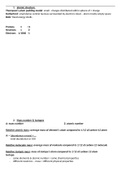
Thompson’s plum pudding model: small - charges distributed within sphere of + charge
Rutherford: small dense central nucleus surrounded by electron cloud – atom mostly empty space
Bohr: fixed energy shells
Protons 1 +1
Neutrons 1 0
Electrons 1/1840 -1
2. Mass number & Isotopes
A: mass number Z: atomic number
Relative atomic mass: average mass of element’s atom compared to 1/12 of carbon-12 atom
Ar = (abundance x mass) + …
total abundance or 100
Relative molecular mass: average mass of molecule compared to 1/12 of carbon-12 molecule
Relative isotopic mass: mass of isotope’s atom compared to 1/12 of carbon-12 atom
Isotope:
- same elements & atomic number = same chemical properties
- different neutrons – mass = different physical properties
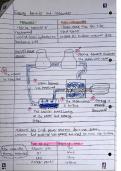
, Mass Spectrometry: Time of Flight – everything gas
1. Ionisation
Electron impact (for smaller atoms)
- electron gun fires high energy electrons at vaporised sample
- knocks e- off each particle = ion+
Electrospray ionisation (for larger atoms – fragmentation less likely to occur)
- sample dissolved in volatile solvent
injected through fine hypodermic needle – gives fine mist (aerosol)
tip of needle has high voltage
- particles gain proton from solvent at tip = XH+ ions
- solvent evaporates away
2. Acceleration of ions by electric field (negative plates) – brings ions to constant KE
KE = ½mv2
3. Flight tube – ion drift
ions enter tube
all have same KE – velocity & time depend on mass
ions separate depending on mass (lighter = faster) – ions distinguished by different flight times
t = d (length of tube)
v
4. Ion detection
ions gain e- when hitting detector – generate electrical current
size of current determines relative abundance of isotope
Mass spectrum: y-axis = abundance x-axis = m/z (mass)
peak = isotope
(peak at lower m/z = fragment – caused by break up of molecular ion)
Relative atomic mass = (Abundance (height) x mass (m/z)) + …
100
Identify elements from characteristic relative atomic masses
Relative molecular mass = m/z value of (largest) peak
Thompson’s plum pudding model: small - charges distributed within sphere of + charge
Rutherford: small dense central nucleus surrounded by electron cloud – atom mostly empty space
Bohr: fixed energy shells
Protons 1 +1
Neutrons 1 0
Electrons 1/1840 -1
2. Mass number & Isotopes
A: mass number Z: atomic number
Relative atomic mass: average mass of element’s atom compared to 1/12 of carbon-12 atom
Ar = (abundance x mass) + …
total abundance or 100
Relative molecular mass: average mass of molecule compared to 1/12 of carbon-12 molecule
Relative isotopic mass: mass of isotope’s atom compared to 1/12 of carbon-12 atom
Isotope:
- same elements & atomic number = same chemical properties
- different neutrons – mass = different physical properties
, Mass Spectrometry: Time of Flight – everything gas
1. Ionisation
Electron impact (for smaller atoms)
- electron gun fires high energy electrons at vaporised sample
- knocks e- off each particle = ion+
Electrospray ionisation (for larger atoms – fragmentation less likely to occur)
- sample dissolved in volatile solvent
injected through fine hypodermic needle – gives fine mist (aerosol)
tip of needle has high voltage
- particles gain proton from solvent at tip = XH+ ions
- solvent evaporates away
2. Acceleration of ions by electric field (negative plates) – brings ions to constant KE
KE = ½mv2
3. Flight tube – ion drift
ions enter tube
all have same KE – velocity & time depend on mass
ions separate depending on mass (lighter = faster) – ions distinguished by different flight times
t = d (length of tube)
v
4. Ion detection
ions gain e- when hitting detector – generate electrical current
size of current determines relative abundance of isotope
Mass spectrum: y-axis = abundance x-axis = m/z (mass)
peak = isotope
(peak at lower m/z = fragment – caused by break up of molecular ion)
Relative atomic mass = (Abundance (height) x mass (m/z)) + …
100
Identify elements from characteristic relative atomic masses
Relative molecular mass = m/z value of (largest) peak