100% satisfaction guarantee Immediately available after payment Both online and in PDF No strings attached 4.2 TrustPilot
logo-home
Exam (elaborations)

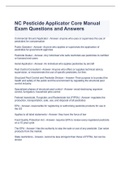
NC Pesticide Applicator Core Manual Exam Questions and Answers

Rating
4.7
(3)
Sold
5
Pages
5
Grade
A+
Uploaded on
29-03-2023
Written in
2022/2023

Commercial Ground Applicator - Answer- anyone who uses or supervises the use of pesticides for compensation Public Operator - Answer- Anyone who applies or supervises the application of pesticides for government agencies Pesticide Dealer - Answer- Any individual who sells restricted-use pesticides to certified or licensed end-users Aerial Applicator - Answer- An individual who applies pesticides by aircraft Pest Control Consultant - Answer- Anyone who offers or supplies technical advice, supervision, or recommends the use of specific pesticides, for free. Structural Pest Control and Pesticide Division - Answer- Their purpose is to protect the health and safety of the public and the environment by regulating the structural pest control industry. Specialized phases of structural pest control - Answer- wood-destroying organism control, fumigation, household pest control Federal Insecticide, Fungicide, and Rodenticide Act (FIFRA) - Answer- regulates the production, transportation, sale, use, and disposal of all pesticides EPA - Answer- responsible for registering or authorizing pesticide products for use in the US Applies to all label statements - Answer- they have the force of law Food Quality Protection Act - Answer- requires EPA to review every registered pesticide on a 15 year cycle The EPA - Answer- Has the authority to stop the sale or use of any pesticide. Can seize products from the market. State restrictions - Answer- cannot be less stringent than those of FIFRA, but can be stricter Potential hazards - Answer- pesticides are classified according to this Federal Food Drug and Cosmetic Act - Answer- governs the establishment of pesticide tolerances for food and feed products. Tolerance - Answer- The maximum level of pesticide residues allowed in or on human food and animal feed. The EPA - Answer- sets the tolerance level of each pesticide Food and Drug administration - Answer- monitors the food and feed products tolerance violations The Food Quality Protection Act - Answer- established a health based standard to be used when assessing the risk of pesticide residues in food or feed. It requires the EPA to establish a tolerance based on "a reasonable certainty" that no harm results from sources of exposure. Worker Protection Standard - Answer- a regulation aimed at protecting employees on agricultural establishments from occupational exposure to pesticides The WPS - Answer- covers any pesticide with an "Agricultural Use Requirements" section on the label The WPS provides the following - Answer- safety training to workers and handlers PPE specified on the label warning to inform of applications, restricted entry intervals, and restricted areas decontamination supplies transport to a medical facility Occupational Safety and Health Act - Answer- requires that employers keep records of all work related deaths, illnesses, and injuries Hazard Communication Standard - Answer- requires employers to make lists of hazardous chemicals, keep safety data sheets, ensure proper labeling, train workers properly, keep files available Endangered Species Act - Answer- Federal law administered by US Fish and Wildlife Service which makes it illegal to kill, harm, or collect endangered or threatened wildlife. Requires other agencies to uphold this. North Carolina Pesticide Law of 1971 - Answer- establishes pesticide management programs designed to regulate the registration, handling, and storage, and disposal of pesticides as well as certification and licensing of pesticide applicators, consultants, and dealers. North Carolina Pesticide Law of 1971 - Answer- all uses of pesticides in NC are regulated under this, except those under the NC structural pest control act The North Carolina Pesticide Board (NCPB) - Answer- is responsible for carrying out provision of the NCPL NCDA&CS - Answer- conducts routine inspections of certified applicators, public agencies, and restricted use pesticide dealers. All pesticides must be registered through this agency. North Carolina Pesticide Storage Regulation - Answer- Pest - Answer- Any animal which an injure plants, humans, domestic animals, or substances. Commissioner of Agriculture or Pesticide Board - Answer- must notify Wildlife Resource Commission when a vertebrate animal is declared a pest NCDA&CS Pesticide Disposal Assistance Program - Answer- collects banned, outdated, or unwanted pesticides on Pesticide Disposal Collection Days Restricted use pesticide record must be kept - Answer- a minimum of 3 years Major types of pests - Answer- weeds, invertebrates, disease agents or pathogens, vertebrates Preventions - Answer- pre-plant or pre-emergence herbicides, fungicide treatments, wood structure treatments Suppression - Answer- does not eliminate all pests, but reduces them to a point below economic injury level Eradication - Answer- the total elimination from a pest in a given area Mode of Action - Answer- how the pesticide works i.e., affects nervous system, digestive system, etc. Selectivity - Answer- control only certain species of pests or affect only certain stage of pest development Non-selective - Answer- affect a range of species. i.e., fumigants harmful to many species. Systemic Pesticides - Answer- absorbed in plants through leaves and roots, though skin in animals, then are transported within the treated pest Contact Pesticides - Answer- remain on surface of treated pest and are not absorbed and only affect part of plant or pest that is exposed. Residual Pesticides - Answer- the persistence, or how long a pesticide remains in the environment, which varies among pesticides Integrated Pest Management - Answer- coordinated use of appropriate pest control tactics to reduce pests and their damage to an acceptable level Pest Control Failure - Answer- most often caused by incorrect pest identification and lack of information about pest Scouting and trapping - Answer- pest monitoring technique Thresholds - Answer- pest population levels at which you should take pest control action to prevent pests from causing unacceptable injury. Economic, health, and aesthetic considerations. Economic Injury Level - Answer- The pest population level at which the value of lost crop yield EQUALS the cost of controlling that pest population. Economic or Action Threshold - Answer- the pest population at which control measure are needed to prevent reaching the economic injury level management method or control strategy - Answer- should offer best combination of effectiveness and environmental safety Natural Control Measures - Answer- may stop or destroy pests without human interference. ex. weather, topography, natural enemies Applied controls - Answer- Pest control measures used by humans. These include biological, cultural, mechanical, and chemical control. Biological Control - Answer- the intentional release of a natural enemy to attack a pest population Biological Controls - Answer- Predators, parasites, pathogens Mechanical Controls - Answer- screens, machines, fences, traps that prevent pest activity Exclusion - Answer- screen barriers, sealing cracks and small openings Cultural Control - Answer- sometimes the lowest cost option, designed to alter the environment or the condition of the host plant or site to prevent or suppress an infection Physical/ Environmental Modifications - Answer- altering these aspects of an enclosed area, such as lowering humidity, regulating temperature, increasing air movement Natural Resistance - Answer- use of plants with this quality may prevent pest problems more effectively and for longer than applying pesticieds Genetic Resistance - Answer- when a plant or animal is bred to be resistant Types of Regulatory pest Control - Answer- Quarantine and eradication Chemical Controls (Pesticides) - Answer- usually effective, usually quick acting, cost less than other control options Chemical Controls (Pesticides) - Answer- may lose effectiveness over time, may harm non-target species, may drift offsite, often perceived as best solution when they aren't Pesticide Resistance - Answer- the ability of a n insect, fungus, weed, or rodent to tolerate a pesticide that previously controlled it; this happens from repeat use of a pesticide Resistance - Answer- must be detected when it is very low and controlled early To delay the occurrence of resistance - Answer- monitoring and treating only when necessary, rotating pesticides, applying less persistent pesticides, applying over limited areas, keeping good records Control Failure - Answer- occurs due to incorrect pest identification, dosage, or method, poor timing, and new infestation development after initial treatment

Show more Read less
Institution
NC Pesticide Applicator
Course
NC Pesticide Applicator


Whoops! We can’t load your doc right now. Try again or contact support.

Written for

Institution
NC Pesticide Applicator
Course
NC Pesticide Applicator

Document information

Uploaded on
March 29, 2023
Number of pages
5
Written in
2022/2023
Type
Exam (elaborations)
Contains
Questions & answers

Subjects

Content preview

NC Pesticide Applicator Core Manual
Exam Questions and Answers
Commercial Ground Applicator - Answer- anyone who uses or supervises the use of
pesticides for compensation

Public Operator - Answer- Anyone who applies or supervises the application of
pesticides for government agencies

Pesticide Dealer - Answer- Any individual who sells restricted-use pesticides to certified
or licensed end-users

Aerial Applicator - Answer- An individual who applies pesticides by aircraft

Pest Control Consultant - Answer- Anyone who offers or supplies technical advice,
supervision, or recommends the use of specific pesticides, for free.

Structural Pest Control and Pesticide Division - Answer- Their purpose is to protect the
health and safety of the public and the environment by regulating the structural pest
control industry.

Specialized phases of structural pest control - Answer- wood-destroying organism
control, fumigation, household pest control

Federal Insecticide, Fungicide, and Rodenticide Act (FIFRA) - Answer- regulates the
production, transportation, sale, use, and disposal of all pesticides

EPA - Answer- responsible for registering or authorizing pesticide products for use in
the US

Applies to all label statements - Answer- they have the force of law

Food Quality Protection Act - Answer- requires EPA to review every registered pesticide
on a 15 year cycle

The EPA - Answer- Has the authority to stop the sale or use of any pesticide. Can seize
products from the market.

State restrictions - Answer- cannot be less stringent than those of FIFRA, but can be
stricter

, Potential hazards - Answer- pesticides are classified according to this

Federal Food Drug and Cosmetic Act - Answer- governs the establishment of pesticide
tolerances for food and feed products.

Tolerance - Answer- The maximum level of pesticide residues allowed in or on human
food and animal feed.

The EPA - Answer- sets the tolerance level of each pesticide

Food and Drug administration - Answer- monitors the food and feed products tolerance
violations

The Food Quality Protection Act - Answer- established a health based standard to be
used when assessing the risk of pesticide residues in food or feed. It requires the EPA
to establish a tolerance based on "a reasonable certainty" that no harm results from
sources of exposure.

Worker Protection Standard - Answer- a regulation aimed at protecting employees on
agricultural establishments from occupational exposure to pesticides

The WPS - Answer- covers any pesticide with an "Agricultural Use Requirements"
section on the label

The WPS provides the following - Answer- safety training to workers and handlers
PPE specified on the label
warning to inform of applications, restricted entry intervals, and restricted areas
decontamination supplies
transport to a medical facility

Occupational Safety and Health Act - Answer- requires that employers keep records of
all work related deaths, illnesses, and injuries

Hazard Communication Standard - Answer- requires employers to make lists of
hazardous chemicals, keep safety data sheets, ensure proper labeling, train workers
properly, keep files available

Endangered Species Act - Answer- Federal law administered by US Fish and Wildlife
Service which makes it illegal to kill, harm, or collect endangered or threatened wildlife.
Requires other agencies to uphold this.

North Carolina Pesticide Law of 1971 - Answer- establishes pesticide management
programs designed to regulate the registration, handling, and storage, and disposal of
pesticides as well as certification and licensing of pesticide applicators, consultants, and
dealers.


Reviews from verified buyers

Showing all 3 reviews
6 months ago

1 year ago

1 year ago

1 year ago

Thank you for review

4.7

3 reviews

5
2
4
1
3
0
2
0
1
0
Trustworthy reviews on Stuvia

All reviews are made by real Stuvia users after verified purchases.

Get to know the seller

Seller avatar
Reputation scores are based on the amount of documents a seller has sold for a fee and the reviews they have received for those documents. There are three levels: Bronze, Silver and Gold. The better the reputation, the more your can rely on the quality of the sellers work.
millyphilip West Virginia University
View profile
Follow You need to be logged in order to follow users or courses
Sold
2814
Member since
3 year
Number of followers
1959
Documents
41009
Last sold
2 days ago
white orchid store

EXCELLENCY IN ACCADEMIC MATERIALS ie exams, study guides, testbanks ,case, case study etc

3.7

534 reviews

5
234
4
83
3
103
2
31
1
83

Recently viewed by you

Why students choose Stuvia

Created by fellow students, verified by reviews

Quality you can trust: written by students who passed their tests and reviewed by others who've used these notes.

Didn't get what you expected? Choose another document

No worries! You can instantly pick a different document that better fits what you're looking for.

Pay as you like, start learning right away

No subscription, no commitments. Pay the way you're used to via credit card and download your PDF document instantly.

Student with book image

“Bought, downloaded, and aced it. It really can be that simple.”

Alisha Student

Frequently asked questions