Marketing chapter 10 advertising
10.1 The role of advertising
- Advertising: any paid form of non-personal communication about products, services, ideas
or organisations by an identified sponsor using the mass media to influence the knowledge,
attitudes and behaviour of those who are part of a target market.
- Advertising
1. Helps to create an exchange between a company and its customers.
2. Builds a sound reputation for the firm.
3. Promotes lasting relationships.
4. It adds value for suppliers and buyers by giving information that saves time, money and
effort.
- A company’s advertising plan is based on the communication plan and marketing plan,
which are derived from the strategic business plan.
- Advertising plan, consist of:
1. Analysis of the product or service
2. Selecting the advertising target audience
3. Formulating advertising objectives
4. Setting the advertising budget
5. Determining the advertising strategy
6. Developing the advertising campaign
7. Selecting the media
8. Measurement of advertising effectiveness
10.2 Types of advertising
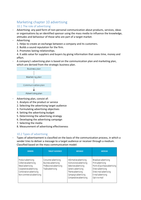
- Types of advertisement is classified on the basis of the communication process, in which a
sender tries to deliver a message to a target audience or receiver through a medium.
Classified based on the mass communication model:
,- By sender:
1. Product advertising: to make consumers aware of a companies brands, goods, or services
and to to inform them of new or improved products. Try to create brand loyalty.
2. Collective advertising: joint advertising by competitors in the same sector to stimulate
primary demand, not for a specific brand.
Paid by organisations at same level of supply chain horizontal collective advertising.
Used to stimulate interest or demand for the introduction stage pioneer advertising.
3. Retail advertising: to bring as many customers as possible into the store. Sometimes they
use joint advertisements, however they are not at the same level in the supply chain
vertical collective advertising, costs on percentage basis.
4. Cooperative advertising: the retailer and manufacturer share the costs of a joint
advertisement campaign.
5. Combination advertising: companies not selling the same products but have a shared
interest in sharing the costs of an advertising campaign (shopping mall).
6. Non-commercial advertising: to create a positive attitude towards certain matters, by
non-profit organisations.
- By target audience:
1. Consumer advertising: advertising targeted at the consumer, who buy products/services
for their own use or for household members.
2. Business advertising: targeted at organisations and people who buy products/services for
use in business.
3. Professional advertising: targeted at licensed/qualified individuals, such as doctors.
4. Trade advertising: to communicate with members of a distribution channel (wholesalers,
retailers and agents).
- By message:
1. Informative advertising: to pass on factual and supportable information about a product
or how it is used.
2. Institutional advertising: to influence attitudes of stakeholders, rather than sell products.
Advocacy advertising: to react to criticism or to express views on issues.
3. Selective advertising: seeks to affect the demand for a particular brand, product or service
by promoting its unique or differentiating characteristics.
4. Generic advertising: concentrates on the consumer benefits that apply to all brands in a
product category, rather than those that are unique to specific brands.
5. Theme advertising: to increase familiarity with the product’s name and package or to
enhance its brand image.
6. Campaign advertising: intended to bring about immediate action on the part of the
reader/viewer and get him to buy the product right away.
7. Comparative advertising: in which two or more brands are compared based on one or
more product characteristics.
- By medium:
1. Broadcast advertising: commercials on TV or radio.
2. Print advertising: advertisement on printed paper (newspaper, magazine, fliers, etc.).
3. Point-of-purchase advertising: in-store advertising and promotional materials.
4. Direct advertising: mass promotion sent from advertiser to individual customer.
5. Direct mail advertising: direct advertising through the mail.
6. E-mail advertising:
7. Opt-in e-mail: a customer gave permission to send him e-mails on certain topics.
, - Expressive product features: symbolic, such as brand image.
- Instrumental product characteristics: functional or technical features.
10.3 Advertising planning
- Advertising objectives: what do you want to change by advertising? Knowledge, attitude or
behaviour? Which target audience? Within what period?
- Advertising appeal: a product’s unique qualities, a reason for someone to buy it, that would
make effective advertising content.
- Unique selling proposition: product’s unique strengths that is important to customers and
can’t be easily copied by competitors.
- DAGMAR model: applies to objectives for all types of marketing communication. Provides
criteria for setting objectives. Don’t express goals in terms of sales, but directly to
communication, the intended effect on knowledge, attitudes or behaviour.
Defining
Advertising
Goals (for)
Measured
Advertising
Results
- Dagmar model: consumers pass through four stages:
1. Awareness
2. Understanding
3. Conviction
4. Action
Advertising should lead customers to a purchasing decision.
10.4 advertising strategies
- Which message has to be transferred to get the desired effect? Start with positioning.
positioning: strategy where an organisation chooses a certain market position by trying to
place their product/service in the perception/brain of the consumer.
- Strategies:
1. Introduction stage: informing customers about the brand and creating interest in its
benefits
Functional product characteristics
Added value.
2. Market growth stage: persuasive advertising and positioning to create brand preference
Distinctive product attributes (unique claim no one else made, first to highlight).
Affective attributes (emotional value, brand image).
3. Market maturity stage: increase brand loyalty, awareness and attract new customers
Differentiate brand (point out product characteristics at which they perform superior).
Announcing something new (product improvement, price deal).
4. Market decline stage: alternatives for ‘milking’ (keep costs down)
Suggest new uses for the product, increase consumption frequency.
Attract new target market.
10.1 The role of advertising
- Advertising: any paid form of non-personal communication about products, services, ideas
or organisations by an identified sponsor using the mass media to influence the knowledge,
attitudes and behaviour of those who are part of a target market.
- Advertising
1. Helps to create an exchange between a company and its customers.
2. Builds a sound reputation for the firm.
3. Promotes lasting relationships.
4. It adds value for suppliers and buyers by giving information that saves time, money and
effort.
- A company’s advertising plan is based on the communication plan and marketing plan,
which are derived from the strategic business plan.
- Advertising plan, consist of:
1. Analysis of the product or service
2. Selecting the advertising target audience
3. Formulating advertising objectives
4. Setting the advertising budget
5. Determining the advertising strategy
6. Developing the advertising campaign
7. Selecting the media
8. Measurement of advertising effectiveness
10.2 Types of advertising
- Types of advertisement is classified on the basis of the communication process, in which a
sender tries to deliver a message to a target audience or receiver through a medium.
Classified based on the mass communication model:
,- By sender:
1. Product advertising: to make consumers aware of a companies brands, goods, or services
and to to inform them of new or improved products. Try to create brand loyalty.
2. Collective advertising: joint advertising by competitors in the same sector to stimulate
primary demand, not for a specific brand.
Paid by organisations at same level of supply chain horizontal collective advertising.
Used to stimulate interest or demand for the introduction stage pioneer advertising.
3. Retail advertising: to bring as many customers as possible into the store. Sometimes they
use joint advertisements, however they are not at the same level in the supply chain
vertical collective advertising, costs on percentage basis.
4. Cooperative advertising: the retailer and manufacturer share the costs of a joint
advertisement campaign.
5. Combination advertising: companies not selling the same products but have a shared
interest in sharing the costs of an advertising campaign (shopping mall).
6. Non-commercial advertising: to create a positive attitude towards certain matters, by
non-profit organisations.
- By target audience:
1. Consumer advertising: advertising targeted at the consumer, who buy products/services
for their own use or for household members.
2. Business advertising: targeted at organisations and people who buy products/services for
use in business.
3. Professional advertising: targeted at licensed/qualified individuals, such as doctors.
4. Trade advertising: to communicate with members of a distribution channel (wholesalers,
retailers and agents).
- By message:
1. Informative advertising: to pass on factual and supportable information about a product
or how it is used.
2. Institutional advertising: to influence attitudes of stakeholders, rather than sell products.
Advocacy advertising: to react to criticism or to express views on issues.
3. Selective advertising: seeks to affect the demand for a particular brand, product or service
by promoting its unique or differentiating characteristics.
4. Generic advertising: concentrates on the consumer benefits that apply to all brands in a
product category, rather than those that are unique to specific brands.
5. Theme advertising: to increase familiarity with the product’s name and package or to
enhance its brand image.
6. Campaign advertising: intended to bring about immediate action on the part of the
reader/viewer and get him to buy the product right away.
7. Comparative advertising: in which two or more brands are compared based on one or
more product characteristics.
- By medium:
1. Broadcast advertising: commercials on TV or radio.
2. Print advertising: advertisement on printed paper (newspaper, magazine, fliers, etc.).
3. Point-of-purchase advertising: in-store advertising and promotional materials.
4. Direct advertising: mass promotion sent from advertiser to individual customer.
5. Direct mail advertising: direct advertising through the mail.
6. E-mail advertising:
7. Opt-in e-mail: a customer gave permission to send him e-mails on certain topics.
, - Expressive product features: symbolic, such as brand image.
- Instrumental product characteristics: functional or technical features.
10.3 Advertising planning
- Advertising objectives: what do you want to change by advertising? Knowledge, attitude or
behaviour? Which target audience? Within what period?
- Advertising appeal: a product’s unique qualities, a reason for someone to buy it, that would
make effective advertising content.
- Unique selling proposition: product’s unique strengths that is important to customers and
can’t be easily copied by competitors.
- DAGMAR model: applies to objectives for all types of marketing communication. Provides
criteria for setting objectives. Don’t express goals in terms of sales, but directly to
communication, the intended effect on knowledge, attitudes or behaviour.
Defining
Advertising
Goals (for)
Measured
Advertising
Results
- Dagmar model: consumers pass through four stages:
1. Awareness
2. Understanding
3. Conviction
4. Action
Advertising should lead customers to a purchasing decision.
10.4 advertising strategies
- Which message has to be transferred to get the desired effect? Start with positioning.
positioning: strategy where an organisation chooses a certain market position by trying to
place their product/service in the perception/brain of the consumer.
- Strategies:
1. Introduction stage: informing customers about the brand and creating interest in its
benefits
Functional product characteristics
Added value.
2. Market growth stage: persuasive advertising and positioning to create brand preference
Distinctive product attributes (unique claim no one else made, first to highlight).
Affective attributes (emotional value, brand image).
3. Market maturity stage: increase brand loyalty, awareness and attract new customers
Differentiate brand (point out product characteristics at which they perform superior).
Announcing something new (product improvement, price deal).
4. Market decline stage: alternatives for ‘milking’ (keep costs down)
Suggest new uses for the product, increase consumption frequency.
Attract new target market.