2 Nation States
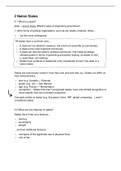
2.1 What is a state?
state = one of many different ways of organising government
⇨ other forms of political organisation, such as city-states, empires, tribes…
⇨ … but the most widespread
All states have a common core...
o A state isn’t an abstract construct, but a form of social life (a community).
o A state is the most important community.
o A state can also be called a ‘political community’ that holds sovereign,
ultimate power in terms of governing and policy making, so power is vital
(= essentieel, van belang).
o States have symbols of statehood (only considered crucial if the state is a
nation-state).
States are enormously varied in how they look and how they act. States can differ on
next characteristics…
o size (e.g. Canada ↔ Estonia)
o power (e.g. US ↔ San Marino)
o age (e.g. France ↔ Montenegro)
o recognition – States that aren’t recognized states, have only limited recognition or
have majority (but not universal) recognition.
Concepts similar to states (e.g. European Union, IMF, global companies…) aren’t
considered states.
2.2 What are key features of states?
States have three core features…
o territory
o sovereignty
o people
…and two additional features.
o monopoly of the legitimate use of physical force
o rule of law
, 2.2.1 Territory
territory = terrain or geographical area of a state that it considers to be its own
⇨ doesn’t need to be continuous (e.g. the Netherlands, because of the islands), but
should be persistent
⇨ includes air space and coastal waters
⇨ term country is commonly used
Jurisdiction of the state is geographically defined.
Activities linked to territory are…
o defend territory
o guard borders
o exploit resources on territory
2.2.2 Sovereignty
sovereignty = the state holds the highest power and can - in principle - act with
complete freedom and independence within its own territory
≠ power (e.g. the US and Mauretania are equal as sovereign states, but the US is
way more powerful)
There are two forms of sovereignty…
1) internal sovereignty = within its own territory every state can act as it wishes
and is independent of other powers
2) external sovereignty = the state is recognised as a state by other states
⇨ State can voluntarily give up (part of) its sovereignty (e.g. EU) – They may
voluntarily limit their power by signing international agreements. If circumstances
change, states may also decide to revoke these agreements.
⇨ There are limits to sovereignty: no widespread harm against population (e.g.
genocide) or economic constraints
2.2.3 People
A state entails a people (= community) that has a significant relationship with the
state.
o relatively permanent population
o consisting of citizens
o forming a collective entity (= nation)
citizen = legally recognized member of a state with all the individual rights and duties
of that state
2.1 What is a state?
state = one of many different ways of organising government
⇨ other forms of political organisation, such as city-states, empires, tribes…
⇨ … but the most widespread
All states have a common core...
o A state isn’t an abstract construct, but a form of social life (a community).
o A state is the most important community.
o A state can also be called a ‘political community’ that holds sovereign,
ultimate power in terms of governing and policy making, so power is vital
(= essentieel, van belang).
o States have symbols of statehood (only considered crucial if the state is a
nation-state).
States are enormously varied in how they look and how they act. States can differ on
next characteristics…
o size (e.g. Canada ↔ Estonia)
o power (e.g. US ↔ San Marino)
o age (e.g. France ↔ Montenegro)
o recognition – States that aren’t recognized states, have only limited recognition or
have majority (but not universal) recognition.
Concepts similar to states (e.g. European Union, IMF, global companies…) aren’t
considered states.
2.2 What are key features of states?
States have three core features…
o territory
o sovereignty
o people
…and two additional features.
o monopoly of the legitimate use of physical force
o rule of law
, 2.2.1 Territory
territory = terrain or geographical area of a state that it considers to be its own
⇨ doesn’t need to be continuous (e.g. the Netherlands, because of the islands), but
should be persistent
⇨ includes air space and coastal waters
⇨ term country is commonly used
Jurisdiction of the state is geographically defined.
Activities linked to territory are…
o defend territory
o guard borders
o exploit resources on territory
2.2.2 Sovereignty
sovereignty = the state holds the highest power and can - in principle - act with
complete freedom and independence within its own territory
≠ power (e.g. the US and Mauretania are equal as sovereign states, but the US is
way more powerful)
There are two forms of sovereignty…
1) internal sovereignty = within its own territory every state can act as it wishes
and is independent of other powers
2) external sovereignty = the state is recognised as a state by other states
⇨ State can voluntarily give up (part of) its sovereignty (e.g. EU) – They may
voluntarily limit their power by signing international agreements. If circumstances
change, states may also decide to revoke these agreements.
⇨ There are limits to sovereignty: no widespread harm against population (e.g.
genocide) or economic constraints
2.2.3 People
A state entails a people (= community) that has a significant relationship with the
state.
o relatively permanent population
o consisting of citizens
o forming a collective entity (= nation)
citizen = legally recognized member of a state with all the individual rights and duties
of that state