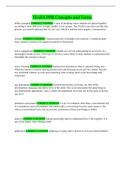
TExES PPR Concepts and Terms
ability grouping CORRECT ANSWER A type of grouping where students are placed together according to their skill level, in high, middle or low groups. The TExES exam does not like this practice as research indicates that it is not very effective and has some negative consequences. abstract CORRECT ANSWER Characterized only in thought; non-concrete. Considered apart from concrete existence.Not applied or practical; theoretical. active engagement CORRECT ANSWER Student are actively participating in an activity in a meaningful, hands-on way. This type of activity is more likely to help students to understand and remember the concept or lesson. acitve listening CORRECT ANSWER Paying close attention to what is currently being said. Often the listener is silently making mental notes and focusing on not just the content, but also any emotional content, as well, and connecting what is being said to prior knowledge and experience. age appropriate CORRECT ANSWER Instructional lessons, activities, etc, that fit the development, language and ability level of the child. This is not necessarily the same thing as developmentally appropriate, since a child's developmental level may not be the same as his/her age level. alternative assessment CORRECT ANSWER A type of evaluation other than a conventional test. It is sometimes used with students who cannot take a conventional test for some reason or for whom a conventional test is not an accurate assessment of their knowledge or ability. analysis CORRECT ANSWER Taking knowledge apart to understand how it fits together. It is one of the higher order thinking skills. application CORRECT ANSWER Applying or using what is known to solve an actual problem.
Written for
- Institution
- TExES PPR
- Course
- TExES PPR
Document information
- Uploaded on
- March 27, 2023
- Number of pages
- 23
- Written in
- 2022/2023
- Type
- Exam (elaborations)
- Contains
- Questions & answers
Subjects
-
texes ppr concepts and terms

Also available in package deal