Final Exam - Requires Respondus LockDown Browser + Webcam Question 1
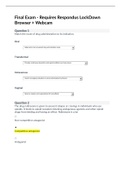
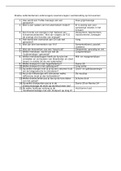
Match the route of drug administration to its indication.
Correct!
Oral Correct!
Transdermal Correct!
Intravenous Correct!
Vaginal Question 2
The drug naltrexone is given to prevent relapse or cravings in individuals who use opioids. It binds to opioid receptors blocking endogenous agonists and other opioid drugs from binding and having an effect. Naltrexone is a/an Non-competitive antagonist Competitive antagonist Antagonist Safest and most convenient drug administration route.
Provides continuous absorption and systemic effects over many hours.
Used in emergency situations or when administered by infusion.
Given as creams and suppositories for local effects. Partial agonist Agonist Question 3
Due to the many chronic diseases associated with aging, the elderly can have decreased blood flow to the kidneys and overall decreased renal function, which can increase the duration of a drug in the patient’s system. Which pharmacokinetic process is affected in this scenario?
Answer: Excretion Question 4
When the combined effect of two drugs is greater than the sum of their individual effects it is referred to as Incompatibility Additive effects Synergism Antagonism Question 5
True or False. If the statement is false, explain why it is false. Schedule I drugs have low abuse potential and an accepted medical use.
Answer: False: Schedule I drugs have a high abuse potential and no accepted medical use OR
False: Schedule IV drugs have low abuse potential and an accepted medical use. Question 6
Michael is a 6-year-old male with a history of exercise-induced asthma. It is controlled by
short-acting beta agonist (SABA) usage prior to exercise, and it is well controlled. While on a family vacation, Michael developed a fever, and his parents found Children’s Motrin
as the only antipyretic option at the hotel convenience shop. Is this appropriate for Michael? Explain why or why not. No, Michael’s doctor should be consulted because of his asthma.
Match the route of drug administration to its indication.
Correct!
Oral Correct!
Transdermal Correct!
Intravenous Correct!
Vaginal Question 2
The drug naltrexone is given to prevent relapse or cravings in individuals who use opioids. It binds to opioid receptors blocking endogenous agonists and other opioid drugs from binding and having an effect. Naltrexone is a/an Non-competitive antagonist Competitive antagonist Antagonist Safest and most convenient drug administration route.
Provides continuous absorption and systemic effects over many hours.
Used in emergency situations or when administered by infusion.
Given as creams and suppositories for local effects. Partial agonist Agonist Question 3
Due to the many chronic diseases associated with aging, the elderly can have decreased blood flow to the kidneys and overall decreased renal function, which can increase the duration of a drug in the patient’s system. Which pharmacokinetic process is affected in this scenario?
Answer: Excretion Question 4
When the combined effect of two drugs is greater than the sum of their individual effects it is referred to as Incompatibility Additive effects Synergism Antagonism Question 5
True or False. If the statement is false, explain why it is false. Schedule I drugs have low abuse potential and an accepted medical use.
Answer: False: Schedule I drugs have a high abuse potential and no accepted medical use OR
False: Schedule IV drugs have low abuse potential and an accepted medical use. Question 6
Michael is a 6-year-old male with a history of exercise-induced asthma. It is controlled by
short-acting beta agonist (SABA) usage prior to exercise, and it is well controlled. While on a family vacation, Michael developed a fever, and his parents found Children’s Motrin
as the only antipyretic option at the hotel convenience shop. Is this appropriate for Michael? Explain why or why not. No, Michael’s doctor should be consulted because of his asthma.