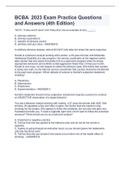
BCBA 2023 Exam Practice Questions and Answers (4th Edition)
"30+5", "3 tens and 5 ones" and "thirty-five" are an example of a(n) ______. A. stimulus salience B. stimulus equivalence C. transfer of stimulus control D. arbitrary stimulus class - ANSWER-D In arbitrary stimulus classes, stimuli DO NOT look alike but share the same response. Harriet is a behavior analyst working with Landon, a 30-year-old man with Moderate Intellectual Disability at a day program. His service coordinator at the regional center tells Landon that she wants to transfer him to a paid work program when he shows appropriate behaviors and exhibits verbal aggression fewer than 2 times per month. Harriet is very busy, so she forgets to collect his behavior data. She thinks that Landon is doing very well, so she tells his service coordinator that Landon should be transferred to the paid work program. Which attitude of science is Harriet's subjective statement violating? A. Parsimony B. Determinism C. Empiricism D. Experimentation - ANSWER-C Harriet's statement should not be subjective. Empiricism requires a person to conduct an OBJECTIVE observation of a target behavior. You are a behavior analyst working with Audrey, a 27-year-old woman with ASD. She smokes 18 cigarettes a day and often coughs. Her doctor that she needs to stop smoking for her breaks. She agrees to follow the schedule, but one day she gets very frustrated and tells you, "I need a cigarette right now! I don't want to follow the schedule anymore!" What should you do as a behavior analyst? A. Implement a negative practice. B. Tell her that she has agreed to the behavior plan and do not let her smoke a cigarette. C. Audrey is going through an extinction burst, so you should ignore her statements until she becomes calm. D. Tell her that she can smoke if she wants to but inform her of the health effect of smoking. - ANSWER-D Even though Audrey agrees to follow the schedule, it is her decision whether she smokes or not. The behavior plan does not have the authority to prohibit someone from engaging in a behavior. It is rather a SUPPORT to live better. A teacher suggests the use of a behavior analyst because her 8-year-old student, Billy, has severe aggressive behavior of destroying classroom property. The behavior analyst decides to conduct a functional analysis. During what conditions should the behavior analyst provide attention before the target behavior occurs? A. play condition only B. play condition & escape conditions C. attention condition D. None of the above - ANSWER-B During the play condition, the behavior analyst should provide attention and play with Billy. During the contingent escape condition, attention is delivered in the form of asking Billy to complete a task. Attention is not delivered in the contingent attention phase UNTIL the target behavior occurs. A behavior analyst is adhering to which underlying assumption of behavior analysis when she conducts several tests of her treatment before she writes it in a formal behavior program? A. Determinism B. Law of parsimony C. Empiricism D. None of the above - ANSWER-C Providing a complete description of one's procedures in a behavior analytic study of classroom management techniques is adhering to which dimensions of behavior analysis? A. Conceptually systematic B. Applied C. Technological D. Analytic - ANSWER-A Describing behavior program procedures in terms of the basic principles of behavior is adhering to which dimension of behavior analysis? A. Conceptually systematic B. Applied C. Technological D. Analytic - ANSWER-A When asked why a certain behavior analyst states that the behavior came out of nowhere. If the behavior analyst meant what he said, he is violating the assumption of _________. A. Philosophical doubt B. Determinism C. Technological D. Being conceptually systematic - ANSWER-A Which of the following is NOT a dimension of ABA? A. Effective B. Technological C. Applied D. Empirical - ANSWER-D A behavior analyst is measuring the time it takes for a client to say "You're welcome" after the staff says, "Thank you". The behavior analyst is measuring __________. A. Frequency B. Duration C. Inter-response time D. Latency - ANSWER-D Which measure would probably be the best measure for crying? A. Frequency B. Duration C. Percentage D. Latency - ANSWER-B If a behavior analyst states "It took four attempts, but Johnny completed the puzzle", she is using which measure? A. Whole interval B. Percent of occurrence C. Trials to criterion D. Frequency - ANSWER-A Jody had an access-maintained tantrum for 14 minutes and it started 3 seconds after she was told "No". It had been 2 days since the previous tantrum. The latency is _____. A. Unknown B. 2 days C. 14 minutes D. 3 seconds - ANSWER-A Manipulating a student's chair in a classroom setting to avoid distraction from the window is an example of manipulation of a ______. A. Context variable B. Antecedent variable C. Confounding variable D. Ecological variable - ANSWER-A The number of time intervals in a specific period of time during which a response occurs continuously for an entire interval is which measure? A. Partial-interval recording B. Whole-interval recording C. Momentary time sampling D. Percentage of occurrence - ANSWER-B In behavior analysis, the ______ is usually __________. A. Independent variable; a measure of behavior B. Dependent variable; a measure of behavior C. Baseline measure; unrelated to the behavior D. Independent variable; implemented before the baseline measure - ANSWER-B An experimenter examines the effects of three types of prompts on compliance in a person who is developmentally disabled. In this experiment, what is the IV? A. The location of the environment B. The three types of prompts C. The level of compliance D. The diagnosis of the individual - ANSWER-B A person is asked to make his bed. His caregiver checks 30 minutes later and the bed was made. No one else was present during that time. The caregiver records that the client made his bed even though he did not observe the behavior directly. The data collection method used is ________. A. Duration recording B. Whole-interval recording C. Latency recording D. Permanent product recording - ANSWER-D Talking out in class results in a child losing a star on his star chart. The loss of a star appears to be an attempt to implement a(n) _______ procedure. A. Response cost B. Negative reinforcement C. Aversion therapy D. Errorless learning - ANSWER-A Gradually transferring stimulus control from prompts to other discriminative stimuli is a process called ________. A. Shaping B. Modeling C. Maintenance D. Fading - ANSWER-A Requiring a student who disrupts the class by throwing papers and tipping over chairs to clean the mess up and then clean the rest of the room by sweeping and cleaning desktops is a(n) _______ procedure. A. Negative reinforcement B. Negative punishment C. Positive punishment D. Extinction - ANSWER-C A procedure that is considered positive punishment where a teacher requires a student who disrupts class by throwing papers and tipping over chairs to clean the mess up and clean the rest of the classroom is called _________. A. Restitution B. Stimulus shaping C. Over-correction D. Corporal punishment - ANSWER-C Teaching a child to match printed words to pictures, then pictures to the actual objects, and then testing to determine if the child can now match printed words to the actual objects is known as _______. A. PECS B. Discrete trial training C. Verbal behavior training D. Stimulus equivalence - ANSWER-D The purpose of conducting a functional assessment is to ______. A. Complete a functional analysis B. Manipulate variables that affect behavior C. Obtain information from which to create a hypothesis statement D. Determine how effective a treatment intervention is - ANSWER-C Which is the best definition of a behavior function? A. What the teacher believes the reinforcer should be for the child B. How the behavior controls antecedents C. How the child feels concerning his or her own behavior D. The reinforcers that maintain a behavior - ANSWER-D Alternative appropriate behaviors that serve the same function for an individual _______. A. Always involve skills the individuals already possess B. Produces the same reinforcer for the individual C. Have the same topography as the problem behavior D. Always requires the same amount of response effort as the problem behavior - ANSWER-B A ______ is derived from a descriptive analysis. A. Hypothesis B. Statement of causation C. Data-driven conclusion D. Hypotenuse - ANSWER-A When an observer notes everything the client does or says as well as events before and after the episode of behavior, she or he is using _______. A. Duration recording B. Permanent product recording C. ABC recording D. Time sampling - ANSWER-C What are the three elements of informed consent? A. No coercion, approval, voluntariness B. Capacity, age, voluntariness C. Informed, age, voluntariness D. Capacity, informed, voluntariness - ANSWER-D Behavior analytic interventions that are effective in changing an individual's behavior in a socially important way are said to have ______. A. Parsimony B. Social validity C. Primary importance D. Interobserver reliability - ANSWER-B Which of the following would not be a type of function of behavior identified during a functional assessment? A. Attention B. Escape C. Frustration D. Access to tangibles - ANSWER-C Results of a functional assessment reveal that a child engages in hand-biting when she is in her room by herself. The likely function of behavior is _______. A. Attention B. Access to tangibles C. Escape/avoidance D. Automatic reinforcement - ANSWER-D You are working with a child on teaching swimming. You teach the child to do the front crawl. After a few weeks of teaching, the child is doing both the front crawl and also starts doing the breast stroke. What has occurred? A. Stimulus generalization B. Response generalization C. Failure to generalize D. Maintenance - ANSWER-A If you teach a child to swim in a pool and he learns to do both the front crawl and breast stroke with being taught only how to do the front crawl in the pool and he visits a beach and is able to do the front crawl in the ocean, what has occurred? A. Stimulus generalization B. Response generalization C. Failure to generalize D. Natural contingencies - ANSWER-B In reference to maintenance, functional arrangements between behavior, antecedent, and consequence events that occur in the environment in which the behavior of interest is to be maintained are called _______. A. Stimulus discriminates B. Natural contingencies C. Generalization D. Maintenance schedules - ANSWER-B A child who learns to say "red" when presented with a red card, also says "red" when presented with an orange card. This is called ______. A. Stimulus generalization B. Response generalization C. Discrimination D. Failure to generalize - ANSWER-A Which schedule of reinforcement is most effective at maintaining behaviors? A. Continuous reinforcement B. Intermittent reinforcement C. Extinction D. Ratio - ANSWER-B You are teaching David to clean the workshop to prepare him for working on the cleaning crew. Read the descriptions below and identify which is LEAST likely to promote generalization of the workshop cleaning skills to real-life cleaning jobs. A. Make the workshop as much like a cleaning situation as possible B. Transition to variable, delayed reinforcement C. Teach David to use a checklist, which could be used on the cleaning crew D. Make the workshop distinctive from the cleaning crew and then gradually make it more like it - ANSWER-D You are working with a client who finds physical touch to be aversive. When the person is off task, the program calls for you to give a warning by counting to 10; at that point, you gently touch him if he is not back on task. The touch remains until he returns to the task. Please note that being touched is aversive for this particular individual. If the person gets back on task during counting, this is an example of _______. A. Escape B. Avoidance C. Positive reinforcement D. Stimulus fading - ANSWER-B You are working with a client who finds physical touch to be aversive. When the person is off task, the program calls for you to give a warning by counting to 10; at that point, you gently touch him if he is not back on task. The touch remains until he returns to the task. Please note that being touched is aversive for this particular individual. If the person gets back on task when he is touched, this is an example of _______. A. Escape B. Avoidance C. Positive reinforcement D. Stimulus fading - ANSWER-A Staff alerts you that one of their clients seems to become aggressive when he has not consumed food for several hours. This phenomenon demonstrates the effect of a(n) __________. A. Discriminative stimulus B. Conditioned stimulus C. Establishing operation D. Negative reinforcer - ANSWER-C A child is exhibiting tantrum behaviors. You believe the tantrum is occurring for your attention. You therefore ignore the tantrum until it ceases while continuing daily activities. You note that the tantrums decrease over time. This is an example of _______. A. Positive punishment B. Establishing operations C. Time-out D. Extinction - ANSWER-D Tokens are generally referred to as _______. A. Conditioned reinforcers B. Generalized conditioned reinforcers C. Negative reinforcers D. SDs - ANSWER-A You are designing a treatment program for Susan. Before getting into details, you wish to identify some ultimate outcomes towards which Susan will progress. Which of the following is NOT an appropriate ultimate outcome for Susan? A. The variety and diversity of events in Susan's life B. Susan's access to reinforcers in the community C. The range of interpersonal interactions with others D. The convenience of staff with whom Susan works - ANSWER-D Non-contingent reinforcement is this type of intervention: A. Antecedent intervention B. Consequent intervention C. Punishment strategy D. Behavioral momentum intervention - ANSWER-A A teacher uses a group contingency with her students. She states the following rule: "If everyone gets a 100% on their spelling test this week, I will do cartwheels down the hall for you". What type of group contingency is this? A. This is not a group contingency B. Independent group contingency C. Interdependent group contingency D. Dependent group contingency - ANSWER-C A teacher says, "Everyone has math homework tonight. Tomorrow, I will draw a name from a hat. If that person has completed her or his homework and remembered to bring it back to school, everyone will get extra recess." What type of group contingency is this? A. This is not a group contingency B. Independent group contingency C. Interdependent group contingency D. Dependent group contingency - ANSWER-D Self-management is best defined as the ______. A. Personal application of behavior change tactics that produces a desired change in behavior B. Personal application of behavior change tactics that produces an increase in a desired behavior C. Personal application of behavior change tactics that produces a decrease in a desired behavior D. Application of behavior change tactics that cause changes to a particular behavior - ANSWER-A A study was conducted to determine the effectiveness of time-out for physical aggression. The time-out procedure would be considered the _______. A. baseline measure B. dependent variable C. independent variable D. response measure - ANSWER-C When conducting an analog functional analysis, the condition commonly used as a control is the ______. A. home condition B. play condition C. social attention condition D. demand condition - ANSWER-B Which method is the BEST to use when presenting categorical data from a functional analysis? A. a bar graph B. anecdotal report C. scatterplot D. standard celeration chart - ANSWER-A What is the next step in the assessment process if data from the functional analysis do NOT support the original hypothesis? A. Base the intervention on the original hypothesis and re-assess after a time lapse B. Design a package intervention to address all possible functions of the behavior C. Continue to conduct the functional assessment until the data coincides with the original hypothesis D. Alter the hypothesis regarding the maintaining variable of the behavior based on the results of the functional assessment - ANSWER-D When developing a task analysis, a behavior analyst would first ______. A. assess the mastery level of the individual B. conduct a functional assessment of the target skills C. determine the necessary component steps D. observe the individual to collect baseline data - ANSWER-C In general, when a behavior analyst is asked to help someone make friends, the behavior analyst should _____. A. avoid interfering in interpersonal relationships B. refer the person to a counselor, social worker, or other professional C. evaluate the current social repertoire D. set up a social skills training program - ANSWER-C Holly is learning to use a spoon to feed herself. Applesauce is known to function as a reinforcer. Her teacher has selected the following objective for Holly: "Given a spoon and a 3-ounce dish of applesauce, Holly will independently scoop the applesauce to her mouth." This objective is incomplete. Which component is missing? A. antecedent stimulus B. consequence condition C. prerequisite skill criteria D. standard of performance - ANSWER-D Speed, magnitude, durability, and generality of effect are some of the MOST important ______. A. dimensions of behavior that lend themselves to quantification more readily than others B. variables that are overlooked by other social sciences in solving problems C. variables to consider when selecting reinforcers and punishers D. components of treatment packages used in treating the most severe behavior problems - ANSWER-C Jim's teacher has taught him to say, "Hello, how are you?" and when he does this, she delivers praise. Now Jim says this whenever he meets anyone, and some people say, "Fine, how are you?" What is the natural consequence for Jim's behavior? A. increased number of friends B. continuous reinforcement C. improved social repertoire for Jim D. the responses of the people he meets - ANSWER-D When shopping with her dad, Sally knocks items off the shelf, especially canned goods. The cans make a loud noise when they hit the floor. Her dad decides to teach her an alternative behavior. What alternative behavior is the BEST choice to teach? A. Sally pushes the shopping cart with both hands B. Sally drops items into the cart when her dad gives them to her C. Sally keeps her hands in her pockets while in the store D. Sally holds dad's hand while shopping and gets to let go when quiet - ANSWER-B When setting criteria for behavior change, behavior analysts attempt to implement the simplest mode of intervention necessary to elicit the desired outcome. As such, the identified outcome criteria should be _____. A. applied to ecological assessments to generalize skills B. developed prior to the identified intervention C. initially broad in focus with subsequent reduction to a target response D. measured independent of practice effects of reactivity - ANSWER-B Jamie and Morgan have similar behavior challenges and similar daily schedules. A behavior analyst has spent extensive time and effort on developing and implementing Morgan's plan, which is proving to be very successful. How should the behavior analyst proceed with developing a treatment plan for Jamie? A. Because the behaviors are topographically similar, implementing the plan designed for Morgan would be appropriate as it is the least restrictive option B. Complete a separate functional assessment and plan for Jamie C. Use the same plan for both, just ensure the ecological variables correspond to the student D. Do a separate functional analysis, but the same behavior supports can be applied to both students - ANSWER-B The use of withdrawal design is LEAST appropriate when _______. A. evaluating an intervention for severe problem behavior B. evaluating the effects of an intervention for behavior that has multiple functions C. extraneous variables cannot be controlled D. multiple participants are being evaluated - ANSWER-A When using an alternating treatments design, it is important to randomly _______. A. assign participants to treatment conditions B. select participants from the population of interest C. order treatment conditions presented during each phase D. change each criterion level - ANSWER-C When using a changing criterion design, the BEST demonstration of experimental control would be produced if the _____. A. criterion level is changed in equal increments B. criterion level is changed slightly on each manipulation C. criterion level is set well above that of the behavior D. behavior changes concurrently with the criterion level - ANSWER-D The PRIMARY advantage of using a multiple baseline design across subjects is that ______. A. an intervention may be applied to more than one individual B. experimental control can be demonstrated without a reversal C. it is the most effective method for establishing functional relations D. more individuals benefit from the effects of an intervention - ANSWER-B Jamie frequently falls to the floor and screams at school. Preliminary behavioral assessment data indicate that his tantrums are maintained by attention and escape from demand situations. Jamie's behavior analyst wants to examine how attention and escape conditions affect these behaviors. The behavior analyst does not want to conduct the analysis in Jamie's classroom because she would not be able to control for potentially important factors. Relating to the scenario, which statement is TRUE? A. Analyses that involve experimental conditions are almost always conducted in the person's natural environment. B. The behavior analyst could conduct the analysis in a vacant classroom, but the generality of the findings is an issue to be considered. C. The behavior analyst should conduct detailed interviews with the teacher and school staff to determine functional relations. D. Only if the analysis is conducted in Jamie's classroom can a reasonable hypothesis be generated. - ANSWER-B Carlos participated in a toothbrushing skill acquisition program. When he started the program, he needed physical assistance to perform each step. After 2 weeks, he met all objectives and was able to complete each step independently. The program involved the use of graduated guidance, praise, and token reinforcement. In the future, the behavior analyst would like to examine which procedures made the program most effective (i.e., guidance, praise, or token reinforcement). To determine this, the behavior analyst could use a ______. A. component analysis B. discriminant analysis C. non-parametric analysis D. parametric analysis - ANSWER-A The behavior analyst has had good results with an intervention she designed to make access to video games contingent upon playing with other children. She now wants to compare the effects of different amounts of video game access time. She should conduct a _______. A. changing criterion study B. non-parametric study C. parametric study D. reversal study - ANSWER-C Which of the following measures would be MOST appropriate for reporting head banging during each 5-min interval of work? A. duration of head bang B. latency from request to the first response C. rate of head banging D. inter-response time - ANSWER-C A person "getting wet" in the rain is NOT considered an occurrence of behavior because "getting wet" _______. A. does not specify an interaction between an organism and its environment B. can occur under only one, very specific environmental condition C. is a hypothetical construct and cannot therefore meet the criteria for an occurrence of behavior D. does not have social or clinical significance in a science of human behavior - ANSWER-A The BEST definition for mouthing behavior would be any instance of Luke ____. A. placing his mouth on any object for at least 5 seconds B. placing his open mouth on a non-nutritive object or placing a non-nutritive object in his mouth C. making contact with his mouth to any non-nutritive object D. mouthing a non-nutritive item for 3 or more consecutive instances within a 30-sec interval - ANSWER-B Susan recorded data on a student's fidgeting behavior in the following way: She divided a 10-min recording period into 10-sec intervals and recorded in each interval a "+" if the target behavior occurred at least once. The percentage of intervals of target behavior occurrence was about 45%. The data resulting are most likely to be an _______. A. accurate measure of inter-response time B. inaccurate measure of inter-response time C. overestimate of the occurrence of the behavior D. underestimate of the occurrence of the behavior - ANSWER-C A major benefit of product recording is that _______. A. it is the easiest recording method B. it is used when a behavior results in a certain tangible outcome C. the observer does not have to be present when the behavior occurs D. one can always determine who engaged in the behavior that led to the product that was recorded - ANSWER-C Observation sessions should be scheduled so that the representativeness of the data can be maximized. Considering behaviors occurring in a school setting, which of the following options is consistent with the recommendations? A. Behaviors are given letter-codes that represent the competed topographical definition of the behaviors, e.g. on-task academic behavior is represented by "A" on the recording sheet. B. Observations should be made only when the behavior is likely to occur most frequently during a day, for instance, during a particular academic class. C. Recordings of behavior during the whole school day may be needed initially to assess the representativeness of samples within the day. D. Representativeness can be assured by scheduling observations in sessions of 60 min or more in the morning and afternoon school schedule. - ANSWER-C Frequency would be MOST appropriate measure for which scenario? A. The behavior analyst wants to reduce the number of times Jack hits Jill. B. Jack wants his employees to increase the number of kits made in 1 hour. C. Jack's parents want him to reduce his persistent hand flapping. D. Jill wants to increase her son's compliance with room-cleaning requests. - ANSWER-A What is the most appropriate response to a behavior analyst could make when a learner responds incorrectly on a match-to-sample trial? A. Immediately provide the least intrusive prompt necessary for a successful trial. B. Allow the learner to respond again after handing the sample stimulus back. Continue to do this until the correct response occurs and provide a strong reinforcer to assist in skill acquisition. C. Immediately remove the sample stimulus and comparison stimuli and start another trial. D. None of the above. - ANSWER-C The behavior analyst should provide as little attention as possible and begin another trial. He should not provide hand-over-hand or similar prompting after incorrect responses since this could develop a defective behavior chain (through rearranging the sample stimuli, delivering the SD, and THEN providing hand-over-hand or similar prompting may be appropriate) A behavior analyst is working with a child who has a disorder that limits his ability to reliably retain liquids and saliva in his mouth during mealtime. The behavior analyst wants the child to wipe his mouth with a napkin each time he loses any liquid from his mouth. What would be the BEST measurement procedure the behavior analyst could use to determine if the child is wiping his mouth each time he begins to make a mess? A. The behavior analyst should track the rate of the child's mouth-wiping behavior. B. The behavior analyst should take frequency data on how many times the child wipes his mouth. C. The behavior analyst should measure permanent products by counting the number of napkins the child uses each day. D. The behavior analyst should measure the percent of occurrence. - ANSWER-D Each mess is an opportunity to wipe his mouth. By determining the percentage of times he wipes his mouth after a mess is made, the behavior analyst will be able to determine if the child is increasing his mouth-wiping behavior after a mess is made. Counting the number of napkins the child uses, counting how many times the child makes a mess, and determining the rate of mouth-wiping is not sufficient in determining if the child is wiping his mouth each time he makes a mess. An adolescent is working on acquiring vocational skills to prepare for the workplace. He is working on learning to cut and prepare wood planks for shipments, as an organization in the Fall will allow him to work for a wage with them in a warehouse doing similar tasks and this is a goal the parents and the client voiced that they desired he learn. He enjoys working with hand tools but has never operated electronic power-saws or tools because he previously learned that it requires operating buttons and levers which he does not enjoy. Which strategy would be most beneficial for teaching the adolescent to correctly cut and prepare wooden planks? A. First allow him to cut with hand tools before asking him to cut using a power-saw. B. Allow him to cut wooden planks using hand tools. C. Do not allow him to use hand tools for any other crafts until he operates a power-saw to cut and prepare wooden planks. D. Stop working on cutting wooden planks until the adolescent can operate a power-saw without complaining. - ANSWER-B Behavior analysts use skills that are already in a learner's repertoire - cutting planks with a power-saw is not in his repertoire. The behavior analyst may want to work on this skills at a later time though, especially if it is the tool of choice by the company he will be hired by. Since the goal is to correctly cut wooden planks, it is appropriate to let him use hand tools since the skill of utilizing hand tools is in his repertoire. A grandmother is driving down the road. Her grandchild is sitting in the back seat when he sees a pool near the community center. The grandmother says, "Did you see that pool?" The child replies, "Yeah, pools are so fun!" What verbal operant(s) did the child use? A. An intraverbal B. A mand C. Cannot be determined D. A tact - ANSWER-A The boy's verbal behavior is evoked by his grandmother's verbal behavior. Therefore, it was an intraverbal. Him saying, "Yeah, pools are so fun!" was not evoked by the sight of a pool, so it is not a tact. We cannot conclude this is a mand because it appears the child's verbal behavior was evoked by his grandmother's question and not the motivation for the pool itself. You are a behavior analyst visiting your client at his group home. You are collecting partial-interval data on his group-time contribution behavior. During the first minute of a 10-min interval, your client contributes during the group time activity. After you record that the response occurred, you immediately go to the group home's kitchen and grab a coffee while briefly chatting with another resident of the group home. You make it back shortly before the next interval begins. Since you went to the kitchen in the middle of an interval, what should you do with the data you collected this session? A. Don't dispose of the datasheet since you were only absent during 1 interval and the likelihood of this negatively impacting the entire outcome of the intervention is minimal. B. Void the entire datasheet for this session since you were absent during a portion of 1 interval. C. Don't dispose of the datasheet since you did not need to observe the rest of that interval. D. Don't dispose the datasheet for this session. Simply void out the interval in which you went to the kitchen since you were not absent for any of the other intervals. - ANSWER-C You are using partial-interval recording to record whether or not the target response occurs at any point during the 10-min interval. Since the target response occurred at the beginning of the interval, you do not need to observe the rest of the interval (as long as you are back in time for the beginning of the next interval). The data is not negatively impacted by you going to the kitchen in this scenario. Jillian is traveling to see the Eiffel Tower in France. She did not know how to speak French before she arrived there. When she arrives, she is taught to say, "Salut" when someone waves at her. Then, without being taught, she begins waving to people when they say, "Salut!" What type of stimulus equivalence is this an example of? A. Reflexivity B. Symmetry C. Reversibility D. Transitivity - ANSWER-B This is an example of symmetry because if A=B (waving="Salut") then this means B=A ("Salut"=waving). After observing your client in his home, school, and clinical environment, you notice that many behaviors only occur in the clinical environment. You then decide that you will best increase the likelihood of generative learning taking place, by teaching your client ________. A. to use the behavior only in the environmental conditions that were taught. B. every possible environmental condition the behavior will be used for. C. to ask for help. D. the basic skills he will need to allow him to respond generatively in untrained environmental conditions. - ANSWER-D Generative learning occurs when a learner uses skills in different conditions that what has been taught (under untrained stimuli). This gives the learner the ability to adapt the skill under many possible scenarios. It is NOT possible to teach every condition the skill will need to be used under. You are performing a functional analysis of shouting behavior that lasts an average of 3 seconds with a range of 12-26 seconds between each response. The functional analysis reveals that shouting occurs at relatively high rates in all conditions except the demand condition. What is the most likely function of this problem behavior? A. Access to tangibles B. Escape C. Automatic reinforcement D. All of the above - ANSWER-C If a functional analysis reveals that the behavior occurs at relatively the same frequency in all conditions, it is most likely maintained by automatic reinforcement. If a behavior is automatically maintained, a functional analysis may also show lower rates of behavior in the demand condition. A marksman team is split up into 4 different groups, each containing 2 marksmen. Each marksman gets to shoot their firearm once at a bullseye target down the firing range. Then, each 2-marksman group finds the mean distance of their group's shots from the center of the bullseye by adding the distances from the center of the bullseye to where they hit on the target, divided by 2. The group that has the smallest average distance from the bullseye (that hit closest to the bullseye on average per hit) gets to go home early (a reward). What type of group contingency is this? A. A dependent group contingency B. The Good Behavior Game C. An independent group contingency D. An interdependent group contingency - ANSWER-D It is an interdependent group contingency since the behavior of every player in the 2-person group is measured to gain a reward for the entire group. You begin writing behavioral interventions and a treatment plan for your client Barry. You are certain you would like to implement your interventions with Barry. When should you obtain consent from a guardian? A. Before changing an intervention goal B. ONLY if the guardian requested to be asked for their approval before changes are made C. ONLY before a more restrictive intervention is used D. All of the above - ANSWER-A It is best practice to gain consent BEFORE any significant change to services provided is made. There are MANY other scenarios where gaining guardian consent is necessary. This includes any time a significant change is made to the behavior plans or if anything new is introduced to the current plan. A behavior analyst begins working with a client who has several target behaviors. Which one of his problem behaviors would be considered the MOST important to address immediately? A. Pica, he swallowed a coin when he was a toddler but has not engaged in pica since. B. Self-induced vomiting, he had made himself vomit in the past 1 time per month on average. It typically occurs in the morning before breakfast. C. Visual self-stimulatory behavior of looking up at the ceiling lights. He engages in this behavior 4 hours per day, on average, and it gets in the way of him interacting with peers and performing tasks at home and school. D. Setting fires. He has done this twice but it has not occurred in 13 years. - ANSWER-C Visual stereotypy is the most significant and important behavior to address at this time. Since it occurs for several hours per day, it is negatively impacting his life and ability to learn new skills the most. Yesterday, Brittany found out she passed the BCBA exam. She had waited for a month to receive her score and was relieved when she heard the news. This morning at her apartment, her boyfriend congratulated her and told her how proud he was of her. Brittany could not stop smiling all day. Her boyfriend congratulating her is an example of _______. A. positive reinforcement B. imitation C. extinction D. none of the above - ANSWER-D A department store manager is tracking how often a specific cashier says "thank you for shopping with us today." The manager tracks this behavior for 1 hour, which is broken up into four 15-min intervals. During the first 15-min interval, the cashier said "thank you for shopping with us today" 14 times. During the second 15-min interval, the cashier said "thank you for shopping with us today" 26 times. The cashier did not say "thank you for shopping with us" during the third or fourth intervals. What is the cashier's rate of saying "thank you for shopping with us today"? A. 40 instances per hour B. 1.33 instances per minute C. 40 instances D. 10 instances per session - ANSWER-A Even though no instances occurred in the final 2 intervals, there were still 40 instances that hour. In this scenario, the 4 intervals made up one observation session. Graham is a carpenter who makes wooden bowls. Today, his foreman said, "For every oak wood bowl you make, you will receive $6. For every cedar wood bowl you make, you will receive $4." It takes about 15 min to craft a wooden bowl, no matter what the wood type is. It also takes the same amount of effort to craft an oak or cedar wood bowl. Graham crafts 30 oak wood bowls today. According to the Matching Law, Graham also likely crafted _______ cedar wood bowl today. A. 15 B. 0 C. 60 D. 30 - ANSWER-B The matching law refers to the distribution of responses when there is more than 1 schedule of reinforcement available at the same time. With concurrent variable interval or concurrent fixed interval schedules of reinforcement, the person is likely to distribute their responding proportionally between the 2 schedules. With concurrent variable ratio or concurrent fixed ratio schedules, the person is likely to to allocate all their responses to the highest level of reinforcement. Since Graham's reinforcement schedule is on a fixed ratio schedule (one oak bowl=$6 & one cedar bowl=$4), he is likely to allocate all his time to craft oak wood bowls. Therefore, according to Matching Law, Graham likely crafted 0 cedar wood bowls this day. A behavior analyst is working with an adult who engages in self-injurious behavior. One day, the client's psychiatrist discontinues one of the client's medications and prescribes him a new one. Since this switch, the client's self-injurious behavior has tripled. What should the behavior analyst do? A. Refer the client to a new psychiatrist B. Tell the psychiatrist that the new medication is not working C. Tell the psychiatrist that the old medication worked better than the new one D. None of the above - ANSWER-D The behavior analyst should tell the psychiatrist that the client's self-injurious behavior has tripled and allow them to perform their services accordingly. Behavior analysts do not provide recommendations that are outside of their area of expertise. Therefore, a behavior analyst should not tell a psychiatrist which medication should or should not be used, or which medication would work better. A behavior analyst wants to decrease her adult client's offensive language toward others. The behavior is tracked at the client's group home during meal times and social times in the lounging area and the behavior analyst records 12 occurrences per hour during baseline conditions. The behavior analyst begins the intervention in the client's personal space of the group home and the behavior occurs 3 times per hour on average there. Which of the following statements regarding the intervention is true? A. The intervention appears to be working. B. The intervention is not working. C. The intervention appears to be working but it should be extended to show the intervention itself was responsible for the behavior change. D. None of the above - ANSWER-D With the information given, we cannot determine if the intervention was effective or not. An 8-year-old leaves his bedroom at night and goes to sleep in the family home's living room on the couch. The parents want their son sleeping in his own room and bed. The parents determine that their son is doing this because his room is bright at night due to the brightly lit restaurant signs across the street from the home. What would be the most practical course of action the parents could implement to decrease this behavior or sleeping on the couch in the living room? A. Setting up a token economy where every hour the child stays in his room, he earns a token B. Putting up blinds in the windows of the child's bedroom and making sure all sources of light in the room are turned off C. Contacting a behavior analyst to have her conduct a functional analysis D. Installing door alarms on his bedroom door - ANSWER-B Since the function of behavior is to access a darker environment, putting up blinds or making his bedroom darker is the easiest and most practical antecedent intervention that could be used to address the behavior of sneaking into the living room at night. What is the MOST accurate method to identify what may function as a reinforcing stimulus for your client? A. An open interview with your client where your client can tell you what she/he wants B. A stimulus preference assessment C. A reinforcer assessment D. A questionnaire with a list of reinforcer options the client can check - ANSWER-C A reinforcer assessment measures what effects particular stimuli have on behavior. It is an experiment to see how responding is affected when a client is given the option to work for various possible reinforcers. When a reinforcer assessment shows that the rate of responding increases when a particular stimulus is delivered, it accurately shows that this stimulus would serve as a reinforcer at that time. You are beginning to organize a research project that focuses on self-injurious behavior. You hire 4 data collectors to assist in your research. You notice that each data collector observing the same behavior is getting very different and inconsistent data. You then decide to rewrite your operational definition with a focus on its topography and train the data collectors on this new definition. A topographical operational definition for self-injurious behavior may be _______. A. any occurrence of pulling her own hair that results in attention. B. pulling her own hair with enough force that it detaches from her scalp. C. any behavior that occurs to gain attention such as hair pulling and biting herself. D. pulling her own hair, biting herself, or otherwise purposefully causing herself harm. - ANSWER-B Topographical definitions DO NOT include the function of behavior, or what happens when the behavior occurs. They simply state what the behavior looks like. You show up to your client's home and the client's parents seem eager to see you. They say, "Tom has not had a bowel movement in 3 days. Every time we put him on the toilet, he screams and throws anything he finds nearby. Could you please fix this?" How should you respond? A. "Sure, I'd love to help. Because he hasn't had a bowel movement in 3 days, there might be something else going on such as an illness, an unfavorable side effect of a new medication, etc. Why don't you first take him to his physician to rule out any medical causes, medical conditions, or dietary problems? Then I can come back and work on it if there is no medical explanation for his refusal to use the bathroom." B. "I can't help with refusing to use the bathroom." C. "Sure, that's what I'm here for. Let's pair healthy foods rich in fiber with some laxatives to help him defecate and give him more motivation to do so." D. "Sure, I'll be glad to help. Let me first run a functional assessment to see why this behavior is occurring." - ANSWER-A For some behaviors, a behavioral intervention is unnecessary. There may be something medical going on that is suppressing his ability to have a bowel movement to defecate. A behavior analyst would not step out of her/his boundaries by providing advice before a medical cause is ruled out. Your factory foreman walks onto the operating floor and says, "I need you to complete this shipment of metal plating as soon as you can. I've been waiting all week!" You say, "Absolutely, I will get that done right away," even though that is what you have told him the previous 5 times that he has asked you this week. Even though you said you would get the metal plating to him right away, you do not do so. What type of verbal operant did you use? A. Listener responding B. An echoic C. A tact D. An intraverbal - ANSWER-D Your verbal behavior is an intraverbal operant since it was evoked by the verbal behavior of your foreman. Harry takes part in short-distance spring races. After walking up to the starting line, he must wait for the sound of a gunshot before he can start sprinting forward, or he will be disqualified. However, Harry consistently sprints across the starting line before the sound of the gunshot, resulting in disqualification. With regards to starting to sprint, Harry needs to work on _______. A. decreasing his inter-response time B. increasing his latency C. decreasing his latency D. None of the above - ANSWER-D Latency is the amount of time between the signal to begin the response (the sound of the gunshot) and the response (sprinting forward). Since Harry is consistently sprinting forward BEFORE the signal to do so, latency has nothing to do with this scenario (because latency cannot be measured until the gunshot goes off). A behavior analyst wants to begin using generalized conditioned reinforcers with her client. She believes this will help decrease the likelihood that her client will become satiated on a particular reinforcer. Which of the following stimuli can be used as a generalized conditioned reinforcer? A. A thumbs up B. Coins C. Saying, "Well done!" D. All of the above - ANSWER-D A generalized conditioned reinforcer is a stimulus that functions as a reinforcer because it has been paired with multiple backup reinforcers. All of the above are examples of possible generalized conditioned reinforcers. You just began a new case with a 10-year-old client, Jenny, who engages in self-injurious head-hitting behavior. You interview Jenny's mother regarding the self-injurious behavior. Her mother reports that whenever she asks Jenny to eat her lunch or dinner, she is likely to engage in head-hitting. What is the function of the target behavior? A. Automatic B. Attention C. Escape D. Cannot be determined with the information provided - ANSWER-D A functional assessment includes indirect assessment procedures, direct assessment procedures, and functional analyses. Of these, indirect assessments are often inaccurate. Since the only source of information is from the interview with Jenny's mother, we cannot assume the function of the behavior. Further assessment of behavior needs to be conducted. During the contingent attention phase of a functional analysis, what should a therapist do prior to the target behavior occurring? A. The therapist should enter the room only when the behavior of interest occurs. B. The therapist should be in the same room but withhold attention by engaging in an activity such as drawing a picture. C. The therapist should provide attention at all times. D. None of the above - ANSWER-B In the contingent attention phase, the therapist is present but does not deliver attention until the target behavior occurs. You are a behavior analyst that has developed a program to teach Walter how to socially interact with others more effectively by utilizing both a DRA and extinction procedure. Walter has made much progress during the 6 weeks he has received your services. His behavior therapist is well-trained and has been working with you for over a year. When should you evaluate the effectiveness of this behavior program? A. After the behavior therapist has implemented the program for a week B. Before the program is implemented, while the behavior program is being implemented, and after the behavior program has been implemented C. Throughout the entire implementation of the behavior program and during follow-up probes D. Before the behavior program is implemented and after the behavior program is implemented - ANSWER-C A behavioral program should be monitored THROUGHOUT the implementation phase to see how well it is working and to see if anything needs to be changed. Carson was taught in driver's education class to turn on his blinker before he turns into his driveway. One day, Carson realized that his blinker was not working. Therefore, he rolled down his window and used a hand gesture to signal to other drivers that he was going to turn into his driveway. In this scenario, using hand gestures is an example of ________. A. response maintenance B. response generalization C. stimulus generalization D. multiple exemplar training - ANSWER-B This is response generalization because Carson used an untrained response (hand gestures) that is functionally equivalent to the trained response (turning on his blinker). It is functionally equivalent because it signaled to the other drivers that he was about to turn his car into his driveway. Which reinforcement schedules are characterized as NOT having a post-reinforcement pause? A. Variable-ratio and variable-ratio B. Fixed-ratio and variable-ratio C. Fixed-interval and fixed-ratio D. Fixed-interval and variable-ratio - ANSWER-A VR and VI reinforcement schedules do NOT have post-reinforcement pauses. FI and FR reinforcement schedules DO have post-reinforcement pauses. Event recording would be MOST appropriate to use with which behavior? A. The number of steps a child takes in one day B. The number of times a woodpecker pecks wood in a day C. The number of lollipop suckers a child eats in a day D. The number of hours a child spends sitting in one day - ANSWER-C Event recording is appropriate to track behavior, since the behavior has a clear starting and ending point and the frequency of responses will (hopefully) not be too high to accurately count in a day. Andrew shoots his bow and arrow at the archery range on weekends. He wanted to increase his bullseye shooting percentage to 75% or better. Each weekend day, he shot 12 arrows within 5 min and recorded his percentage of bullseyes. On the 6th weekend day, he made 85% of his shots as bullseyes, finally meeting his goal. How many trials did it take for Andrew to reach criterion? A. 75% B. 98 C. 94 D. 6 - ANSWER-D The terminal goal is to shoot a 75% or better bullseye percentage during a block, or series, of 12 shots. This means we are tracking the behavior for the entire 12-shot series as one trial when determining trials-to-criterion, rather than counting each individual shot. Since he met criterion on the 6th day of shooting, 6 trials to criterion is the correct answer. You begin working with a 9-year-old by the name of Matt, your new client. His parents informed you in an interview of a few items that he prefers, but said that what he enjoys to play is very limited. You decide that you will attempt to identify some new stimuli that will function as effective reinforcers for Matt. You consider several options and decide that ______ is the LEAST effective method out of those you are considering for determining whether a particular stimulus will or will not function as a reinforcer for this client. A. A progressive-ratio schedule reinforcer assessment B. A multiple-stimuli preference assessment C. A multiple schedule reinforcer assessment D. A concurrent schedule reinforcer assessment - ANSWER-B A multiple-stimuli preference assessment is considered a stimulus preference assessment. Stimulus preference assessments are not as accurate as reinforcer assessments because they do NOT contingently reinforce a behavior. Since reinforcer assessments deliver reinforcement contingent on a behavior, you can document that a behavior is increasing and determine that the stimulus is functioning as a reinforcer at that time. The other answer choices are examples of REINFORCER assessments. A child that does not have language yet screams loudly towards his mother in the grocery store because he has a history of receiving a small piece of candy from his mother for his behavior. A behavior analyst teaches the American Sign Language (ASL) gesture for candy to the child to do so towards his mother at the grocery store, rather than screaming. The behavior analyst then teaches the mother what the ASL gesture for candy is, so she can identify it. The behavior analyst also instructs the mother to ignore screaming and only give candy to him when he uses the proper ASL gesture. What is teaching the child to use the ASL gesture for candy an example of? A. Functional Communication Training B. Differential reinforcement of incompatible behavior C. Differential reinforcement of other behavior D. All of the above - ANSWER-A FCT involves teaching an appropriate verbal response that results in the same reinforcer as the inappropriate response. FCT also involves differentially reinforcing the appropriate response while withholding reinforcement for the inappropriate response
Written for
- Institution
- BCBA 2023
- Course
- BCBA 2023
Document information
- Uploaded on
- March 23, 2023
- Number of pages
- 104
- Written in
- 2022/2023
- Type
- Exam (elaborations)
- Contains
- Questions & answers
Subjects
- bcba
- bcba 2023 exam
-
bcba 2023 exam set 336 practice questions and answers
-
bcba 2023 exam practice questions and answers 4th edition
-
which of the following is not a dimension of aba
-
305

Also available in package deal