Chapter - 2 Structure
Structureof
ofAtom
Atom
FAST TRACK : QUICK REVISION
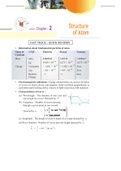
• Information about fundamental particles of atom
Name of UNIT Electron Proton Neutron
Constant
Mass amu 0.000546 1.00728 1.008665
–31 –27
kg 9.109 × 10 1.673 × 10 1.675 × 10⁻²⁷
Charge Coloumbs – 1.602 × 10⁻¹⁹ + 1.602 × 10⁻¹⁹ Zero
esu – 4.8 × 10⁻¹⁰ + 4.8 × 10⁻¹⁰ Zero
Relative –1 +1 Zero
Charge
• Electromagnetic radiations : Energy emitted from any source (in forms
of waves) in which electric and magnetic fields oscillated perpendicular to
each other and travelling with a velocity of light is known as EM radiation.
• Characteristics of waves :
(a) Wavelength : The distance of one crest and
one trough in a wave. Denoted by ‘’.
(b) Frequency : Number of waves passing
through a given point in one second.
Denoted by .
(c) Amplitude : The height of crest or depth of a trough denoted by ‘a’.
(d) Wave Number : Number of waves per unit length denoted by
= (or m–1)
, (e) Velocity : Linear distance travelled by a wave in one second.
velocity of light c = =
=
• Energywise order for EM radiation.
cosmic < rays < X rays < UV < VIBGYOR < IR < Microwaves < Radiowaves
(Increases) ((Decreases) Energy (Decreases)
• Photon : A packet or particle of light energy is knows as Photon.
• Planck’s quantum theory : The energy emitted or absorbed by a source
is discontinuous in form of small packet of energy, called quantum.
Quantum of light is called photon.
Ev
E = hv (h = Planck's constant)
E = nhv (h = 6.626×10⁻³⁴ J sec)
If ‘n’ photons are emitted E = nh
• Photo electric effect : The phenomenon of ejection of electrons from a
metal surface when a light of suitable frequency falls on metal surface.
h – h0 = mv2
h Energy of incident light on metal surface.
h0 Work function of metal.
mv2 Kinetic energy by which e– is emitted from metal surface.
• de Broglie equation : All material particles in motion also exhibit wave like
properties.
h h
mv p
For microscopic particles mass is very less therefore Wavelength of wave
associated with it can be detected.
26 Chemistry Class XI
, For macroscopic particles mass is large, of wave associated with it can
not be detected. Hence dominant wave character.
Hence microscopic bodies have dual nature, where as macroscopic bodies
have particle nature.
Heisenberg's Uncertainty Principle
It is impossible to determine the exact position and velocity of a moving
subatomic particle simultaneously with accuracy.
x × mv
x = uncertainty in position
v = uncertainty in velocity
Bohr’s theory for H [H like one e– systems He+; Li2+]
(1) e– revolving round the nucleus in circular path [stationary state; SHELL]
with a definite angular momentum [Here n = no. of shell of e–] and
with definite energy
En = – 2.18 × 10⁻¹⁸
(2) As n increases, Energy of e– becomes less – ve [Due to less force of Proton
attraction]
As n decreases, Energy of e– becomes More – ve [Due to more force of
attraction by protons]
(3) In infinity shell e– has zero force of attraction therefore zero energy.
(4) Electron energy only changes by definite values E = Ef – Ei.
Hydrogen spectrum : When e– in hydrogen atom is provided energy it gets
excited to higher shell from ground state, it comes back to ground state by
emitting energy in definite values.
“Quanta” : The emission of light energy is known as emission spectra. It
corresponds to each atom depending upon which energy shell e– is excited.
Structure of Atom 27
Structureof
ofAtom
Atom
FAST TRACK : QUICK REVISION
• Information about fundamental particles of atom
Name of UNIT Electron Proton Neutron
Constant
Mass amu 0.000546 1.00728 1.008665
–31 –27
kg 9.109 × 10 1.673 × 10 1.675 × 10⁻²⁷
Charge Coloumbs – 1.602 × 10⁻¹⁹ + 1.602 × 10⁻¹⁹ Zero
esu – 4.8 × 10⁻¹⁰ + 4.8 × 10⁻¹⁰ Zero
Relative –1 +1 Zero
Charge
• Electromagnetic radiations : Energy emitted from any source (in forms
of waves) in which electric and magnetic fields oscillated perpendicular to
each other and travelling with a velocity of light is known as EM radiation.
• Characteristics of waves :
(a) Wavelength : The distance of one crest and
one trough in a wave. Denoted by ‘’.
(b) Frequency : Number of waves passing
through a given point in one second.
Denoted by .
(c) Amplitude : The height of crest or depth of a trough denoted by ‘a’.
(d) Wave Number : Number of waves per unit length denoted by
= (or m–1)
, (e) Velocity : Linear distance travelled by a wave in one second.
velocity of light c = =
=
• Energywise order for EM radiation.
cosmic < rays < X rays < UV < VIBGYOR < IR < Microwaves < Radiowaves
(Increases) ((Decreases) Energy (Decreases)
• Photon : A packet or particle of light energy is knows as Photon.
• Planck’s quantum theory : The energy emitted or absorbed by a source
is discontinuous in form of small packet of energy, called quantum.
Quantum of light is called photon.
Ev
E = hv (h = Planck's constant)
E = nhv (h = 6.626×10⁻³⁴ J sec)
If ‘n’ photons are emitted E = nh
• Photo electric effect : The phenomenon of ejection of electrons from a
metal surface when a light of suitable frequency falls on metal surface.
h – h0 = mv2
h Energy of incident light on metal surface.
h0 Work function of metal.
mv2 Kinetic energy by which e– is emitted from metal surface.
• de Broglie equation : All material particles in motion also exhibit wave like
properties.
h h
mv p
For microscopic particles mass is very less therefore Wavelength of wave
associated with it can be detected.
26 Chemistry Class XI
, For macroscopic particles mass is large, of wave associated with it can
not be detected. Hence dominant wave character.
Hence microscopic bodies have dual nature, where as macroscopic bodies
have particle nature.
Heisenberg's Uncertainty Principle
It is impossible to determine the exact position and velocity of a moving
subatomic particle simultaneously with accuracy.
x × mv
x = uncertainty in position
v = uncertainty in velocity
Bohr’s theory for H [H like one e– systems He+; Li2+]
(1) e– revolving round the nucleus in circular path [stationary state; SHELL]
with a definite angular momentum [Here n = no. of shell of e–] and
with definite energy
En = – 2.18 × 10⁻¹⁸
(2) As n increases, Energy of e– becomes less – ve [Due to less force of Proton
attraction]
As n decreases, Energy of e– becomes More – ve [Due to more force of
attraction by protons]
(3) In infinity shell e– has zero force of attraction therefore zero energy.
(4) Electron energy only changes by definite values E = Ef – Ei.
Hydrogen spectrum : When e– in hydrogen atom is provided energy it gets
excited to higher shell from ground state, it comes back to ground state by
emitting energy in definite values.
“Quanta” : The emission of light energy is known as emission spectra. It
corresponds to each atom depending upon which energy shell e– is excited.
Structure of Atom 27