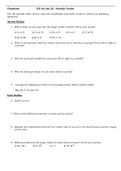
Chemistry ICP for Jan 22: Periodic Trends
Use the periodic table, charts, and your knowledge of periodic trends to answer the following
questions.
Atomic Radius
1. Which atom in each pair has the larger atomic radius? Circle your answer.
a) Li or K b) Ca or Ni c) Ga or B d) O or C e) Cl or Br
f) Be or Ba g) Si or S h) Fe or Au
2. What is the periodic trend for atomic size from top to bottom in a group? From left to right in
a period?
3. Why do atoms get smaller as you move left to right in a period?
4. Why do atoms get larger as you move down a group?
5. Arrange the following in order of increasing atomic radius atomic radius.
Mg, Na, P, Si and Ar?
Ionic Radius
6. Define an ion.
7. What is the difference between a cation and an anion?
8. Explain the relationship between the relative size of an ion to its neutral atom and the charge
on the ions.
9. Which particle has the larger radius in each atom/ion pair? Circle your answer.
a) Na, Na+ b) S, S2- c) I, I- d) Al, Al3+
Use the periodic table, charts, and your knowledge of periodic trends to answer the following
questions.
Atomic Radius
1. Which atom in each pair has the larger atomic radius? Circle your answer.
a) Li or K b) Ca or Ni c) Ga or B d) O or C e) Cl or Br
f) Be or Ba g) Si or S h) Fe or Au
2. What is the periodic trend for atomic size from top to bottom in a group? From left to right in
a period?
3. Why do atoms get smaller as you move left to right in a period?
4. Why do atoms get larger as you move down a group?
5. Arrange the following in order of increasing atomic radius atomic radius.
Mg, Na, P, Si and Ar?
Ionic Radius
6. Define an ion.
7. What is the difference between a cation and an anion?
8. Explain the relationship between the relative size of an ion to its neutral atom and the charge
on the ions.
9. Which particle has the larger radius in each atom/ion pair? Circle your answer.
a) Na, Na+ b) S, S2- c) I, I- d) Al, Al3+