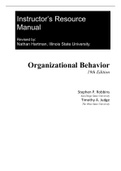
Instructor’s Resource
Manual
Revised by:
Nathan Hartman, Illinois State University
Organizational Behavior
19th Edition
Stephen P. Robbins
San Diego State University
Timothy A. Judge
The Ohio State University
,Introduction- Organizational Behavior I-3
Introduction
Welcome to the Instructor’s Manual for thenineteenth edition of Organizational Behavior! Long
considered the standard for all organizational behavior textbooks,this edition continues its
tradition of making current, relevant research come alive for students. While maintaining its
hallmark features—clear writing style, cutting-edge content, and engaging pedagogy—the
nineteenth edition has been updated to reflect the most recent research within the field of
organizational behavior. We've preserved the core material in this comprehensive and thorough
revision of Organizational Behavior. We’re confident that this edition reflects the most
important research and topical issues facing organizations, managers, and employees. The
world’s most successful organizational behavior text is better than ever!
I. How to Prepare for the Course
The concept of organizational behavior is an interesting one. It brings together ideas and
practices developed in a diverse group of disciplines to better understand people's behaviors in
the organizational context. Organizations usually have goals to produce their desired output in
the most effective and efficient manner. Optimizing these factors creates an organization with the
highest level of productivity and success.
The human factor in this productivity equation has been of interest to management studies since
the early days of Frederick Taylor, Frank and Lillian Gilbreth, Henry Gantt, and others and their
applications and derivatives of Scientific Management. Henri Fayol included concepts of
directing and controlling in his functions of management, which have been the basis for
management theories and research for almost a century.
People are the organization. Without people, the organization cannot survive and be productive.
Therefore, preparing this course for introducing concepts and developing skills and talents in
students is essential to their success in managing organizations of any type. For that reason, this
book and instructor’s manual provide you with a myriad of support material such as cases,
discussion topics, ways managers aremoving toward making a better world, ethicalconcerns,
experiential exercises, and other components. You can use them to enliven the course content
for your students to make skill development a fun, exciting, and challenging experience. All it
takes is time for preparation.
II. Who Is Your Audience?
Depending on your institution’s curriculum requirements for business/management, you could
have a combination of juniors and seniors in your classes, some traditional college student age
and some non-traditional students. Regardless of age or academic year/status, what is typical of
the first-time student in an organizational behavior class is a feeling that many of the topics, such
as communication or leadership, are natural things that people do automatically. Students have
little realization that they can improve the effectiveness and efficiency of such topics by
understanding them as they have been researched and variables of influence have been isolated.
This uninformed perspective provides an exciting platform for discovery and inspiration for you
Copyright © 2023Pearson Education, Inc.
,Introduction- Organizational Behavior I-4
as the instructor to use to create a dynamic learning experience. By the end of the course, your
students should recognize how incredibly challenging it is for companies to successfully manage
the people in their organizations and, more importantly, how they can be successful in their
careers.
III. New Features of the Textbook
Key changes to the nineteenthedition are listed in the preface of the textbook.
NOTE: In some instances, students may ask you if they can use a previous edition of the text
since they can find it online at reduced prices. This is not a good idea. Success in organizations is
people and management-driven, but organizations exist within the continually evolving societal
context.Major societal changes (e.g., the rise of the gig economy, working from home, advances
in gender identity acceptance and awareness, more extreme weather, intensive parenting, the
continued increase in mental illness among young adults, binge-watching television and
streaming entertainment, more smartphones and no more landlines, increased focus on
workplace diversity and inclusion, increased time spent on social media and the decline of the
newspaper), in the last 10 years, have dramatically changed the ways people live and work1.
These changesrequire workers and managers to be armed with the most up-to-date information
on individual, group, and organizational behavior. Students using previous editions of the text
would be at severe disadvantages, particularly when it comes toparticipating in assignments and
discussions taken from the end of each chapter material and instruction manual. More
importantly, these students would miss coverage of contemporary topics and research concerning
today’s workers and managers.
IV. Learning Resources
The textbook provides many learning resources. Each of these learning resources is referenced
in the Instructor’s Manual and is accompanied by teaching notes that provide suggestions on how
to use this content in an engaging way.
Learning Objectivesrepresentthe skills and knowledge students are asked to master.
Chapter-opening topic storiesintroduce the chapter material and spark student interest.
Myth or Science? engages students with popular opinions, conclusions, or conjectures from
the working world, carefully considering whether these conclusions are supported or refuted
based on empirical evidence.
Toward a Better Worldhighlightssocial responsibility, justice, and ethics issues facing
organizations today.
An Ethical Choiceconfronts students with common ethical dilemmas in the working world
related to OB topics and how these dilemmas can be approached with fairness, justice, and
respect for others.
Point/Counterpointfeatures reflect ongoing tensions between perspectives in OB.
Questions for Review. Short answer or essay type questions at the end of the chapter are
available to test students’ comprehension of the chapter’s content.
1
- - - - - - ;
https://stacker.com/stories/3779/25-ways-america-has-changed-last-decade
Copyright © 2023Pearson Education, Inc.
, Introduction- Organizational Behavior I-9
COURSE SCHEDULE
Week Chapter Covered Assignment Due at Beginning of Class
Chapter 1: What Is Organizational
Behavior?
1
Chapter 2: Diversity, Equity, and
Inclusion in Organizations
2 Chapter 3: Job Attitudes
3 Chapter 4: Emotions and Moods
Chapter 5: Personality and
4 Individual Differences
Chapter 6: Perception and
5 Individual Decision Making
Chapter 7: Motivation Concepts
6
Chapter 8: Motivation: From
Concepts to Applications
7 Mid-Term Exam
Chapter 9: Foundations of Group
8 Behavior
Chapter 10: Understanding Work
9 Teams
Chapter 11: Communication
10
Chapter 12: Leadership
Chapter 13: Power and Politics
11
Chapter 14: Conflict and
Negotiation
Chapter 15: Foundations of
12 Organization Structure
Chapter 16: Organizational Culture
13 and Change
Chapter 17: Human Resource
14 Systems and Practices
Chapter 18: Stress and Health in
15 Organizations
16 Final Exam
Copyright © 2023Pearson Education, Inc.
Manual
Revised by:
Nathan Hartman, Illinois State University
Organizational Behavior
19th Edition
Stephen P. Robbins
San Diego State University
Timothy A. Judge
The Ohio State University
,Introduction- Organizational Behavior I-3
Introduction
Welcome to the Instructor’s Manual for thenineteenth edition of Organizational Behavior! Long
considered the standard for all organizational behavior textbooks,this edition continues its
tradition of making current, relevant research come alive for students. While maintaining its
hallmark features—clear writing style, cutting-edge content, and engaging pedagogy—the
nineteenth edition has been updated to reflect the most recent research within the field of
organizational behavior. We've preserved the core material in this comprehensive and thorough
revision of Organizational Behavior. We’re confident that this edition reflects the most
important research and topical issues facing organizations, managers, and employees. The
world’s most successful organizational behavior text is better than ever!
I. How to Prepare for the Course
The concept of organizational behavior is an interesting one. It brings together ideas and
practices developed in a diverse group of disciplines to better understand people's behaviors in
the organizational context. Organizations usually have goals to produce their desired output in
the most effective and efficient manner. Optimizing these factors creates an organization with the
highest level of productivity and success.
The human factor in this productivity equation has been of interest to management studies since
the early days of Frederick Taylor, Frank and Lillian Gilbreth, Henry Gantt, and others and their
applications and derivatives of Scientific Management. Henri Fayol included concepts of
directing and controlling in his functions of management, which have been the basis for
management theories and research for almost a century.
People are the organization. Without people, the organization cannot survive and be productive.
Therefore, preparing this course for introducing concepts and developing skills and talents in
students is essential to their success in managing organizations of any type. For that reason, this
book and instructor’s manual provide you with a myriad of support material such as cases,
discussion topics, ways managers aremoving toward making a better world, ethicalconcerns,
experiential exercises, and other components. You can use them to enliven the course content
for your students to make skill development a fun, exciting, and challenging experience. All it
takes is time for preparation.
II. Who Is Your Audience?
Depending on your institution’s curriculum requirements for business/management, you could
have a combination of juniors and seniors in your classes, some traditional college student age
and some non-traditional students. Regardless of age or academic year/status, what is typical of
the first-time student in an organizational behavior class is a feeling that many of the topics, such
as communication or leadership, are natural things that people do automatically. Students have
little realization that they can improve the effectiveness and efficiency of such topics by
understanding them as they have been researched and variables of influence have been isolated.
This uninformed perspective provides an exciting platform for discovery and inspiration for you
Copyright © 2023Pearson Education, Inc.
,Introduction- Organizational Behavior I-4
as the instructor to use to create a dynamic learning experience. By the end of the course, your
students should recognize how incredibly challenging it is for companies to successfully manage
the people in their organizations and, more importantly, how they can be successful in their
careers.
III. New Features of the Textbook
Key changes to the nineteenthedition are listed in the preface of the textbook.
NOTE: In some instances, students may ask you if they can use a previous edition of the text
since they can find it online at reduced prices. This is not a good idea. Success in organizations is
people and management-driven, but organizations exist within the continually evolving societal
context.Major societal changes (e.g., the rise of the gig economy, working from home, advances
in gender identity acceptance and awareness, more extreme weather, intensive parenting, the
continued increase in mental illness among young adults, binge-watching television and
streaming entertainment, more smartphones and no more landlines, increased focus on
workplace diversity and inclusion, increased time spent on social media and the decline of the
newspaper), in the last 10 years, have dramatically changed the ways people live and work1.
These changesrequire workers and managers to be armed with the most up-to-date information
on individual, group, and organizational behavior. Students using previous editions of the text
would be at severe disadvantages, particularly when it comes toparticipating in assignments and
discussions taken from the end of each chapter material and instruction manual. More
importantly, these students would miss coverage of contemporary topics and research concerning
today’s workers and managers.
IV. Learning Resources
The textbook provides many learning resources. Each of these learning resources is referenced
in the Instructor’s Manual and is accompanied by teaching notes that provide suggestions on how
to use this content in an engaging way.
Learning Objectivesrepresentthe skills and knowledge students are asked to master.
Chapter-opening topic storiesintroduce the chapter material and spark student interest.
Myth or Science? engages students with popular opinions, conclusions, or conjectures from
the working world, carefully considering whether these conclusions are supported or refuted
based on empirical evidence.
Toward a Better Worldhighlightssocial responsibility, justice, and ethics issues facing
organizations today.
An Ethical Choiceconfronts students with common ethical dilemmas in the working world
related to OB topics and how these dilemmas can be approached with fairness, justice, and
respect for others.
Point/Counterpointfeatures reflect ongoing tensions between perspectives in OB.
Questions for Review. Short answer or essay type questions at the end of the chapter are
available to test students’ comprehension of the chapter’s content.
1
- - - - - - ;
https://stacker.com/stories/3779/25-ways-america-has-changed-last-decade
Copyright © 2023Pearson Education, Inc.
, Introduction- Organizational Behavior I-9
COURSE SCHEDULE
Week Chapter Covered Assignment Due at Beginning of Class
Chapter 1: What Is Organizational
Behavior?
1
Chapter 2: Diversity, Equity, and
Inclusion in Organizations
2 Chapter 3: Job Attitudes
3 Chapter 4: Emotions and Moods
Chapter 5: Personality and
4 Individual Differences
Chapter 6: Perception and
5 Individual Decision Making
Chapter 7: Motivation Concepts
6
Chapter 8: Motivation: From
Concepts to Applications
7 Mid-Term Exam
Chapter 9: Foundations of Group
8 Behavior
Chapter 10: Understanding Work
9 Teams
Chapter 11: Communication
10
Chapter 12: Leadership
Chapter 13: Power and Politics
11
Chapter 14: Conflict and
Negotiation
Chapter 15: Foundations of
12 Organization Structure
Chapter 16: Organizational Culture
13 and Change
Chapter 17: Human Resource
14 Systems and Practices
Chapter 18: Stress and Health in
15 Organizations
16 Final Exam
Copyright © 2023Pearson Education, Inc.