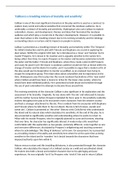
‘Caliban is a troubling mixture of brutality and sensitivity’
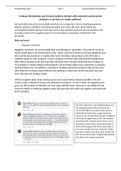
Caliban is one of the most significant characters in the play and he is used as a construct to
explore many social and cultural anxieties that concerned the Jacobean audience. He is
undeniably a mixture of brutality and sensitivity. Shakespeare also uses Caliban to explore
colonialism, slavery, and development, themes and ideas that fascinated the Jacobean
audience and which play a crucial role in the play’s development. However, it is possible to
state that Caliban is this troubling mixture due to his evolving sensitivity and the ideology
surrounding nature vs nurture and its impacts on people in society.
Caliban is presented as a troubling mixture of brutality and sensitivity within ‘The Tempest’;
his initial introduction and his plot with Trinculo and Stephano are crucial in exploring his
dual nature. Within the original 1610 text, he is introduced as a ‘slave’ and ‘tortoise’ by his
master Prospero, he is brutal in his reaction and is arguably sensitive to the names he is
being called. Over time, he rejects Prospero as his master and becomes submissive to both
the jester and the butler; Trinculo and Stephano, where they create a plan to kill Prospero
and usurp his power over the island. A Jacobean audience would see him as brutal within his
change of master and his desire for murder, yet it is possible to argue that a modern critic of
the play would see his desperation to murder as justified, as an enslaved man trying to
escape his conquerors grasp. This relays ideas about colonialism and its importance at the
time, Shakespeare uses this to play into the recent Jacobean fascinations of the ‘new world’
where Caliban would have been a means to riches for the lower-class society, where he
would have been exhibited publicly. He is presented as both brutal and sensitive through
the use of post-colonialism his attempts to deceive those around him.
The evolving sensitivity of the character Caliban is also significant in his exploration and the
assessment of his brutality. Originally, he was alone with ‘the isle’ and witnessed its beauty
with his mother Sycorax before Prospero imploded his force upon it. His sensitivity evidently
evolves throughout the play as he encounters more characters from the western society
and feels a stronger attachment to the isle. This is evident from his encounter with Stephano
and Trinculo where he tells them to ‘be not afeard, the isle is full of noises, sounds and
sweet airs’. Caliban is presented as ‘the other’ (literary critic Cicily Berry) who understands
the island and its natural state which elucidates his sensitivity. At the end of the play, he is
also presented as significantly sensitive and understanding where he wants to return to
Milan with his master Prospero, who he originally planned to curse and torment, showing
that over time, his character has significantly altered. A modern-day critic would feel
comfortable with this exploration as two people, extremely different, come together as one
and overcome differences, elucidated by Prospero’s enlightening and touching comment
where he acknowledges ‘this thing of darkness’ as his own. On assessment, he is presented
as a troubling mixture of brutality and sensitivity here where he at the same time as being
sensitive to the island and its ‘wonders’ he is brutal towards the characters that have
imposed authority upon him within it.
Nature versus nurture and this troubling dichotomy, is also presented through the character
Caliban, who elucidates the impact of a civilised society on a wild and uncultivated island.
He evolves into both a brutal and sensitive character due to his upbringing and past
experiences. He was originally ‘lov’d’ by Prospero who ‘strok’d’ him and in return Caliban
Caliban is one of the most significant characters in the play and he is used as a construct to
explore many social and cultural anxieties that concerned the Jacobean audience. He is
undeniably a mixture of brutality and sensitivity. Shakespeare also uses Caliban to explore
colonialism, slavery, and development, themes and ideas that fascinated the Jacobean
audience and which play a crucial role in the play’s development. However, it is possible to
state that Caliban is this troubling mixture due to his evolving sensitivity and the ideology
surrounding nature vs nurture and its impacts on people in society.
Caliban is presented as a troubling mixture of brutality and sensitivity within ‘The Tempest’;
his initial introduction and his plot with Trinculo and Stephano are crucial in exploring his
dual nature. Within the original 1610 text, he is introduced as a ‘slave’ and ‘tortoise’ by his
master Prospero, he is brutal in his reaction and is arguably sensitive to the names he is
being called. Over time, he rejects Prospero as his master and becomes submissive to both
the jester and the butler; Trinculo and Stephano, where they create a plan to kill Prospero
and usurp his power over the island. A Jacobean audience would see him as brutal within his
change of master and his desire for murder, yet it is possible to argue that a modern critic of
the play would see his desperation to murder as justified, as an enslaved man trying to
escape his conquerors grasp. This relays ideas about colonialism and its importance at the
time, Shakespeare uses this to play into the recent Jacobean fascinations of the ‘new world’
where Caliban would have been a means to riches for the lower-class society, where he
would have been exhibited publicly. He is presented as both brutal and sensitive through
the use of post-colonialism his attempts to deceive those around him.
The evolving sensitivity of the character Caliban is also significant in his exploration and the
assessment of his brutality. Originally, he was alone with ‘the isle’ and witnessed its beauty
with his mother Sycorax before Prospero imploded his force upon it. His sensitivity evidently
evolves throughout the play as he encounters more characters from the western society
and feels a stronger attachment to the isle. This is evident from his encounter with Stephano
and Trinculo where he tells them to ‘be not afeard, the isle is full of noises, sounds and
sweet airs’. Caliban is presented as ‘the other’ (literary critic Cicily Berry) who understands
the island and its natural state which elucidates his sensitivity. At the end of the play, he is
also presented as significantly sensitive and understanding where he wants to return to
Milan with his master Prospero, who he originally planned to curse and torment, showing
that over time, his character has significantly altered. A modern-day critic would feel
comfortable with this exploration as two people, extremely different, come together as one
and overcome differences, elucidated by Prospero’s enlightening and touching comment
where he acknowledges ‘this thing of darkness’ as his own. On assessment, he is presented
as a troubling mixture of brutality and sensitivity here where he at the same time as being
sensitive to the island and its ‘wonders’ he is brutal towards the characters that have
imposed authority upon him within it.
Nature versus nurture and this troubling dichotomy, is also presented through the character
Caliban, who elucidates the impact of a civilised society on a wild and uncultivated island.
He evolves into both a brutal and sensitive character due to his upbringing and past
experiences. He was originally ‘lov’d’ by Prospero who ‘strok’d’ him and in return Caliban