theonlinephysicstutor.com
Q1.
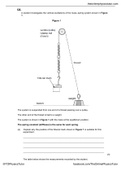
A student investigates the vertical oscillations of the mass–spring system shown in Figure
1.
The system is suspended from one end of a thread passing over a pulley.
The other end of the thread is tied to a weight.
The system is shown in Figure 1 with the mass at the equilibrium position.
The spring constant (stiffness) is the same for each spring.
(a) Explain why the position of the fiducial mark shown in Figure 1 is suitable for this
experiment.
___________________________________________________________________
___________________________________________________________________
___________________________________________________________________
___________________________________________________________________
(1)
The table below shows the measurements recorded by the student.
@TOPhysicsTutor facebook.com/TheOnlinePhysicsTutor
, theonlinephysicstutor.com
Time for 20 oscillations of the mass-spring system/s
22.9 22.3 22.8 22.9 22.6
(b) (i) Determine the percentage uncertainty in these data.
percentage uncertainty = _________________________________________
(3)
(ii) Determine the natural frequency of the mass-spring system.
natural frequency = _________________________________________
(1)
(c) The student connects the thread to a mechanical oscillator. The oscillator is set in
motion using a signal generator and this causes the mass–spring system to undergo
forced oscillations.
A vertical ruler is set up alongside the mass–spring system as shown in Figure 2.
The student measures values of A, the amplitude of the oscillations of the mass as f,
the frequency of the forcing oscillations, is varied.
@TOPhysicsTutor facebook.com/TheOnlinePhysicsTutor
, theonlinephysicstutor.com
A graph for the student’s experiment is shown in Figure 3.
(i) Add a suitable scale to the frequency axis.
You should refer to your answer in part (b)(ii) and note that the scale starts at
0 Hz.
(1)
(ii) Deduce from Figure 3 the amplitude of the oscillations of X, the point where
the mass–spring system is joined to the thread.
You should assume that the length of the thread is constant.
amplitude of X = _________________________________________
(1)
@TOPhysicsTutor facebook.com/TheOnlinePhysicsTutor
Q1.
A student investigates the vertical oscillations of the mass–spring system shown in Figure
1.
The system is suspended from one end of a thread passing over a pulley.
The other end of the thread is tied to a weight.
The system is shown in Figure 1 with the mass at the equilibrium position.
The spring constant (stiffness) is the same for each spring.
(a) Explain why the position of the fiducial mark shown in Figure 1 is suitable for this
experiment.
___________________________________________________________________
___________________________________________________________________
___________________________________________________________________
___________________________________________________________________
(1)
The table below shows the measurements recorded by the student.
@TOPhysicsTutor facebook.com/TheOnlinePhysicsTutor
, theonlinephysicstutor.com
Time for 20 oscillations of the mass-spring system/s
22.9 22.3 22.8 22.9 22.6
(b) (i) Determine the percentage uncertainty in these data.
percentage uncertainty = _________________________________________
(3)
(ii) Determine the natural frequency of the mass-spring system.
natural frequency = _________________________________________
(1)
(c) The student connects the thread to a mechanical oscillator. The oscillator is set in
motion using a signal generator and this causes the mass–spring system to undergo
forced oscillations.
A vertical ruler is set up alongside the mass–spring system as shown in Figure 2.
The student measures values of A, the amplitude of the oscillations of the mass as f,
the frequency of the forcing oscillations, is varied.
@TOPhysicsTutor facebook.com/TheOnlinePhysicsTutor
, theonlinephysicstutor.com
A graph for the student’s experiment is shown in Figure 3.
(i) Add a suitable scale to the frequency axis.
You should refer to your answer in part (b)(ii) and note that the scale starts at
0 Hz.
(1)
(ii) Deduce from Figure 3 the amplitude of the oscillations of X, the point where
the mass–spring system is joined to the thread.
You should assume that the length of the thread is constant.
amplitude of X = _________________________________________
(1)
@TOPhysicsTutor facebook.com/TheOnlinePhysicsTutor