theonlinephysicstutor.com
Mark schemes
1
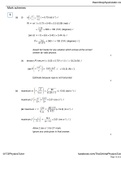
(a) (i) ω ( = 5.73 rad s−1) ✓
θ( = ωt ) = 5.73 × 0.40 = 2.3 (2.29) (rad) ✓
= × 360 = 130 (131) (degrees) ✓
[or s(( = vt) = 8.6 × 0.40 ( = 3.44 m) ✓
θ= × 360 ✓ = 130 (131) (degrees) ✓ ]
Award full marks for any solution which arrives at the correct
answer by valid physics.
3
(ii) tension F(=mω2r) = 0.25 × 5.732 × 1.5 ✓ = 12(.3) (N) ✓
[or F = ✓ = 12(.3) (N) ✓ ]
Estimate because rope is not horizontal.
2
(b) maximum ω = (= 12.6) (rad s−1) ✓
maximum f = 2.01 (rev s−1) ✓
[or maximum v = = (= 19.0) (m s−1) ✓
maximum f = = 2.01 (rev s−1) ✓ ]
Allow 2 (rev s−1) for 2nd mark.
Ignore any units given in final answer.
2
@TOPhysicsTutor facebook.com/TheOnlinePhysicsTuto
Page 13 of 22
, theonlinephysicstutor.com
(c) The student’s writing should be legible and the spelling, punctuation and
grammar should be sufficiently accurate for the meaning to be clear.
The student’s answer will be assessed holistically. The answer will be assigned to
one of three levels according to the following criteria.
High Level (Good to excellent): 5 or 6 marks
The information conveyed by the answer is clearly organised, logical and coherent,
using appropriate specialist vocabulary correctly. The form and style of writing is
appropriate to answer the question.
The student appreciates that the velocity of the ball is not constant and that this
implies that it is accelerating. There is a comprehensive and logical account of how
Newton’s laws apply to the ball’s circular motion: how the first law indicates that an
inward force must be acting, the second law shows that this force must cause an
acceleration towards the centre and (if referred to) the third law shows that an equal
outward force must act on the point of support at the centre. The student also
understands that the rope is not horizontal and states that the weight of the ball is
supported by the vertical component of the tension.
A high level answer must give a reasonable explanation of the
application of at least two of Newton’s laws, and an appreciation of
why the rope will not be horizontal.
Intermediate Level (Modest to adequate): 3 or 4 marks
The information conveyed by the answer may be less well organised and not fully
coherent. There is less use of specialist vocabulary, or specialist vocabulary may be
used incorrectly. The form and style of writing is less appropriate.
The student appreciates that the velocity of the ball is not constant. The answer
indicates how at least one of Newton’s laws applies to the circular motion. The
student’s understanding of how the weight of the ball is supported is more superficial,
the student possibly failing to appreciate that the rope would not be horizontal and
omitting any reference to components of the tension.
An intermediate level answer must show a reasonable
understanding of how at least one of Newton’s laws applies to the
swinging ball.
Low Level (Poor to limited): 1 or 2 marks
The information conveyed by the answer is poorly organised and may not be relevant
or coherent. There is little correct use of specialist vocabulary. The form and style of
writing may be only partly appropriate.
The student has a much weaker knowledge of how Newton’s laws apply, but shows
some understanding of at least one of them in this situation. The answer coveys little
understanding of how the ball is supported vertically.
A low level answer must show familiarity with at least one of
Newton’s laws, but may not show good understanding of how it
applies to this situation.
References to the effects of air resistance, and/or the need to keep
supplying energy to the system would increase the value of an
answer.
@TOPhysicsTutor facebook.com/TheOnlinePhysicsTuto
Page 14 of 22
Mark schemes
1
(a) (i) ω ( = 5.73 rad s−1) ✓
θ( = ωt ) = 5.73 × 0.40 = 2.3 (2.29) (rad) ✓
= × 360 = 130 (131) (degrees) ✓
[or s(( = vt) = 8.6 × 0.40 ( = 3.44 m) ✓
θ= × 360 ✓ = 130 (131) (degrees) ✓ ]
Award full marks for any solution which arrives at the correct
answer by valid physics.
3
(ii) tension F(=mω2r) = 0.25 × 5.732 × 1.5 ✓ = 12(.3) (N) ✓
[or F = ✓ = 12(.3) (N) ✓ ]
Estimate because rope is not horizontal.
2
(b) maximum ω = (= 12.6) (rad s−1) ✓
maximum f = 2.01 (rev s−1) ✓
[or maximum v = = (= 19.0) (m s−1) ✓
maximum f = = 2.01 (rev s−1) ✓ ]
Allow 2 (rev s−1) for 2nd mark.
Ignore any units given in final answer.
2
@TOPhysicsTutor facebook.com/TheOnlinePhysicsTuto
Page 13 of 22
, theonlinephysicstutor.com
(c) The student’s writing should be legible and the spelling, punctuation and
grammar should be sufficiently accurate for the meaning to be clear.
The student’s answer will be assessed holistically. The answer will be assigned to
one of three levels according to the following criteria.
High Level (Good to excellent): 5 or 6 marks
The information conveyed by the answer is clearly organised, logical and coherent,
using appropriate specialist vocabulary correctly. The form and style of writing is
appropriate to answer the question.
The student appreciates that the velocity of the ball is not constant and that this
implies that it is accelerating. There is a comprehensive and logical account of how
Newton’s laws apply to the ball’s circular motion: how the first law indicates that an
inward force must be acting, the second law shows that this force must cause an
acceleration towards the centre and (if referred to) the third law shows that an equal
outward force must act on the point of support at the centre. The student also
understands that the rope is not horizontal and states that the weight of the ball is
supported by the vertical component of the tension.
A high level answer must give a reasonable explanation of the
application of at least two of Newton’s laws, and an appreciation of
why the rope will not be horizontal.
Intermediate Level (Modest to adequate): 3 or 4 marks
The information conveyed by the answer may be less well organised and not fully
coherent. There is less use of specialist vocabulary, or specialist vocabulary may be
used incorrectly. The form and style of writing is less appropriate.
The student appreciates that the velocity of the ball is not constant. The answer
indicates how at least one of Newton’s laws applies to the circular motion. The
student’s understanding of how the weight of the ball is supported is more superficial,
the student possibly failing to appreciate that the rope would not be horizontal and
omitting any reference to components of the tension.
An intermediate level answer must show a reasonable
understanding of how at least one of Newton’s laws applies to the
swinging ball.
Low Level (Poor to limited): 1 or 2 marks
The information conveyed by the answer is poorly organised and may not be relevant
or coherent. There is little correct use of specialist vocabulary. The form and style of
writing may be only partly appropriate.
The student has a much weaker knowledge of how Newton’s laws apply, but shows
some understanding of at least one of them in this situation. The answer coveys little
understanding of how the ball is supported vertically.
A low level answer must show familiarity with at least one of
Newton’s laws, but may not show good understanding of how it
applies to this situation.
References to the effects of air resistance, and/or the need to keep
supplying energy to the system would increase the value of an
answer.
@TOPhysicsTutor facebook.com/TheOnlinePhysicsTuto
Page 14 of 22