theonlinephysicstutor.com
Q1.
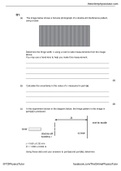
(a) The image below shows a full-size photograph of a double-slit interference pattern,
using a laser.
Determine the fringe width w using a ruler to take measurements from the image
above.
You may use a hand-lens to help you make this measurement.
___________________________________________________________________
___________________________________________________________________
___________________________________________________________________
___________________________________________________________________
(3)
(b) Calculate the uncertainty in the value of w measured in part (a).
___________________________________________________________________
___________________________________________________________________
___________________________________________________________________
(2)
(c) In the experiment shown in the diagram below, the fringe pattern in the image in
part (a) is produced.
s = 0.60 ± 0.02 mm
D = 1.500 ± 0.002 m
Using these data and your answers to part (a) and part (b), determine
@TOPhysicsTutor facebook.com/TheOnlinePhysicsTutor
, theonlinephysicstutor.com
(i) the wavelength of the laser light used
______________________________________________________________
______________________________________________________________
______________________________________________________________
(1)
(ii) the percentage uncertainty in this value of wavelength
______________________________________________________________
______________________________________________________________
______________________________________________________________
(1)
(iii) the absolute uncertainty in this value of wavelength.
______________________________________________________________
______________________________________________________________
______________________________________________________________
(1)
(Total 8 marks)
Q2.
A student carries out an experiment to determine the diameter of a cylindrical wire based
on the theory of Young’s double−slit experiment, using the arrangement shown in Figure
1.
Figure 1
The wire is mounted vertically in front of a single narrow slit which is illuminated by
monochromatic light. The wire produces a shadow between points P and Q on a
glass slide covered with tracing paper. The light diffracts as it passes the wire.
Points A and B act as coherent sources causing interference fringes to be seen
between P and Q.
@TOPhysicsTutor facebook.com/TheOnlinePhysicsTutor
, theonlinephysicstutor.com
The student uses a metre ruler to measure the distances L and D shown in Figure
1. Figure 2 shows the pattern of interference fringes between P and Q. The student
takes readings from a vernier scale to indicate the positions of the centres of two of
the fringes.
Figure 2
The student’s measurements are shown in Table 1.
Table 1
L/mm D/mm R1/mm R2/mm
46 395 8.71 11.16
(a) Determine the spacing of the interference fringes w using Figure 1 and the data in
Table 1.
Give your answer to an appropriate number of significant figures.
w ___________________ m
(2)
(b) Determine the diameter d of the wire.
wavelength of the monochromatic light = 589.3 nm
@TOPhysicsTutor facebook.com/TheOnlinePhysicsTutor
Q1.
(a) The image below shows a full-size photograph of a double-slit interference pattern,
using a laser.
Determine the fringe width w using a ruler to take measurements from the image
above.
You may use a hand-lens to help you make this measurement.
___________________________________________________________________
___________________________________________________________________
___________________________________________________________________
___________________________________________________________________
(3)
(b) Calculate the uncertainty in the value of w measured in part (a).
___________________________________________________________________
___________________________________________________________________
___________________________________________________________________
(2)
(c) In the experiment shown in the diagram below, the fringe pattern in the image in
part (a) is produced.
s = 0.60 ± 0.02 mm
D = 1.500 ± 0.002 m
Using these data and your answers to part (a) and part (b), determine
@TOPhysicsTutor facebook.com/TheOnlinePhysicsTutor
, theonlinephysicstutor.com
(i) the wavelength of the laser light used
______________________________________________________________
______________________________________________________________
______________________________________________________________
(1)
(ii) the percentage uncertainty in this value of wavelength
______________________________________________________________
______________________________________________________________
______________________________________________________________
(1)
(iii) the absolute uncertainty in this value of wavelength.
______________________________________________________________
______________________________________________________________
______________________________________________________________
(1)
(Total 8 marks)
Q2.
A student carries out an experiment to determine the diameter of a cylindrical wire based
on the theory of Young’s double−slit experiment, using the arrangement shown in Figure
1.
Figure 1
The wire is mounted vertically in front of a single narrow slit which is illuminated by
monochromatic light. The wire produces a shadow between points P and Q on a
glass slide covered with tracing paper. The light diffracts as it passes the wire.
Points A and B act as coherent sources causing interference fringes to be seen
between P and Q.
@TOPhysicsTutor facebook.com/TheOnlinePhysicsTutor
, theonlinephysicstutor.com
The student uses a metre ruler to measure the distances L and D shown in Figure
1. Figure 2 shows the pattern of interference fringes between P and Q. The student
takes readings from a vernier scale to indicate the positions of the centres of two of
the fringes.
Figure 2
The student’s measurements are shown in Table 1.
Table 1
L/mm D/mm R1/mm R2/mm
46 395 8.71 11.16
(a) Determine the spacing of the interference fringes w using Figure 1 and the data in
Table 1.
Give your answer to an appropriate number of significant figures.
w ___________________ m
(2)
(b) Determine the diameter d of the wire.
wavelength of the monochromatic light = 589.3 nm
@TOPhysicsTutor facebook.com/TheOnlinePhysicsTutor