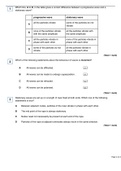
Which line, A to D, in the table gives a correct difference between a progressive wave and a
1 stationary wave?
progressive wave stationary wave
all the particles vibrate some of the particles do not
A
vibrate
none of the particles vibrate all the particles vibrate with
B
with the same amplitude the same amplitude
all the particles vibrate in none of the particles vibrate in
C
phase with each other phase with each other
some of the particles do not all the particles vibrate in
D
vibrate phase with each other
(Total 1 mark)
Which of the following statements about the behaviour of waves is incorrect?
2
A All waves can be diffracted.
B All waves can be made to undergo superposition.
C All waves can be refracted.
D All waves can be polarised.
(Total 1 mark)
Stationary waves are set up on a length of rope fixed at both ends. Which one of the following
3 statements is true?
A Between adjacent nodes, particles of the rope vibrate in phase with each other.
B The mid point of the rope is always stationary.
C Nodes need not necessarily be present at each end of the rope.
D Particles of the rope at adjacent antinodes always move in the same direction.
(Total 1 mark)
Page 2 of 37
, Which one of the following statements about stationary waves is true?
4
A Particles between adjacent nodes all have the same amplitude.
B Particles between adjacent nodes are out of phase with each other.
C Particles immediately on either side of a node are moving in opposite directions.
D There is a minimum disturbance of the medium at an antinode.
(Total 1 mark)
The frequency of the first harmonic of a standing wave on a wire is f. The length of the wire and
5
tension in the wire are both doubled.
What is the frequency of the first harmonic as a result?
A
B f
C
D 2f
(Total 1 mark)
Which one of the following statements about stationary waves is true?
6
A Particles between adjacent nodes all have the same amplitude.
B Particles between adjacent nodes are out of phase with each other.
C Particles immediately on either side of a node are moving in opposite directions.
D There is minimum disturbance of the medium at an antinode.
(Total 1 mark)
7
frequency of vibration = 50 Hz
The diagram above shows a stationary wave on a stretched string at a time t = 0. Which one of
the diagrams, A to D, correctly shows the position of the string at a time t = 0.010 s?
Page 3 of 37
, A
B
C
D
(Total 1 mark)
A uniform wire fixed at both ends is vibrating in its fundamental mode. Which one of the following
8 statements is not correct for all the vibrating particles?
A They vibrate in phase.
B They vibrate with the same amplitude.
C They vibrate with the same frequency.
D They vibrate at right angles to the wire.
(Total 1 mark)
Page 4 of 37
1 stationary wave?
progressive wave stationary wave
all the particles vibrate some of the particles do not
A
vibrate
none of the particles vibrate all the particles vibrate with
B
with the same amplitude the same amplitude
all the particles vibrate in none of the particles vibrate in
C
phase with each other phase with each other
some of the particles do not all the particles vibrate in
D
vibrate phase with each other
(Total 1 mark)
Which of the following statements about the behaviour of waves is incorrect?
2
A All waves can be diffracted.
B All waves can be made to undergo superposition.
C All waves can be refracted.
D All waves can be polarised.
(Total 1 mark)
Stationary waves are set up on a length of rope fixed at both ends. Which one of the following
3 statements is true?
A Between adjacent nodes, particles of the rope vibrate in phase with each other.
B The mid point of the rope is always stationary.
C Nodes need not necessarily be present at each end of the rope.
D Particles of the rope at adjacent antinodes always move in the same direction.
(Total 1 mark)
Page 2 of 37
, Which one of the following statements about stationary waves is true?
4
A Particles between adjacent nodes all have the same amplitude.
B Particles between adjacent nodes are out of phase with each other.
C Particles immediately on either side of a node are moving in opposite directions.
D There is a minimum disturbance of the medium at an antinode.
(Total 1 mark)
The frequency of the first harmonic of a standing wave on a wire is f. The length of the wire and
5
tension in the wire are both doubled.
What is the frequency of the first harmonic as a result?
A
B f
C
D 2f
(Total 1 mark)
Which one of the following statements about stationary waves is true?
6
A Particles between adjacent nodes all have the same amplitude.
B Particles between adjacent nodes are out of phase with each other.
C Particles immediately on either side of a node are moving in opposite directions.
D There is minimum disturbance of the medium at an antinode.
(Total 1 mark)
7
frequency of vibration = 50 Hz
The diagram above shows a stationary wave on a stretched string at a time t = 0. Which one of
the diagrams, A to D, correctly shows the position of the string at a time t = 0.010 s?
Page 3 of 37
, A
B
C
D
(Total 1 mark)
A uniform wire fixed at both ends is vibrating in its fundamental mode. Which one of the following
8 statements is not correct for all the vibrating particles?
A They vibrate in phase.
B They vibrate with the same amplitude.
C They vibrate with the same frequency.
D They vibrate at right angles to the wire.
(Total 1 mark)
Page 4 of 37