Fundamentals of Equity and Trusts
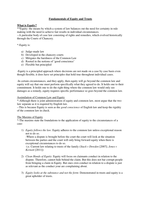
What is Equity?
**Equity: the means by which a system of law balances out the need for certainty in rule
making with the need to achieve fair results in individual circumstances.
--A particular body of case law consisting of rights and remedies, which evolved historically
through the Courts of Chancery.
*-Equity is:
a) Judge-made law
b) Developed in the chancery courts
c) Mitigates the harshness of the Common Law
d) Rooted in the notions of ‘good conscience’
e) Flexible but principled
-Equity is a principled approach where decisions are not made on a case by case basis even
though flexible, it does have set principles that hold true throughout individual cases.
-In certain circumstances, and they apply, then equity will go beyond the common law and
equity will say that one must perform specifically what they agreed to do. It holds one to their
commitment. It holds one to do the right thing where the common law would only see
damages as a remedy, equity requires specific performance so goes beyond the common law.
Assimilation of Common Law and Equity
*-Although there is joint administration of equity and common law, most argue that the two
law separate as it is required by English law.
--This is because Equity is seen as the good conscience of English law and keep the rigidity
of the common law in check.
The Maxims of Equity
*-The maxims state the foundations to the application of equity to the circumstances of a
case:
1) Equity follows the law: Equity adheres to the common law unless exceptional reason
not to do so.
-Where a dispute is brought before the court the court will look at the situation
between the parties and the court will only bring forward equity when there is
exceptional circumstances to do so.
-i.e. Current law relating to trusts of the family (Stack v Dowden [2007]; Jones v
Kernott [2011])
2) Clean Hands of Equity: Equity will focus on claimants conduct in relation to the
dispute. Therefore, cannot hide behind the claim. But this does not bar corrupt people
from bringing a claim in Equity. But ones own conduct in relation to a dispute is just
as relevant as the conduct your are complaining about.
3) Equity looks at the substance and not the form: Demonstrated in trusts and equity is a
great upholder of trusts.
What is Equity?
**Equity: the means by which a system of law balances out the need for certainty in rule
making with the need to achieve fair results in individual circumstances.
--A particular body of case law consisting of rights and remedies, which evolved historically
through the Courts of Chancery.
*-Equity is:
a) Judge-made law
b) Developed in the chancery courts
c) Mitigates the harshness of the Common Law
d) Rooted in the notions of ‘good conscience’
e) Flexible but principled
-Equity is a principled approach where decisions are not made on a case by case basis even
though flexible, it does have set principles that hold true throughout individual cases.
-In certain circumstances, and they apply, then equity will go beyond the common law and
equity will say that one must perform specifically what they agreed to do. It holds one to their
commitment. It holds one to do the right thing where the common law would only see
damages as a remedy, equity requires specific performance so goes beyond the common law.
Assimilation of Common Law and Equity
*-Although there is joint administration of equity and common law, most argue that the two
law separate as it is required by English law.
--This is because Equity is seen as the good conscience of English law and keep the rigidity
of the common law in check.
The Maxims of Equity
*-The maxims state the foundations to the application of equity to the circumstances of a
case:
1) Equity follows the law: Equity adheres to the common law unless exceptional reason
not to do so.
-Where a dispute is brought before the court the court will look at the situation
between the parties and the court will only bring forward equity when there is
exceptional circumstances to do so.
-i.e. Current law relating to trusts of the family (Stack v Dowden [2007]; Jones v
Kernott [2011])
2) Clean Hands of Equity: Equity will focus on claimants conduct in relation to the
dispute. Therefore, cannot hide behind the claim. But this does not bar corrupt people
from bringing a claim in Equity. But ones own conduct in relation to a dispute is just
as relevant as the conduct your are complaining about.
3) Equity looks at the substance and not the form: Demonstrated in trusts and equity is a
great upholder of trusts.