NURS 6660N FINAL EXAM 1 QUESTION AND ANSWERS (75/75 POINTS). GRADED A+
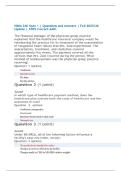
NURS 6660N FINAL EXAM 1 – QUESTION AND ANSWERS (75/75 POINTS) Question 1 In which demographic is depression twice as prevalent in girls as compared to boys? A. Preschoolers B. School aged C. Adolescents D. All children Question 2 Andrew is a 14-year-old male who is being managed for bipolar I disorder. He was started on lithium 6 weeks ago and has achieved a serum level of 1.1 mEq/L according to his most recent blood work. Andrew says he does not feel any different, but both his parents and teachers report improvement in his mood. He has been more stable, is getting along better with friends and siblings, and is even more interested in his schoolwork. The PMHNP plans to maintain Andrew on this medication and knows that he will need which of the following ongoing laboratory assessments? A. Complete blood count, thyroid function tests, and serum calcium B. Liver function tests, complete blood count, and 12-lead electrocardiogram C. White blood cell differential, fasting glucose, and fasting lipid profile D. Comprehensive metabolic panel, complete blood count, and thyroid function tests Question 3 Confidentiality is a complex topic in the world of child and adolescent psychiatry. The last 40 to 50 years have been characterized by increased attention to this issue and the publication of various ethical codes and practice position statements by professional organizations. Which of the following is not a true statement with respect to confidentiality of the child or adolescent client? A. The PMHNP should not be concerned with consent for disclosure when child abuse or maltreatment has occurred. 1 WALDEN UNIVERSITY NURS 6660 FINAL EXAM B. In 1979, the American Psychiatric Association (APA) stated that children 12 years of age or older can give consent for disclosure. C. The American Academy of Child and Adolescent Psychiatry (AACAP) Code of Ethics 2 states that consent is not required for disclosure. D. Regardless of code or position statement by any organization, the best approach is when the child and PMHNP agree on disclosure. Question 4 Debi is a 15-year-old girl who is currently being treated for depression. Her parents have been very proactive and involved in her care, and Debi has achieved remission 2 months after beginning treatment with a combination of pharmacotherapy and cognitive behavioral therapy. While counseling Debi’s parents about important issues in management, the PMHNP advises that: A. There is a > 50% likelihood that Debi’s younger sibling will develop depressive symptoms B. The mean length of major depressive episode in adolescents is 4 months C. 20 to 40% of adolescents who have major depressive disorder will develop bipolar I within 5 years D. Adolescent-onset depression typically needs long-term pharmacologic management to prevent relapse Question 5 The therapeutic outcomes for children with disorders of written expression are most favorable when they are characterized by: Concomitant pharmacotherapy with a psychostimulant to promote attention and focus Multimodal therapy to include group interaction with peer-to-peer feedback on writing samples A variety of tutors who will offer a variety of writing techniques, composition strategies, and critiques Intensive, continuous administration of individually tailored, one-on-one expressive and creative writing therapy 3 Question 6 When considering a diagnosis of developmental coordination disorder, the PMHNP knows that the diagnosis may be associated with: A. Above-average scores on performance subtests of standardized intelligence testing B. Below-average scores on verbal subtests of standardized intelligence testing C. Soft neurologic signs on physical examination such as slight reflex abnormalities D. Physical findings consistent with neuromuscular disease such as muscular dystrophy Question 7 Caylee is a 5-year-old girl who is referred for evaluation by child protective services. She was recently removed from her biological family and placed in foster care, as her home environment was reportedly unsafe due to conditions of extreme neglect. Her foster mother reports that Caylee is very quiet and withdrawn and always appears sad and disinterested in her surroundings; however, she becomes very irritable when anything unexpected or unplanned occurs. The foster mother became very concerned when it appeared that Caylee was hallucinating. The PMHNP considers that: A. Caylee is at high risk for suicide and precautions should be taken B. The hallucinations are consistent with brief psychotic disorder or schizophrenia C. The history and reported symptoms are typical of depressive disorder in young children D. This is a common situation when prepubertal children are removed from the biological parents regardless of how dysfunctional they are 4 Question 8 Children with gender dysphoria typically have higher rates of all the following except: A. Depression B. Impulse control disorders C. Anxiety disorders D. Eating disorder Question 9 Eileen is a 23-month-old girl who is being evaluated for autism spectrum disorder because her pediatrician is concerned about the presence of developmental red flags. She has just a few words of speech and has not put together any meaningful two-word phrases. While taking a history from Eileen’s mother the PMHNP learns that for approximately the last 2 months Eileen has been seen eating paint chips that are peeling off the baseboard and window sills in the family home; when she sees one she puts it in her mouth. This is a concern because they live in an old farmhouse and there may be lead-based paint in some of the paint layers. The PMHNP considers that which of the following is not consistent with a diagnosis of pica? A. A diagnosis of autism spectrum disorder B. Symptoms < 6 months duration C. The pattern of eating D. Lack of potential consequences Question 10 The current scholarly consensus is that the etiology of bulimia nervosa is multifactorial to include biological, sociocultural, family, cognitive-behavioral, and psychodynamic factors. 5 When considering the etiology of bulimia nervosa, the PMHNP understands that: 6 A. Family factors contributing to bulimia nervosa include emotional restraint, tight parental control of behavior, and avoidance of conflict. B. Lowered serotonin activity is seen in the brains of patients with bulimia nervosa. C. There is a disproportionate incidence in childhood sexual abuse in patients with bulimia nervosa. D. Cultural influences are much less implicit in the development of bulimia nervosa as compared to anorexia nervosa. Question 11 Standardized instructional programs used in the management of reading disorders include all the following except: A. The Orton Gillingham and Direct Instructional System for Teaching and Remediation B. Science Research Associates, Inc. Basic Reading Program C. Bridge Reading Program D. Woodcock-Johnson Psychoeducational Battery Question 12 Which of the following symptom clusters is most likely in a 16-year-old male with major depressive disorder? A. Disturbance of mood, loss of interest, and mood-congruent hallucinations B. Irritability, persistent abdominal complaints, and insomnia C. Decreased concentration, social withdrawal, and substance abuse D. Pervasive anhedonia, hopelessness, and severe psychomotor retardation 7 Question 13 The PMHNP is working with rural primary care providers to increase awareness of mental health disorders in infancy and early childhood. The program includes a session on screening for feeding disorders in infants. If an infant is either observed by the provider or reported by the parent to frequently suck the tongue rhythmically or appear to strain with his or her back arched and then swallow, the examiner should consider the possibility of: A. Gastroesophageal reflux disease B. Failure to thrive C. Iron deficiency D. Inadequate emotional attachment Question 14 An astute pediatrician has referred Kyle, a 5-month-old infant, for evaluation of rumination disorder. His mother was concerned because he seemed to “want” to regurgitate every time he ate and would even seem to “put his hand down his throat” in order to stimulate regurgitation. Kyle had a thorough evaluation and according to the pediatrician did not have gastroesophageal reflux or hiatal hernia. The mother-infant relationship appeared to be healthy and, via assessment, the PMHNP could not identify any clear emotional issues. The primary treatment strategy for Kyle will likely focus on: A. Aversive therapies, e.g., squirting lemon juice into Kyle’s mouth when he ruminates B. Medication therapies to include trials of first-line agents such as metoclopramine, cimetidine, or haloperidol C. Psychotherapy for the parents D. Habit-reversal therapies 8 Question 15 The literature indicates that boys whose fathers died before the age of 13 are at a greater risk for the development of depression as compared to controls. This is consistent with which general theory of depression etiology? A. Molecular-genetic B. Biologic C. Psychosocial D. Stress-diathesis Question 16 Katelyn is a16-year-old girl who presents for therapy with her mother and father. Katelyn was born with male genitalia but has felt like a female “all of her life.” She says she knew something was different as far back as she can remember. She always wanted to wear her mother’s clothes and makeup and play with other girls. Katelyn started dressing and openly identifying as a girl when she was 13 years old, and her parents are trying to be supportive but they are struggling. Most recently Katelyn has developed an intimate partner relationship with Jennifer, a 15-year- old girl who was gender-assigned female at birth and identifies as a female. Katelyn’s father does not understand the relationship. The PMHNP explains that Katelyn: A. Is responding to the male hormonal surges of puberty and will ultimately identify with her physiologic gender B. Does not have a clear sense of gender identity and may be a candidate for reparative therapy to correct her gender identity issues C. Is a transgender female who identifies as lesbian D. Is a heterosexual male with transvestic disorder Question 17 9 All of the following are proposed etiologies of pica except: A. Nutritional deficiencies 10 B. Parental neglect C. Compensation for oral needs D. Autism spectrum disorder Question 18 Christine is a 9-year-old female who presents for care after having been placed in the local foster care system. She has been in and out of foster care for the last 4 years after her parents were killed in an automobile accident. Christine has been placed in a variety of homes and residential care facilities. The PMHNP recognizes that Christine is at high risk for: A. Dissociative disorders B. Post-traumatic stress disorder C. Impulse-control disorder D. Attachment disorder Question 19 While the core features of schizophrenia are essentially the same in children as they are in adults, the presentation or characterization is sometimes very different given developmental issues. Unlike adults with schizophrenia, children with schizophrenia do not have: A. Classic positive symptoms B. Poverty of speech content C. Social rejection D. Delusions of persecution 11 Question 20 The PMHNP is working with a couple who has been trying for years to conceive and is now ready to pursue adoption as an option. They are considering all possibilities; private vs. government-mediated adoption, adopting from another country, adopting a child of a different race or ethnicity, adopting an older child rather than an infant, and adopting a child who is currently in foster care vs. one who lives in an orphanage. While counseling this couple, the PMHNP advises them that: A. Younger children adopted from foster care settings have the best outcomes B. Children adopted from abuse and neglect situations have better psychological adaptation than those adopted as newborns C. Transracial adoptions have demonstrated greater disruptions as compared to same-race adoptions D. Adoptions into families as an only child are more successful than those into families with biological children Question 21 Mel is a 15-year-old male with a complex psychiatric assessment. He has a long history of mood instability, behavior problems, and trouble with schoolwork. He was an extremely active child who, at one time, was put on medication for hyperactivity. After a comprehensive evaluation, the PMHP recognizes that he meets diagnostic criteria for both bipolar I disorder and attention deficit hyperactivity disorder (ADHD). The most successful approach to his management is likely to begin with: A. Pharmacotherapy for ADHD B. Pharmacotherapy for bipolar I C. Parental training and behavioral interventions for ADHD D. Family-focused psychoeducational (FFT-A) for bipolar I 12 Question 22 Bruce and Debbie have made an appointment for a psychiatric consultation for what amounts to psychiatric genetic counseling. Bruce is 31 years old and Debbie is 28 years old. They have been married for 3 years and want to have children. Debbie is worried because she has a diagnosis of schizophrenia. Her symptoms first became evident when she was in her junior year of college; fortunately, she knew about the disease due to family history and sought care quickly. She has been very open with Bruce, and they are both well informed about the disease. Debbie is an only child and her father had schizophrenia that was not well controlled. He committed suicide when she was 15 years old. Debbie takes olanzapine and feels well overall. She has a part-time job, functions well, but is concerned about the genetic nature of her disease. Counseling for Bruce and Debbie includes which of the following pieces of information? A. Schizophrenia is up to eight times more prevalent in first-degree relatives as compared to the general population. B. Schizophrenia has been isolated to chromosome number 5 and antenatal testing is available to predict genetic predisposition of the fetus. C. Debbie’s age of onset is more highly correlated with incidence in her offspring as compared to early-onset schizophrenia. D. Environment is at least as important as genetics with respect to expression of schizophrenic symptoms. Question 23
Written for
- Institution
-
Chamberlain College Of Nursing
- Course
-
NURS 6660
Document information
- Uploaded on
- March 18, 2023
- Number of pages
- 46
- Written in
- 2022/2023
- Type
- Exam (elaborations)
- Contains
- Questions & answers
Subjects
-
nurs 6660n final exam 1 – question and answers 7575 points question 1 in which demographic is depression twice as prevalent in girls as compared to boys a preschoolers b school aged c a