
ACNT 2402 Chapter 05 -- Cost-Volume-Profit Relationships – Study Guide
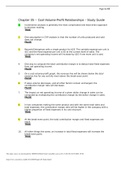
1. Incremental analysis is generally the most complicated and least direct approach to decision making. TRUE 2. One assumption in CVP analysis is that the number of units produced and sold does not change. FALSE 3. Reynold Enterprises sells a single product for $25. The variable expense per unit is $15 and the fixed expense per unit is $5 at the current level of sales. The company's net operating income will increase by $10 if one more unit is sold. TRUE 4. One way to compute the total contribution margin is to deduct total fixed expenses from net operating income. FALSE 5. On a cost-volume-profit graph, the revenue line will be shown below the total expense line for any activity level above the break-even point. FALSE 6. If sales volume decreases, and all other factors remain unchanged, the contribution margin ratio will decrease. FALSE 7. The impact on net operating income of a given dollar change in sales can be computed by multiplying the contribution margin by the dollar change in sales. FALSE 8. In two companies making the same product and with the same total sales and total expenses, the contribution margin ratio will be higher in the company with a higher proportion of fixed expenses in its cost structure. TRUE 9. At the break-even point, the total contribution margin and fixed expenses are equal. TRUE 10. All
Document information
- Uploaded on
- March 17, 2023
- Number of pages
- 8
- Written in
- 2022/2023
- Type
- Exam (elaborations)
- Contains
- Unknown


