MRL 3702 Exam
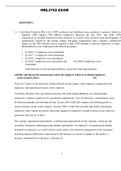
MRL3702 EXAM QUESTION 1 1.1 Cool Dairy Products (Pty) Ltd (‘CDP’) produces and distributes dairy products to grocery outlets inGauteng. CPD employs 500 fulltime employees. Between the year 2016 and 2020, CPDexperienced an unstable demand for dairy products as a result of the unusual rising and dropping oftemperatures caused by the climate change. Dropping temperatures had a negative commercialimpact on the CPD business and in response to that, CPD decided to retrench employees in stages.Retrenchments were conducted in the following manner: • In 2016, 17 employees were retrenched; • In 2017, 11 employees were retrenched; • In 2018, 7 employees were retrenched; • In 2019, 7 employees were retrenched; and In 2020, 8 employees were retrenched. With reference to relevant legal authority, answer the following questions: a.Define and discuss the ground upon which the employer relied on to dismissemployees in the scenario above. (10) There are 3 forms of fair dismissal, dismissal based on misconduct of the employee, incapacityof the employee, and operational reasons of the employer. Cool Dairy Products (Pty) Ltd relied on Section 189 of the Labour Relations Act which permits employers to dismiss employees for operational requirements. Like all dismissals, retrenchments must be both procedurally and substantively fair. Section 189 of the LRA requires all conslting parties to reach consensus on the various matters. Section 189(1) of the LRA provides that, before retrenching, employers must consult any person whom the employeris required to consult in terms of any collective agreement that may be in force. The concept ‘operational requirements’ is defined and characterised in four elements, which are, the economic, structural, technological and similar requirements. An employer’s economicneeds and the dismissal of employees as a result of these needs relate to the financial management of the enterprise including financial difficulties experienced by the business as aresult of changes in the market, a decrease in demand for its products, a decrease in 2 MRL3702 October/November 2020 production itself, in government subsidies or the cost implications of compliance with the BCEA1 . In Kotze v Rebel Discount Liquor Group2 , it was stated that the court should not ‘second guess’ the employer’s commercial reasons for taking a specific decision to retrenchemployees. In later decisions the court adopted a stricter approach and held that the employer’s version will not merely be accepted on face value. Rather, the court itself shoulddetermine whether retrenchment had a reasonable basis and the commercial rationale. In alater judgment, the court held that the retrenchment should remain a matter of last resort. b.Grietjie and Mosebethwane argue about the scale of retrenchments conducted by CPD between the years 2016 and 2018. Grietjie argues that, it was a large-scale retrenchment whereas according to Mosebethwane, it was both a small-scale and a large-scale retrenchment. Dismissals for operational requirements have been categorised as "no fault" dismissals. In other words, it is not the employee who is responsible for the termination of employment. Because retrenchment is a "no fault" dismissal and because of its human cost, this Act places particular obligations on an employer, most of which are directed toward ensuring that all possible alternatives to dismissal are explored and that the employees to be dismissed are treated fairly. (i)Advise Mosebethwane and Grietjie on what wasthe scale of retrenchments conducted by CPD between 2016 and 2018 and why? (3) In terms of section 189 of the Labour Relations Act a large scale retrenchment (section 189A) is where the employer employs more than 50 people, and the employer contemplates to: dismiss 10 employees, if he employs up to 200 people; dismiss 20 employees if he employs more than 200 hundred up to 300: dismiss 30 employees if employs more than 300 but up to 400 people; and employs more than 500 employees, contemplates dismissing 50 employees. Smallscale retrenchment process involves more often than not smaller workplaces where companies has fewer than 50 employees. 1 Basic Conditions of Employment Act 75 of 1997 2 Johann Lindenberg Kotze v Rebel Discount Liquor Group (Pty) Limited (CA3/98) [1999] ZALAC 25 3 MRL3702 October/November 2020 These thresholds apply for a period of 12 months. In other words, if the employer dismisses the prescribed number of employees either at the same time or at different times during a 12-month period, section 189A applies. The total retrenchment by Cool Dairy Products (Pty) Ltd was 35 employees from total of 500 employees between 2016 and 2018. This can be classified as a small scale retrenchment since it happened over 3, 12 months periods. (ii)Would your answer in (b)(i) above remain the same if you were to determine the scale of retrenchments conducted by CPD between 2016 and 2020. Motivate your answer. (4) The total retrenchment between 2016 to 2020 was 50 employees. However the retrenchments occurred over a 5 year period. These thresholds apply for a period of 12 months. In other words, if the employer dismisses the prescribed number of employees either at the same time or at different times during a 12- month period, section 189A applies. Therefore the retrenchments between 2016 and 2020 can still be classified as small scale retrenchments. 1.2.What constitutes a ‘dismissal’? A dismissal is when a contract of employment between an employer and employee is terminated by the employer. In other words, against the will of the employee. Section 186 of the Labour Relations Act 66 of 1995 defines dismissal as follows; a) termination of employment with or without notice, b) when an employee employed on a fixed term contract reasonably expected employer to renew employment contract on the same or similar terms or retain the employee on indefinite basis but the employer offered to renew on less favourable terms or not renew at all, or not to retain employee indefinitely, c) an employer refused an employee to resume work after she took maternity leave in terms of any law, collective agreement or contract of employment, d) an employer who dismissed employees for the same or similar reasons offered to re-employ one or more of them but has refused to re-employ another, e) constructive dismissal or, 4 MRL3702 October/November 2020 f) the new employer offered substantially less favourable terms to employees after the transfer in terms of section 197 of the LRA. Section 186 of the LRA defines dismissals, it can be fair, unfair or automatically unfair. The definition of dismissal indicates what actions performed by the employer would bring the employment relationship to an end
Written for
- Institution
- MRL 3702
- Course
- MRL 3702
Document information
- Uploaded on
- March 16, 2023
- Number of pages
- 195
- Written in
- 2022/2023
- Type
- Exam (elaborations)
- Contains
- Questions & answers
Subjects
- mrl 3702
- mrl 3702 exam
-
mrl3702 exam question 1 11 cool dairy products pty ltd ‘cdp’ produces and distributes dairy products to grocery outlets ingauteng cpd employs 500 fulltime employees betwe

Also available in package deal