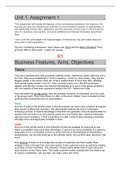
Unit 1, Assignment 1 .
This assignment will include the features of two contrasting businesses, the reasons of its
success and also the relations and methods of communication between its stakeholders. It
will additionally include aims, objectives, and the structures of them both. It will include the
size of a business, their sectors, and some additional and factual information about them
both.
I also cover the advantages and disadvantages of hierarchical, flat, and matrix structure
along with a brief explanation.
The two contrasting businesses I have chosen are Tesco and the Bank of England. They
primarily differ in their sector – public and private.
P1
Business Features, Aims, Objectives .
Tesco .
They are a business who sells groceries, clothing, books, electronics, petrol, kids toys and a
lot more. They were established in 1919 in Hackney, London by Jack Cohen. They are the
biggest retailer in the whole of the UK. It has a market share of more than 28%, labelling
them as the market leader in the UK. They currently employ over 360,000 employees
(please note that this number has reduced dramatically as a result of the global pandemic),
with the majority of their main operations being in the UK + Ireland and India.
They are within the private sector; they are privately owned by an individual, and not a part
of the government. They have shares on offer on the stock market. Tesco is funded by their
profit and the investments from its shareholders.
PROS
One pro of being in the private sector is that businesses can have many investors to support
their growth, funding their business. This dramatically reduces the time of a business
achieving success. A second advantage is that there are generally more job opportunities for
workers with promotions as the business grows at a much faster rate, meaning employees
will have more motivation. A final is that there is a high variety of jobs, meaning a business
will likely have more applicants available to them.
CONS
One con of the private sector is how financial records are available for everyone to see,
which a competitor may use to their advantage. A second con is the possibility of a takeover,
even more so by a competitor. A third would be that due to the likelihood of shareholders
being present, not all profit would go to the ultimate owner, and conflicts upon decisions may
occur.
One purpose of Tesco is to increase the number of customers and their loyalty. Their
strategy to this is through their club card system. It lets customers save up points by making
purchases at their franchises. The collection of these points allows them to gain discounts
and vouchers at any Tesco store. This builds customer loyalty making them less likely to go
to Tesco’s competitors, who are Aldi, Lidl, Asda, and a few more.
,A second purpose of Tesco is to provide many jobs for society. They have definitely
achieved this and proved their effectiveness, as they have over 360,000 individuals
employed in all stores worldwide. They support this as the more common jobs within Tesco
generally require less qualifications and experience, which is beneficial for the younger
people of the world, as they have less experience than others.
A third purpose of this business is to provide products and services for the public. One of
their services would be their telecommunications service, named Tesco Mobile. This is a
network a relatively large number of Tesco customers use, as it is a cheap mobile phone
service which allows text, call and data use. Over 4M people in the UK use this. They offer
many deals with a range of prices to match the majority of people’s budgets. A positive of
this would be how it widens the options of services that people are able to choose between.
One of their aims is to stay as the market leader by increasing its revenue. As they are
already the highest revenue earner in the UK, their only goal should be to stay at #1. Being
the number one market leader will increase its popularity even more as those who are yet to
know about Tesco, when they discover them, they will see it as a trustable company to buy
their groceries from; their best option.
Another aim would be to strive to become a worldwide company. This would drastically help
with the first aim I described, as it will cover more of the population available to Tesco,
meaning they will gain more sales. This aim will also make Tesco more popular and
mainstream worldwide. They should look at avoiding places like America and Canada,
because there are already leading supermarkets there; it would be a challenge for Tesco to
try and fit in, with a high potential of failure.
A third aim of Tesco would to continue being ethical. They are known for their recycling as
they have many recycling points, which mosts homes and councils don’t have. They are also
aiming at reducing its carbon footprint. They reduced theirs by 50% since it’s 2015 carbon
emitting levels. Being ethical obviously increases the reputation and often customer loyalty,
which means customers have less of a chance of shopping at a competitor’s stores.
The size of Tesco is large. They have many more employees than 250; they have over
360,000 at the time of writing. They also have over 4,673 stores globally, and over 4,000 of
them being within the UK and Ireland. The turnover they made in 2021 was £53B. Since at
least 2017, they have had a steady annual turnover of mostly £50B at the least. They are
currently an international business,
They are within the primary, secondary and tertiary sector but mostly tertiary, because they
mostly sell products; both their own and stock from their suppliers. It’s their primary function.
But, they do manufacture their own products. They have their own bakery for which these
products are all made within Tesco’s premises. The products which they manufacture/own
themselves are ‘Tesco Value’ – they are usually cheaper and possibly less qualitative.
Tesco has a hierarchical structure, meaning they have an owner, regional director, store
manager, managers in certain departments, such as food, electrical, clothing, security and
stock managers. They finally have employees, at the bottom. They have a very long chain of
command, meaning there is many levels and ranks. The managers at Tesco tend to have a
lower span of control, and a lower number of staff at their hand. This is good as, the bigger,
more important decisions are made by those of higher ranks; Tesco wouldn’t want, for
example, a manager or supervisor deciding what departments should receive more funding.
In my opinion, the primary reason for Tesco’s success is due to its USP how much it focuses
on it’s customers. They have many features which are aimed at its customers, like its club
,card system, making them become loyal by attracting them more to their business by
offering points to provide vouchers and perks. This is an effective strategy, because it makes
the idea of getting items discounted very addicting for some.
Another reason for Tesco’s success is caused by how low they set their products and
service prices; they are more on the cheaper side of most supermarkets in the UK which
means they make many sales. Although Tesco doesn’t have the worst product and service
quality in the supermarket world, there are definitely better options. But, since there is a
reasonably large group of individuals in the world who are not bothered by the quality of
most items, they simply want to purchase that product/service, with the quality unaccounted
for.
A third reason would be their range of products that they have on offer. They have multiple
brands on the shelves with a big quality and price range. They have food brands such as
Walkers, Nescafé, Oreo, to Coca Cola, Hershey’s, and Mars Inc. Because they have such a
wide range, it allows a bigger audience of customers to be able to purchase something as
some of those may not be able to afford some. It also gives them choice as many prefer
certain brands over others.
Bank of England .
The Bank of England’s primary function is to distribute money across the entirety of the UK
so everyone can purchase things they require. Without this, England wouldn’t have an
economy as there would be no money circulating the nation – trade between nations is what
keeps economies going, and without money, trading would be much, much more difficult in
the modern day. They also the keeper and of the official reserves of gold in the UK.
They are a business in the public sector; they have no shareholders as they are fully owned
by the UK Government. They control the big decisions, but the BoE (Bank of England)
directs themselves. They are funded by the government and a way they make money for
themselves by regulating building societies’ and insurance company’s activities for an
agreed fee.
PROS
One pro of the public sector is stability; the only chance of a business in the public sector
collapsing is if the nation the business operates in collapses, as they are owned and likely
funded by the government. A second pro would be how employees may get more training;
this is because the government is more keen to develop skills, proven by education in the
UK – it’s free for all UK citizens up to the ages of 19+.
CONS
A con of the public sector would be bureaucracy. Governments only care about their people
to the point of keeping them satisfied enough so they’ll work, and care much more about
making sure they are making money. A second disadvantage is the sector’s competency; as
so many people would like to work here because of how secure jobs are, it creates a high
demand but low supply of government jobs due to the quality of experience and skills
required. A third is
The Bank of England has a hierarchical structure. They have a governor which controls
many of the main, large functions and activities. They then have multiple court of directors,
directors, agents, a chief cashier, and many subcommittees who report to these upper
bodies. Finance is a major thing in a country, which is why it’s important to have a tall
ranking system. It makes it harder for people to abuse power that they have, because there
,is a bigger number of ranks they will need to climb and also a the BoE’s trust to be
promoted, which is very difficult to do. This leaves the power to real, trustable individuals.
One purpose of the Bank of England is they are responsible for the issuing and distribution a
GBP bank notes and coins across the UK. It allows everyone in the United Kingdom to have
a currency for which they can buy and sell things. They do this by actively managing and
overseeing money in the UK to ensure not too much and not too little is being distributed.
Too much means the GBP will be devalued, and the latter means not everyone will receive
money. Both mean either little to no economic growth. This ensures money circulating with
stability, and so it doesn’t lose its value.
A second purpose is that they are the government’s bank, and a last-resort money lender for
commercial banks. If a bank happens to be short on money, they are able to turn to the Bank
of England which is a trusted service that the bank can rely on. They can lend a loan to the
bank with added interest. In addition to this, they regulate all other banks in the UK, along
with other financial firms to make sure they are ‘safe and sound’ (not corrupt, and
suspicious).
A third purpose would be that they set the national interest rate within the UK, which is
currently at 0.25%. This dictates how much extra money any group or individual will have to
pay on top of loans, and how much money individuals receive annually from savings
accounts. This the BoE’s main method to make the cost of living maintain its stability, and so
our money doesn’t suffer a loss of purchasing power.
The main mission of the BoE would be to promote the good of everyone and to ensure the
stability of both the financial and monetary (price) policies and targets. Stable prices are
dependent upon and influenced by the government’s inflation targets. The bank looks to
pursue this by providing liquidity insurance, so the cost of disruption is less effective towards
the vital financial institutions of the nation.
A second aim of the Bank of England is to maintain a 2% rate of inflation. The monetary
policy committee makes the ultimate decisions upon the steps the BoE should take in order
to achieve this. The bank must influence the prices of goods/services, and the availability of
credit. The first step they take is by setting the bank rate (interest rate), and follow this by
using a method labelled ‘quantitative easing’, which lowers this rate.
Relative to their main mission, an objective of the Bank of England would be to support the
government’s economic objectives. They are maintaining maximum employment, maintain
price stability, and achieve economic growth. They help achieve economic growth as they
monitor the rate of inflation. They also provide thousands of jobs for the public, assisting the
governments desire for ensuring employment reaches its fullest potential.
The size Bank of England is a large business, seen as they have employed over 4,000
people. They are a national business; they only operate within the UK and Northern Ireland.
In 2020, the Banking Department presented a statement of income which includes an after-
tax profit of £117M, and followed with £57M in 2021.
The Bank of England is in the tertiary sector as they are a business of supplying and service.
They are a service for other banks, whilst supplying them with money and the government
itself. They strive towards building and bulking the economy within the UK (whilst making
revenue for itself in the process).
One reason the Bank of England is successful because of how they are owned by the
government. They are a source which is extremely unlikely to fail to lead them. The chance
of the UK government being overrun, dismantled or the UK as a whole being taken over
,within the current future is so low, it’s almost impossible, making the UK government a
perfect group to be owned by; they offer stability.
Another reason they are successful is because of their method and duty to make money.
One of their ways they make revenue is by printing bank notes. Printing them only costs a
few pence for the BoE, but big banks will buy these notes for what they are worth; they buy
£10 notes for £10, £20 notes for £20, etc. This is a very smart and intelligent method,
because they are legitimately making money from creating and then selling this money. They
then invest into government debt, which pays interest resulting in revenue being earned.
P2
Stakeholder Influence .
Tesco .
Tesco’s stakeholders include customers, employees, competitors, their CEO, suppliers
shareholders/investors and the government.
Tesco is influenced externally by its customers as they are the ones who essentially control
what Tesco sells; they wouldn’t sell things that their customers wouldn’t buy. They receive
feedback from customers, then Tesco typically responds either by keeping things as they are
if it is positive feedback. If it’s negative, they will make the appropriate changes. Feedback
could be in reference to customer service, what Tesco sells and more. They are interested in
cheap prices, good customer service, and discounts. They hold huge power – they are why
Tesco exists, due to the fact that they are Tesco’s main source of revenue by a long shot
because they purchase products and services from them.
They are also influenced by its competitors (Aldi, Asda, Lidl etc.), who are external. As a
result of Tesco having competitors, they are forced to have a USP in order to gain an
advantage on them, to receive the bigger share of customers. In addition, they also know if
they should introduce new products which differentiates from their competitors, or if they
should stock up on improved, existing products. Tesco’s competitors are interested in
information about them, so they can use this to their advantage. Internally they hold no
power, but they can externally affect sales as they attract customers from Tesco.
The third group they are influenced by is their employees. Employees at Tesco are an
internal stakeholder. They are the backbone of almost every public sector business. They
operate day-to-day operations within Tesco, such as customer service, shelf stockers,
delivery drivers, and more. The reason they are influenced is because they control the
business in a way – if they all feel as if they are being treated unfairly, not paid enough or
anything related to these, they can quit or go on strike. This would result in no production for
the business, meaning a loss of revenue would occur. Managers and other workers in the
company are similar to employees in this way. Their interests tend to be good working
conditions, and high pay. They hold large power in the business, because they are the also
backbone of the business’ day-to-day functions, due to this being what they control.
A fourth group would be shareholders/investors, who are external. The people within this
group are able to control multiple key decisions within a business, which is why they
influence Tesco – the company may want to take a path which the shareholder may not
want, like electing company board members or separate a business unit. They give money
to Tesco so they are able to expand and grow, and want a portion of the profits they make in
return. They also influence them by making Tesco focus more on this profit, because the
,majority of the time, shareholders simply want to make money. They are interested in low
share prices, and high return on them through dividends. They also like having a big say in
business decisions - and furthermore, this is why they possess the power that they do (a fair
amount). Their say may make the difference.
A fifth stakeholder is the CEO of Tesco, and they are internal. They are the ultimate body
that decides upon the main choices, commitments, and paths the business as a whole takes.
This can be if Tesco should begin operations in another country, or to make a decision which
affects all current stores they have. They have a major influence due to this reason; they
control everything that Tesco does. Their interests are making profit and increasing sales,
and also
A sixth would be their suppliers, and external stakeholder. They provide Tesco with some of
the things they need in order to operate; this is typically stock, which tends to be groceries,
clothes, toiletries, office supplies. They have an influence on the prices that Tesco will have
to pay. Tesco could negotiate, but the suppliers are the ones who have the items they want,
meaning the suppliers have the decisive say. They may also offer discounts if they are long-
time partners, which encourages Tesco to cooperate with them for longer. They also enjoy
being paid on time, or with low credit. Another interest is when Tesco buys in bulk. They hold
little to no power within Tesco, the maximum of their ability is probably affecting their sales
on a minuscule level, and they directly control none of the businesses decisions.
Lastly, there is the government. The government is an external stakeholder. They are
responsible for setting all of the laws in the UK, and this is what mostly affects Tesco. It
means Tesco must comply with these, which disobedience will result in fines and other
consequences. Common laws they must comply with are health and safety, right to work,
and national minimum wage laws. Tesco is also encouraged by the government to employ
individuals, as they make money from the tax on salaries and wages. The government’s
interests are businesses abiding by these laws, and employing as many people as possible.
They hold the same power within every company and organisation in the UK; they can easily
introduce laws which noticeably affect Tesco, such as collecting data of users through their
official website and selling it to third party companies.
Bank of England .
Their stakeholders are the following: employees, the governor, the government,
banks/building societies/insurance companies, and the public.
They are internally influenced by their governor as he (Andrew Bailey, since Mar 2020) has
control over the large decisions of the business, he also manages the budgets the the Bank
of England on how much they should spend and on what, like the amount of be spent on
note production, and the insurance protecting financial institutions and banks from a lack of
finance and failure. Without the governor, the bank would have a chance of being in
scrambles, as there would be no one to lead it. But, I think they would manage it well as they
are very with business. The governor is interested in his salary, as he also get paid (~£500k
total). He is also interested in the productivity of his workers. He holds major power,
especially with what actions the business does, whether it is to conduct a new set of notes
into circulation, or increase and decrease inflation.
The second entity, the government, is external. They are the complete owner of the Bank of
England. They also hold the debt of the government and act as their bank. They are not
influenced by the political aspect of things, they are purely financial. Without the government,
they wouldn’t have an owner. They would have to resort to being fully independent, meaning
they would likely be a private bank like all of the others. The government is interested in the
,BoE employing people, and the provision of money to fund things such as schools and
hospitals. They quite a powerful entity because they can impose any laws they choose to
which have the potential to harmfully affect what they business can and can’t do.
They are internally influenced by their workers, an internal stakeholder. The workers here
tend to look for jobs with low hours and work which is simple. Their main drive is likely to
come from how much they are paid. Workers at the BoE tend to be agents, directors,
researchers and a few others. They directly influence the BoE because the employee
controls their own productivity, and how much they choose to work. This means they can
simply reduce the work that occurs because, for example, they are too exhausted or
because they think they’ve ‘been working too much’. This group of people is mostly
interested in their salary, but they also have interests in their working hours. They are very
powerful within the BoE, as they can control how much work gets done – they are the ones
working. They can go on strike, leave and much more.
The BoE is influenced by banks/building societies because of how they provide protective
financial insurance for these institutes. These stakeholders are external. They also closely
monitor and regulate them to make sure they are being shady, and possibly stealing money
from the public. Without them, they would have no one to make money from, meaning the
BoE would go bankrupt. They make revenue from these financial institutes. They are
interested in the amount they receive in funds and financial protection through insurance.
They hold a fair deal of power as they are the receivers through the trade process of
purchasing money, they dictate the majority of the deal within this process.
They finally influenced externally by the public, due to them being another big part of the
reason why the BoE exists. Without the public, banks would not have a need to buy money
from the Bank of England. They probably would not exist in the first place due to no one
being available to use them. It would result in The BoE losing a big portion of its revenue,
because this is one of their money-making methods. Members of the public look to have
balanced interest rates, and having money to spend. They are individually powerless, but
when they gather together for a cause, which may be due to unhappiness about poor
interest rates for example, they can make a difference.
P3
Structures, Aims, Objectives, F. Areas .
Hierarchical (Tall) Structure
This is where there is always an owner or CEO at the top of the chain of rank, who controls
all of the large decisions of the business. There is a long chain of ranks, such as CEO,
chairman, directors, managers, assistants etc.
PROS
One pro would be how business decisions are made by those of higher ranks. This is good
because it stops people who are less qualified and have been at the business from making
these important decisions which can affect it harshly. A second pro would be how it gives
managers closer control, due to having less staff to deal with.
CONS
One con would be how there is an increased potential for communication problems. This is
caused by more members of business of higher rank being communicated to. A second
, disadvantage would be how it is costlier to employ managers instead of employees, because
of the roles and qualifications required. A third is how there is less staff independence
because of the lower staff-manager ratio. This means it’s easier to monitor and observe
staff.
Flat Structure
This structure is similar to hierarchical in terms of having a CEO or an owner, but it usually
has less layers of management which managers having more control over many staff.
PROS
One pro is how younger employees tend to have more independence from who they report
to, this results in them enjoying their time at their job more instead of being strictly
monitored. Another pro is related to decisions; there are less managers and therefore less
reliance on them.
CONS
A con of this structure would be how there is still a need for medium and big decisions to be
made by higher ranks, possibly being time-consuming. A second con is how there still needs
to be a limit on the span of control so the business doesn’t end up in anarchy, which would
be due to new and unqualified people having control on decisions.
Matrix Structure
This structure is team and project-based, as it has an CEO/owner similar to the other two
structures, but it has project managers to run these projects and individuals assigned to
certain projects relative to their skills. Projects are generally based on the department of the
project manager, like Senior Development, Sales Rep, HR Rep, Copywriter etc.
PROS
One pro of this structure is that it saves time by gathering and using current members of the
business who have the relevant skills, instead of recruiting externally. A second pro is it that
certain project managers can collaborate, increasing efficiency and how dynamic the
organisation is. A third is by collaborating with others and putting an employee in a new
department, it has them learn and improve new, vital skills, like interpersonal and
communication.
CONS
One con is that employees may suffer from burnout, as these projects are on top of their
regular functions and responsibilities. A second con would be that business decisions also
have to be passed up multiple layers of ranks, which can waste a lot of time. A third
disadvantage is that both team and managerial roles may not be properly explained, creating
confusion upon the project members.
Tesco .
Tesco has a hierarchical structure due to how big of a company they are. This structure suits
them because they are so large, it is vital that they have such a structure in place to ensure
that there is ultimate command over all employees, managers etc. This is so the business
has authority over everyone so there is no loss of control. Having no control would likely
result in Tesco failing due to everyone misbehaving and misusing their power.
This assignment will include the features of two contrasting businesses, the reasons of its
success and also the relations and methods of communication between its stakeholders. It
will additionally include aims, objectives, and the structures of them both. It will include the
size of a business, their sectors, and some additional and factual information about them
both.
I also cover the advantages and disadvantages of hierarchical, flat, and matrix structure
along with a brief explanation.
The two contrasting businesses I have chosen are Tesco and the Bank of England. They
primarily differ in their sector – public and private.
P1
Business Features, Aims, Objectives .
Tesco .
They are a business who sells groceries, clothing, books, electronics, petrol, kids toys and a
lot more. They were established in 1919 in Hackney, London by Jack Cohen. They are the
biggest retailer in the whole of the UK. It has a market share of more than 28%, labelling
them as the market leader in the UK. They currently employ over 360,000 employees
(please note that this number has reduced dramatically as a result of the global pandemic),
with the majority of their main operations being in the UK + Ireland and India.
They are within the private sector; they are privately owned by an individual, and not a part
of the government. They have shares on offer on the stock market. Tesco is funded by their
profit and the investments from its shareholders.
PROS
One pro of being in the private sector is that businesses can have many investors to support
their growth, funding their business. This dramatically reduces the time of a business
achieving success. A second advantage is that there are generally more job opportunities for
workers with promotions as the business grows at a much faster rate, meaning employees
will have more motivation. A final is that there is a high variety of jobs, meaning a business
will likely have more applicants available to them.
CONS
One con of the private sector is how financial records are available for everyone to see,
which a competitor may use to their advantage. A second con is the possibility of a takeover,
even more so by a competitor. A third would be that due to the likelihood of shareholders
being present, not all profit would go to the ultimate owner, and conflicts upon decisions may
occur.
One purpose of Tesco is to increase the number of customers and their loyalty. Their
strategy to this is through their club card system. It lets customers save up points by making
purchases at their franchises. The collection of these points allows them to gain discounts
and vouchers at any Tesco store. This builds customer loyalty making them less likely to go
to Tesco’s competitors, who are Aldi, Lidl, Asda, and a few more.
,A second purpose of Tesco is to provide many jobs for society. They have definitely
achieved this and proved their effectiveness, as they have over 360,000 individuals
employed in all stores worldwide. They support this as the more common jobs within Tesco
generally require less qualifications and experience, which is beneficial for the younger
people of the world, as they have less experience than others.
A third purpose of this business is to provide products and services for the public. One of
their services would be their telecommunications service, named Tesco Mobile. This is a
network a relatively large number of Tesco customers use, as it is a cheap mobile phone
service which allows text, call and data use. Over 4M people in the UK use this. They offer
many deals with a range of prices to match the majority of people’s budgets. A positive of
this would be how it widens the options of services that people are able to choose between.
One of their aims is to stay as the market leader by increasing its revenue. As they are
already the highest revenue earner in the UK, their only goal should be to stay at #1. Being
the number one market leader will increase its popularity even more as those who are yet to
know about Tesco, when they discover them, they will see it as a trustable company to buy
their groceries from; their best option.
Another aim would be to strive to become a worldwide company. This would drastically help
with the first aim I described, as it will cover more of the population available to Tesco,
meaning they will gain more sales. This aim will also make Tesco more popular and
mainstream worldwide. They should look at avoiding places like America and Canada,
because there are already leading supermarkets there; it would be a challenge for Tesco to
try and fit in, with a high potential of failure.
A third aim of Tesco would to continue being ethical. They are known for their recycling as
they have many recycling points, which mosts homes and councils don’t have. They are also
aiming at reducing its carbon footprint. They reduced theirs by 50% since it’s 2015 carbon
emitting levels. Being ethical obviously increases the reputation and often customer loyalty,
which means customers have less of a chance of shopping at a competitor’s stores.
The size of Tesco is large. They have many more employees than 250; they have over
360,000 at the time of writing. They also have over 4,673 stores globally, and over 4,000 of
them being within the UK and Ireland. The turnover they made in 2021 was £53B. Since at
least 2017, they have had a steady annual turnover of mostly £50B at the least. They are
currently an international business,
They are within the primary, secondary and tertiary sector but mostly tertiary, because they
mostly sell products; both their own and stock from their suppliers. It’s their primary function.
But, they do manufacture their own products. They have their own bakery for which these
products are all made within Tesco’s premises. The products which they manufacture/own
themselves are ‘Tesco Value’ – they are usually cheaper and possibly less qualitative.
Tesco has a hierarchical structure, meaning they have an owner, regional director, store
manager, managers in certain departments, such as food, electrical, clothing, security and
stock managers. They finally have employees, at the bottom. They have a very long chain of
command, meaning there is many levels and ranks. The managers at Tesco tend to have a
lower span of control, and a lower number of staff at their hand. This is good as, the bigger,
more important decisions are made by those of higher ranks; Tesco wouldn’t want, for
example, a manager or supervisor deciding what departments should receive more funding.
In my opinion, the primary reason for Tesco’s success is due to its USP how much it focuses
on it’s customers. They have many features which are aimed at its customers, like its club
,card system, making them become loyal by attracting them more to their business by
offering points to provide vouchers and perks. This is an effective strategy, because it makes
the idea of getting items discounted very addicting for some.
Another reason for Tesco’s success is caused by how low they set their products and
service prices; they are more on the cheaper side of most supermarkets in the UK which
means they make many sales. Although Tesco doesn’t have the worst product and service
quality in the supermarket world, there are definitely better options. But, since there is a
reasonably large group of individuals in the world who are not bothered by the quality of
most items, they simply want to purchase that product/service, with the quality unaccounted
for.
A third reason would be their range of products that they have on offer. They have multiple
brands on the shelves with a big quality and price range. They have food brands such as
Walkers, Nescafé, Oreo, to Coca Cola, Hershey’s, and Mars Inc. Because they have such a
wide range, it allows a bigger audience of customers to be able to purchase something as
some of those may not be able to afford some. It also gives them choice as many prefer
certain brands over others.
Bank of England .
The Bank of England’s primary function is to distribute money across the entirety of the UK
so everyone can purchase things they require. Without this, England wouldn’t have an
economy as there would be no money circulating the nation – trade between nations is what
keeps economies going, and without money, trading would be much, much more difficult in
the modern day. They also the keeper and of the official reserves of gold in the UK.
They are a business in the public sector; they have no shareholders as they are fully owned
by the UK Government. They control the big decisions, but the BoE (Bank of England)
directs themselves. They are funded by the government and a way they make money for
themselves by regulating building societies’ and insurance company’s activities for an
agreed fee.
PROS
One pro of the public sector is stability; the only chance of a business in the public sector
collapsing is if the nation the business operates in collapses, as they are owned and likely
funded by the government. A second pro would be how employees may get more training;
this is because the government is more keen to develop skills, proven by education in the
UK – it’s free for all UK citizens up to the ages of 19+.
CONS
A con of the public sector would be bureaucracy. Governments only care about their people
to the point of keeping them satisfied enough so they’ll work, and care much more about
making sure they are making money. A second disadvantage is the sector’s competency; as
so many people would like to work here because of how secure jobs are, it creates a high
demand but low supply of government jobs due to the quality of experience and skills
required. A third is
The Bank of England has a hierarchical structure. They have a governor which controls
many of the main, large functions and activities. They then have multiple court of directors,
directors, agents, a chief cashier, and many subcommittees who report to these upper
bodies. Finance is a major thing in a country, which is why it’s important to have a tall
ranking system. It makes it harder for people to abuse power that they have, because there
,is a bigger number of ranks they will need to climb and also a the BoE’s trust to be
promoted, which is very difficult to do. This leaves the power to real, trustable individuals.
One purpose of the Bank of England is they are responsible for the issuing and distribution a
GBP bank notes and coins across the UK. It allows everyone in the United Kingdom to have
a currency for which they can buy and sell things. They do this by actively managing and
overseeing money in the UK to ensure not too much and not too little is being distributed.
Too much means the GBP will be devalued, and the latter means not everyone will receive
money. Both mean either little to no economic growth. This ensures money circulating with
stability, and so it doesn’t lose its value.
A second purpose is that they are the government’s bank, and a last-resort money lender for
commercial banks. If a bank happens to be short on money, they are able to turn to the Bank
of England which is a trusted service that the bank can rely on. They can lend a loan to the
bank with added interest. In addition to this, they regulate all other banks in the UK, along
with other financial firms to make sure they are ‘safe and sound’ (not corrupt, and
suspicious).
A third purpose would be that they set the national interest rate within the UK, which is
currently at 0.25%. This dictates how much extra money any group or individual will have to
pay on top of loans, and how much money individuals receive annually from savings
accounts. This the BoE’s main method to make the cost of living maintain its stability, and so
our money doesn’t suffer a loss of purchasing power.
The main mission of the BoE would be to promote the good of everyone and to ensure the
stability of both the financial and monetary (price) policies and targets. Stable prices are
dependent upon and influenced by the government’s inflation targets. The bank looks to
pursue this by providing liquidity insurance, so the cost of disruption is less effective towards
the vital financial institutions of the nation.
A second aim of the Bank of England is to maintain a 2% rate of inflation. The monetary
policy committee makes the ultimate decisions upon the steps the BoE should take in order
to achieve this. The bank must influence the prices of goods/services, and the availability of
credit. The first step they take is by setting the bank rate (interest rate), and follow this by
using a method labelled ‘quantitative easing’, which lowers this rate.
Relative to their main mission, an objective of the Bank of England would be to support the
government’s economic objectives. They are maintaining maximum employment, maintain
price stability, and achieve economic growth. They help achieve economic growth as they
monitor the rate of inflation. They also provide thousands of jobs for the public, assisting the
governments desire for ensuring employment reaches its fullest potential.
The size Bank of England is a large business, seen as they have employed over 4,000
people. They are a national business; they only operate within the UK and Northern Ireland.
In 2020, the Banking Department presented a statement of income which includes an after-
tax profit of £117M, and followed with £57M in 2021.
The Bank of England is in the tertiary sector as they are a business of supplying and service.
They are a service for other banks, whilst supplying them with money and the government
itself. They strive towards building and bulking the economy within the UK (whilst making
revenue for itself in the process).
One reason the Bank of England is successful because of how they are owned by the
government. They are a source which is extremely unlikely to fail to lead them. The chance
of the UK government being overrun, dismantled or the UK as a whole being taken over
,within the current future is so low, it’s almost impossible, making the UK government a
perfect group to be owned by; they offer stability.
Another reason they are successful is because of their method and duty to make money.
One of their ways they make revenue is by printing bank notes. Printing them only costs a
few pence for the BoE, but big banks will buy these notes for what they are worth; they buy
£10 notes for £10, £20 notes for £20, etc. This is a very smart and intelligent method,
because they are legitimately making money from creating and then selling this money. They
then invest into government debt, which pays interest resulting in revenue being earned.
P2
Stakeholder Influence .
Tesco .
Tesco’s stakeholders include customers, employees, competitors, their CEO, suppliers
shareholders/investors and the government.
Tesco is influenced externally by its customers as they are the ones who essentially control
what Tesco sells; they wouldn’t sell things that their customers wouldn’t buy. They receive
feedback from customers, then Tesco typically responds either by keeping things as they are
if it is positive feedback. If it’s negative, they will make the appropriate changes. Feedback
could be in reference to customer service, what Tesco sells and more. They are interested in
cheap prices, good customer service, and discounts. They hold huge power – they are why
Tesco exists, due to the fact that they are Tesco’s main source of revenue by a long shot
because they purchase products and services from them.
They are also influenced by its competitors (Aldi, Asda, Lidl etc.), who are external. As a
result of Tesco having competitors, they are forced to have a USP in order to gain an
advantage on them, to receive the bigger share of customers. In addition, they also know if
they should introduce new products which differentiates from their competitors, or if they
should stock up on improved, existing products. Tesco’s competitors are interested in
information about them, so they can use this to their advantage. Internally they hold no
power, but they can externally affect sales as they attract customers from Tesco.
The third group they are influenced by is their employees. Employees at Tesco are an
internal stakeholder. They are the backbone of almost every public sector business. They
operate day-to-day operations within Tesco, such as customer service, shelf stockers,
delivery drivers, and more. The reason they are influenced is because they control the
business in a way – if they all feel as if they are being treated unfairly, not paid enough or
anything related to these, they can quit or go on strike. This would result in no production for
the business, meaning a loss of revenue would occur. Managers and other workers in the
company are similar to employees in this way. Their interests tend to be good working
conditions, and high pay. They hold large power in the business, because they are the also
backbone of the business’ day-to-day functions, due to this being what they control.
A fourth group would be shareholders/investors, who are external. The people within this
group are able to control multiple key decisions within a business, which is why they
influence Tesco – the company may want to take a path which the shareholder may not
want, like electing company board members or separate a business unit. They give money
to Tesco so they are able to expand and grow, and want a portion of the profits they make in
return. They also influence them by making Tesco focus more on this profit, because the
,majority of the time, shareholders simply want to make money. They are interested in low
share prices, and high return on them through dividends. They also like having a big say in
business decisions - and furthermore, this is why they possess the power that they do (a fair
amount). Their say may make the difference.
A fifth stakeholder is the CEO of Tesco, and they are internal. They are the ultimate body
that decides upon the main choices, commitments, and paths the business as a whole takes.
This can be if Tesco should begin operations in another country, or to make a decision which
affects all current stores they have. They have a major influence due to this reason; they
control everything that Tesco does. Their interests are making profit and increasing sales,
and also
A sixth would be their suppliers, and external stakeholder. They provide Tesco with some of
the things they need in order to operate; this is typically stock, which tends to be groceries,
clothes, toiletries, office supplies. They have an influence on the prices that Tesco will have
to pay. Tesco could negotiate, but the suppliers are the ones who have the items they want,
meaning the suppliers have the decisive say. They may also offer discounts if they are long-
time partners, which encourages Tesco to cooperate with them for longer. They also enjoy
being paid on time, or with low credit. Another interest is when Tesco buys in bulk. They hold
little to no power within Tesco, the maximum of their ability is probably affecting their sales
on a minuscule level, and they directly control none of the businesses decisions.
Lastly, there is the government. The government is an external stakeholder. They are
responsible for setting all of the laws in the UK, and this is what mostly affects Tesco. It
means Tesco must comply with these, which disobedience will result in fines and other
consequences. Common laws they must comply with are health and safety, right to work,
and national minimum wage laws. Tesco is also encouraged by the government to employ
individuals, as they make money from the tax on salaries and wages. The government’s
interests are businesses abiding by these laws, and employing as many people as possible.
They hold the same power within every company and organisation in the UK; they can easily
introduce laws which noticeably affect Tesco, such as collecting data of users through their
official website and selling it to third party companies.
Bank of England .
Their stakeholders are the following: employees, the governor, the government,
banks/building societies/insurance companies, and the public.
They are internally influenced by their governor as he (Andrew Bailey, since Mar 2020) has
control over the large decisions of the business, he also manages the budgets the the Bank
of England on how much they should spend and on what, like the amount of be spent on
note production, and the insurance protecting financial institutions and banks from a lack of
finance and failure. Without the governor, the bank would have a chance of being in
scrambles, as there would be no one to lead it. But, I think they would manage it well as they
are very with business. The governor is interested in his salary, as he also get paid (~£500k
total). He is also interested in the productivity of his workers. He holds major power,
especially with what actions the business does, whether it is to conduct a new set of notes
into circulation, or increase and decrease inflation.
The second entity, the government, is external. They are the complete owner of the Bank of
England. They also hold the debt of the government and act as their bank. They are not
influenced by the political aspect of things, they are purely financial. Without the government,
they wouldn’t have an owner. They would have to resort to being fully independent, meaning
they would likely be a private bank like all of the others. The government is interested in the
,BoE employing people, and the provision of money to fund things such as schools and
hospitals. They quite a powerful entity because they can impose any laws they choose to
which have the potential to harmfully affect what they business can and can’t do.
They are internally influenced by their workers, an internal stakeholder. The workers here
tend to look for jobs with low hours and work which is simple. Their main drive is likely to
come from how much they are paid. Workers at the BoE tend to be agents, directors,
researchers and a few others. They directly influence the BoE because the employee
controls their own productivity, and how much they choose to work. This means they can
simply reduce the work that occurs because, for example, they are too exhausted or
because they think they’ve ‘been working too much’. This group of people is mostly
interested in their salary, but they also have interests in their working hours. They are very
powerful within the BoE, as they can control how much work gets done – they are the ones
working. They can go on strike, leave and much more.
The BoE is influenced by banks/building societies because of how they provide protective
financial insurance for these institutes. These stakeholders are external. They also closely
monitor and regulate them to make sure they are being shady, and possibly stealing money
from the public. Without them, they would have no one to make money from, meaning the
BoE would go bankrupt. They make revenue from these financial institutes. They are
interested in the amount they receive in funds and financial protection through insurance.
They hold a fair deal of power as they are the receivers through the trade process of
purchasing money, they dictate the majority of the deal within this process.
They finally influenced externally by the public, due to them being another big part of the
reason why the BoE exists. Without the public, banks would not have a need to buy money
from the Bank of England. They probably would not exist in the first place due to no one
being available to use them. It would result in The BoE losing a big portion of its revenue,
because this is one of their money-making methods. Members of the public look to have
balanced interest rates, and having money to spend. They are individually powerless, but
when they gather together for a cause, which may be due to unhappiness about poor
interest rates for example, they can make a difference.
P3
Structures, Aims, Objectives, F. Areas .
Hierarchical (Tall) Structure
This is where there is always an owner or CEO at the top of the chain of rank, who controls
all of the large decisions of the business. There is a long chain of ranks, such as CEO,
chairman, directors, managers, assistants etc.
PROS
One pro would be how business decisions are made by those of higher ranks. This is good
because it stops people who are less qualified and have been at the business from making
these important decisions which can affect it harshly. A second pro would be how it gives
managers closer control, due to having less staff to deal with.
CONS
One con would be how there is an increased potential for communication problems. This is
caused by more members of business of higher rank being communicated to. A second
, disadvantage would be how it is costlier to employ managers instead of employees, because
of the roles and qualifications required. A third is how there is less staff independence
because of the lower staff-manager ratio. This means it’s easier to monitor and observe
staff.
Flat Structure
This structure is similar to hierarchical in terms of having a CEO or an owner, but it usually
has less layers of management which managers having more control over many staff.
PROS
One pro is how younger employees tend to have more independence from who they report
to, this results in them enjoying their time at their job more instead of being strictly
monitored. Another pro is related to decisions; there are less managers and therefore less
reliance on them.
CONS
A con of this structure would be how there is still a need for medium and big decisions to be
made by higher ranks, possibly being time-consuming. A second con is how there still needs
to be a limit on the span of control so the business doesn’t end up in anarchy, which would
be due to new and unqualified people having control on decisions.
Matrix Structure
This structure is team and project-based, as it has an CEO/owner similar to the other two
structures, but it has project managers to run these projects and individuals assigned to
certain projects relative to their skills. Projects are generally based on the department of the
project manager, like Senior Development, Sales Rep, HR Rep, Copywriter etc.
PROS
One pro of this structure is that it saves time by gathering and using current members of the
business who have the relevant skills, instead of recruiting externally. A second pro is it that
certain project managers can collaborate, increasing efficiency and how dynamic the
organisation is. A third is by collaborating with others and putting an employee in a new
department, it has them learn and improve new, vital skills, like interpersonal and
communication.
CONS
One con is that employees may suffer from burnout, as these projects are on top of their
regular functions and responsibilities. A second con would be that business decisions also
have to be passed up multiple layers of ranks, which can waste a lot of time. A third
disadvantage is that both team and managerial roles may not be properly explained, creating
confusion upon the project members.
Tesco .
Tesco has a hierarchical structure due to how big of a company they are. This structure suits
them because they are so large, it is vital that they have such a structure in place to ensure
that there is ultimate command over all employees, managers etc. This is so the business
has authority over everyone so there is no loss of control. Having no control would likely
result in Tesco failing due to everyone misbehaving and misusing their power.