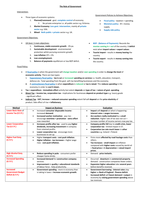
The Role of Government
Intervention:
Government Policies to Achieve Objectives:
Three types of economic systems:
1. Planned/command - govt. complete control of economy. Fiscal policy - taxation + spending.
No private enterprise i.e. all public sector e.g. N.Korea. Monetary policy - IR + money
2. Market Economy: Less govt. intervention, mainly all private supply.
sector e.g. USA. Supply side policy.
3. Mixed - Both public + private sector e.g. UK.
Government Objectives:
UK Govt. 5 main objectives: BOP - (Balance of Payments): Records the
1. Continuous, stable economic growth - 2% pa. monies coming in + out of the country. A deficit
2. Sustainable development - environmental exist when import values > export values.
protection whilst pursuing economic growth. Tourist import - results in money leaving the
3. Low inflation CPI = 2%. country.
4. Low unemployment. Tourist export - results in money coming into
5. Balance of payments equilibrium or low BOP deficit. the country.
Fiscal Policy:
A fiscal policy is when the government will change taxation and/or own spending in order to change the level of
economic activity. There are two types:
1. Expansionary fiscal policy - tax is cut or increased spending on services i.e. health, education, transport,
defence etc. Total spending from the govt. will rise benefiting businesses and the economy.
2. A contractionary fiscal policy is when expenditure is reduced or tax is raised. This reduces spending in the
economy in order to cool it down.
Tax + expenditure - immediate effect activity but extent depends on type of tax + nature of govt. spending.
Direct Tax = income tax, corporation tax - implications for businesses depend on product type e.g. luxury goods
- significant effect.
Indirect Tax - VAT, increase = reduced consumer spending extent fall will depend on the price elasticity of
product. Side effect of rise = inflationary.
Method Impact on Business Evaluation
Lower Basic Rate of Increased consumer disposable income - Impact will depend on what is happening -
Income Tax (E.F.P.) increased demand. interest rates + wages increases.
Increased worker motivation - pay rise - Are workers really motivated by a small
encourage overtime + promotion - extra effort reduction. Higher rate of tax was not cut +
now rewarded. increase number of income earners now pay tax.
Lower Corporation Increases profits after tax - used to pay higher Company profits fell due to credit crisis, lower
Tax (E.F.P.) dividends, increasing investment in company corporation tax - limited impact in ST.
from retained profits. Corporation tax rate much lower in other
Lower corporation tax - encourage more countries e.g. Ireland + Poland.
businesses to set up.
Higher Fuel Duty Higher transport costs - cost push inflation. Firms more affected by road haulage costs than
(C.F.P.) Higher inflation - tax increases = higher wage others.
rises - cost push inflation. Tax increases - small impact on inflation
compared with higher costs caused by world oil
+ food prices + £ depreciation = raised import
prices.
High Alcohol Duty Reduce spending in pubs - consumers prefer Demand - price inelastic.
(C.F.P.) cheaper home drinks
Increased Spending Increased demand for construction company Occurred - downturn in commercial property
(E.F.P.) services. demand - construction companies fewer orders.
Improvement in quality + educational standards Expansion higher education take several years
of labour force - help productivity. before benefits received.
Increased Government spending - more in economy than Government borrowing - interest rates stay
Government Budget is taking in taxes + increase economic growth. higher so Bank of England - finance deficit.
Deficit (E.F.P.) Increased deficit will boost demand + output in
economy by raising government spending above
tax revenues.
Intervention:
Government Policies to Achieve Objectives:
Three types of economic systems:
1. Planned/command - govt. complete control of economy. Fiscal policy - taxation + spending.
No private enterprise i.e. all public sector e.g. N.Korea. Monetary policy - IR + money
2. Market Economy: Less govt. intervention, mainly all private supply.
sector e.g. USA. Supply side policy.
3. Mixed - Both public + private sector e.g. UK.
Government Objectives:
UK Govt. 5 main objectives: BOP - (Balance of Payments): Records the
1. Continuous, stable economic growth - 2% pa. monies coming in + out of the country. A deficit
2. Sustainable development - environmental exist when import values > export values.
protection whilst pursuing economic growth. Tourist import - results in money leaving the
3. Low inflation CPI = 2%. country.
4. Low unemployment. Tourist export - results in money coming into
5. Balance of payments equilibrium or low BOP deficit. the country.
Fiscal Policy:
A fiscal policy is when the government will change taxation and/or own spending in order to change the level of
economic activity. There are two types:
1. Expansionary fiscal policy - tax is cut or increased spending on services i.e. health, education, transport,
defence etc. Total spending from the govt. will rise benefiting businesses and the economy.
2. A contractionary fiscal policy is when expenditure is reduced or tax is raised. This reduces spending in the
economy in order to cool it down.
Tax + expenditure - immediate effect activity but extent depends on type of tax + nature of govt. spending.
Direct Tax = income tax, corporation tax - implications for businesses depend on product type e.g. luxury goods
- significant effect.
Indirect Tax - VAT, increase = reduced consumer spending extent fall will depend on the price elasticity of
product. Side effect of rise = inflationary.
Method Impact on Business Evaluation
Lower Basic Rate of Increased consumer disposable income - Impact will depend on what is happening -
Income Tax (E.F.P.) increased demand. interest rates + wages increases.
Increased worker motivation - pay rise - Are workers really motivated by a small
encourage overtime + promotion - extra effort reduction. Higher rate of tax was not cut +
now rewarded. increase number of income earners now pay tax.
Lower Corporation Increases profits after tax - used to pay higher Company profits fell due to credit crisis, lower
Tax (E.F.P.) dividends, increasing investment in company corporation tax - limited impact in ST.
from retained profits. Corporation tax rate much lower in other
Lower corporation tax - encourage more countries e.g. Ireland + Poland.
businesses to set up.
Higher Fuel Duty Higher transport costs - cost push inflation. Firms more affected by road haulage costs than
(C.F.P.) Higher inflation - tax increases = higher wage others.
rises - cost push inflation. Tax increases - small impact on inflation
compared with higher costs caused by world oil
+ food prices + £ depreciation = raised import
prices.
High Alcohol Duty Reduce spending in pubs - consumers prefer Demand - price inelastic.
(C.F.P.) cheaper home drinks
Increased Spending Increased demand for construction company Occurred - downturn in commercial property
(E.F.P.) services. demand - construction companies fewer orders.
Improvement in quality + educational standards Expansion higher education take several years
of labour force - help productivity. before benefits received.
Increased Government spending - more in economy than Government borrowing - interest rates stay
Government Budget is taking in taxes + increase economic growth. higher so Bank of England - finance deficit.
Deficit (E.F.P.) Increased deficit will boost demand + output in
economy by raising government spending above
tax revenues.