

Figuring out EKG analysis for lab?
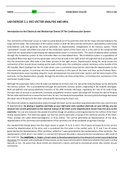
The contraction of the heart occurs in order to pump blood out of its ventricles and into the major arteries leading to the lungs and the body. The contraction of the cardiac muscle in both the atria and the ventricles is stimulated to contract by autorhythmic cells that generate the action potential, or depolarization, independent of the nervous system. These “specialized” muscle cells (fibers) are part of the conductive system of the heart, but it is the cells of the sinoatrial (SA) node that is responsible for generating the depolarization wave in a normal heart. This wave of depolarization spreads through the conductive system to the contractile fibers via intercalated discs. The conductive system is a population of specialized fibers that span from the pacemaker cells of the SA node in the right atrium through both atria as bundles, and into the atrioventricular (AV) node in the lower portion of the right atrium. Depolarization along this route causes the contraction of the muscle tissue making up the walls of the atria. The conductive system continues as the bundle of His (AV bundle), fibers leading from the AV node which cross a connective tissue barrier and bring the depolarization to the interventricular septum. It continues into the bundle branches to the apex of the heart and then up the Purkinje fibers. The depolarization wave traveling along this route will depolarize the interventricular septum and the lateral walls of the ventricles. As the depolarization spreads through the ventricles via intercalated disks, it stimulates the contraction of the ventricular muscle tissue
Document information
- Uploaded on
- March 9, 2023
- Number of pages
- 20
- Written in
- 2022/2023
- Type
- Class notes
- Professor(s)
- Shaw
- Contains
- Human physiology


